
Speciation is the process by which new species are formed from pre-existing species. It is a key concept in the study of Evolutionary Biology and plays an essential role in increasing biodiversity on Earth. Speciation occurs when populations of the same species become sufficiently different from each other that they can no longer interbreed to produce fertile offspring.

A single population gradually divides into separate groups due to reduced gene flow caused by isolation. Over time, genetic changes lead to reproductive isolation between these groups. Eventually, they evolve into two distinct species that can no longer interbreed.
How Does Speciation Occur?
Speciation usually begins when a population is divided into smaller groups. This separation may be caused by geographical barriers such as mountains, rivers, or oceans, or by ecological and behavioural differences. Once separated, these populations experience little or no gene flow.
Over many generations, several processes act on these populations:
- Genetic drift causes random changes in gene frequencies.
- Natural selection favours traits that help organisms survive in their specific environment.
- Mutations introduce new genetic variations.
Gradually, these changes accumulate, making the populations more and more different. Eventually, they become reproductively isolated and form new species.
Types of Speciation
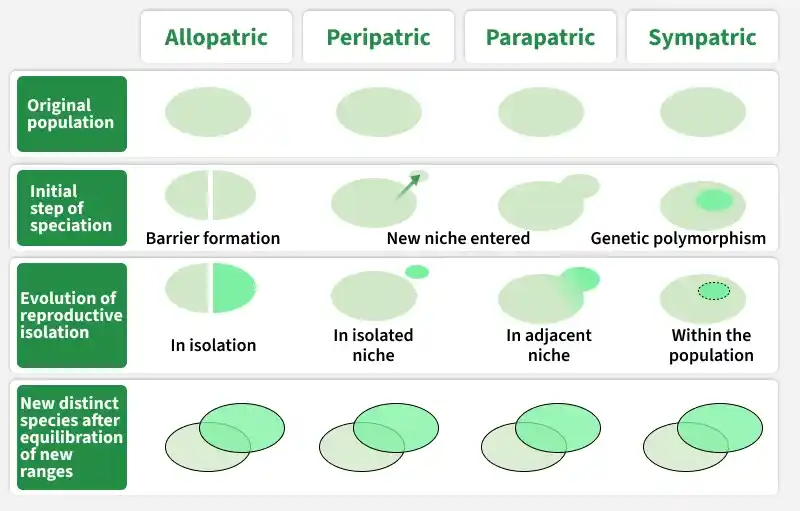
- Allopatric Speciation: In this type of species formation, a part of the population becomes geographically isolated from the main population. An example of Allopatric Speciation is Darwin's finches, which led to the theory of evolution.
- Peripatric Speciation: A special type of allopatric speciation that occurs when a small group becomes isolated from the main population at the edge of its range. Genetic drift plays an important role. Example: Small island populations.
- Sympatric Speciation: This type of speciation occurs between populations occupying the same geographic range. This type of speciation is common in herbivore insects when a new plant is introduced into a geographic range of species.
- Parapatric Speciation: It separates adjacent populations. Parapatric speciation takes place when a population of a species enters a new niche or habitat. When a portion of a surrounding has been polluted, the type of speciation that occurs is known as parapatric speciation. Polluted environments include mining activities that leave waste with high amounts of metal, such as lead and zinc.
Factors Influencing Speciation
- Genetic Drift: Random, non-directional changes in allele frequency that may lead to the loss or fixation of traits.
- Natural Selection: Favourable traits are selected, helping organisms survive and reproduce, leading to adaptation.
- Mutation: Changes in DNA that introduce new genetic variations.
- Geographic Isolation: Physical separation of populations, reducing gene flow.
- Recombination: Mixing of genetic material during reproduction, creating variation.
- Hybridisation: Crossing between different species or populations that may sometimes lead to new species formation.
Important Characteristics of a Species
- All the members, whether present in one or more populations found in different and even remote areas of the globe, are derived from a common ancestor.
- The members resemble one another more than they resemble individuals of other species.
- All the members of a species have a similar karyotype.
- There is a broad similarity in morphological characters.