
I will be at a Seicho Matsumoto event at Genron Cafe (6/2)

I will be participating in a roundtable event about the author Seicho Matsumoto at Genron Cafe in Gotanda, a place I am always indebted to. While the cafe often holds events at night, this one will be held on Sunday, June 2, from 15:00. It is a healthy event, so there is no need to worry about "missing the last train!" or "staying until morning?" You can find the official website here.
I will be doing my best alongside two "pros": Takeshi Hara, known as one of the leading Seicho enthusiasts among historical researchers, having compiled the original anthology "Murder Runs on the Timetable", and Shin Sakai, who published the book guide "Seicho Matsumoto Revived" this year, which discusses all 50 of his works. Please come and join us (there will also be a live stream).
Last summer, I also had an event with Mr. Sakai at Genron Cafe where we discussed Seicho while contrasting him with Ryotaro Shiba, so I think you will enjoy this as a further development of that (though, I suspect there might be a re-stream).
Postscript (May 16)
The "Shiba/Seicho" session is available for re-streaming on Shirasu starting today! It is limited to a six-month period until November 16.

Actually, I have been completely hooked since that event, and whenever I have free time, I only read Seicho mysteries. When I encountered the Noto earthquake on New Year's Day this year, the first thing that came to mind was Zero Focus, and I even wrote a note about it.
After that, as I introduced in this article, Professor Hara also has research that "deduces" the ending of his unfinished posthumous work ("Seicho Matsumoto's 'Testament'"), so I also jumped into Seicho's work for the event, and wow, this is a truly interesting and deep piece of "Showa history."
"The Gods' Madness", serialized starting in 1990 at the beginning of the Heisei era, is set in Japan in the early 1930s, when the sound of military boots was growing louder. The structure is a double-detective story: one is a detective from the Special Higher Police, and the other is a high-society idler who is the second son of a peer.
From the perspective of Seicho, who struggled in a poor family and was even tortured on suspicion of being a communist, he has cast the exact types he would hate as the two protagonists. I think, perhaps, his intention was to show that this is the "essence of the Showa experience" for all Japanese people.
A (fictional) cult called the Getsushinkai begins to infiltrate the Imperial Court and the upper echelons of the military, and their roots seem to be in Manchuria, as revealed by the two men's investigation. In the middle, the scene jumps to the past (Manchuria during the Zhang Zuolin era), and there is a description like this in the scene where the origin of the cult is revealed.
The chairman [of the Japanese Association in Jilin] glanced at Yokokura. Then, after a slight hesitation, he answered. "Actually, it seems Assistant Inspector Emori was also using that kind of manipulation. When you go out on suppression missions as frequently as that, you become familiar with the bandits, and strangely, a sense of closeness naturally arises. It is similar to how, back in the mainland,
police officers in charge of the yakuza become friends with some of the yakuza to grasp the inner workings of the organization. (Omitted) However, there were those among the bandits who hated Police Sergeant Emori. They said Emori was a bad guy who
created traitors among his comrades
, and that if you let a guy like that live, the organization of your allies would fall apart. Mr. Emori was shot in the forests of Changbai Mountain. It seems it happened while he was talking to an informant, and the informant was also shot and killed along with him."
It is typical of Seicho's sensibility to understand the nature of colonial "governance" at the frontier of imperialism by superimposing it on how the police tame organized crime groups, but it makes me think about many things. The informant of the bandits who colluded with the Japanese police officer and tried to use each other and coexist to some extent would be called a "pro-Japanese collaborator" in later terminology.
And there are people on both the imperial side and the resistance side who preach that such dirty coexistence must not exist, and that pure "justice" alone should triumph and eliminate the enemy 100 percent! But if you ask if they are modern, they are not; when they seize power, they become strangely fanatical and religious, causing situations where people think, "The previous situation was better" (there are countries like that around Changbai Mountain even now).
As someone who wrote about something that overlaps a bit in "Sixty Years of Wilderness", I think again that perhaps he was seeking the source of the "darkness" of modern Japan, which continued to expand greatly into Asia for the first time in recorded history and eventually collapsed, in such places.
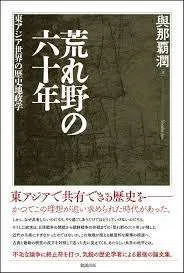
please buy it (seriously). There are also book reviews available online from
Asahi, Yomiuri, nippon.com, and
my first editor.
With that in mind, I hope to make this a session where we can delve deeper into how we should read Seicho Matsumoto today, while relying on the expertise of two people who know much more about him than I do. I look forward to seeing many of you there!