
Kyoto's Ancient Shrine Revived: Suminomiya Shrine (Otokuni-ni-imasu-ikazuchi-jinja) after being burned down and moved to Muko Shrine [Nagaokakyo Series / Oharano Series / Kyoto Nishiyama Series]

It is a Shikinaisha (shrine listed in the Engishiki) called 'Otokuni-ni-imasu-ikazuchi-jinja,' and its enshrined deity is Otokuni-ni-imasu-ikazuchi-no-kami. It is said that Muko Shrine was referred to as the Upper Shrine (Kamisha) and Suminomiya Shrine as the Lower Shrine (Shimosha).
Read as 'Suminomiya-jinja,' it is a Shikinaisha identified as 'Otokuni-ni-imasu-ikazuchi-jinja.' Along with 'Muko Shrine,' it was a Meishin-taisha (a shrine of high rank) and was a very influential shrine in ancient times. It enshrines the Fire-Thunder God, the ancestor of the Kamo clan. According to the Kamo Shrine origins in the 'Yamashiro no Kuni Fudoki,' 'Kamitaketsunomi-no-mikoto married a deity from Tanba Province (Miyagawa Shrine is one of the identified locations), the deity Ikakoyahime, who gave birth to Tamayori-hiko and Tamayori-hime. When Tamayori-hime was playing at the Semino-ogawa river in Ishikawa, a red-painted arrow flowed down from upstream. She took it and placed it by her bedside, where she became pregnant and gave birth to a boy. Eventually, he grew up, and when Taketsunomi-no-mikoto built an eight-fathom house, brewed sake, and gathered the gods for a banquet, his grandfather, Taketsunomi-no-mikoto (enshrined at Shimogamo Shrine), asked, "Let the person you think is your father drink this sake." The boy raised the cup, pierced the roof, and ascended to heaven. Because of this, by the name of Taketsunomi-no-mikoto, the boy was named Kamo-wake-ikazuchi-no-mikoto (enshrined at Kamigamo Shrine). (Omitted) The red-painted arrow is the Fire-Thunder God residing at the shrine in Otokuni District. (Omitted).'
Finally, a little history of this shrine. Originally, it was enshrined on Mt. Muko as the 'Lower Shrine,' but it was burned down during the Jokyu War in 1221 and merged into Muko Shrine (Upper Shrine) in 1275. It was revived as Suminomiya Shrine at its current location in 1484, and the sacred object that had been entrusted to Muko Shrine was moved to Suminomiya Shrine in 1883. Currently, it is managed by Nagaoka Tenmangu (
My NOTE), and the dance hall was moved from Nagaoka Tenmangu.
Change Log
2024/11/09: First edition
▼HP▼Access
35 Inouchi Minamiuchihata, Nagaokakyo City
▼Enshrined Deities/Main Image and Attendants
※See '▼Highlights' below
▼Highlights
Read as 'Suminomiya-jinja'
Also known as 'Otokuni-ni-imasu-ikazuchi-jinja,' or 'Otokuni Shrine' for short
The enshrined deities are the four pillars of the main deity 'Ikazuchi-no-kami' (Fire-Thunder God), 'Tamayori-hime,' 'Taketsunomi-no-mikoto,' and 'Ikume-irihiko-isachi-no-mikoto' on the left side facing the main hall, and Kasuga Daimyojin on the right
In 512, by the imperial decree of Emperor Keitai, 'Otokuni Shrine' was built, and the Fire-Thunder God came to be enshrined there
In 702, it appeared frequently in national history until the mid-Heian period, particularly as a god of rain prayer in the 'Shoku Nihongi'
-
In 784, with the relocation of the capital to Nagaokakyo, Otokuni Shrine, along with the Kamo Upper and Lower Shrines and Matsuo Shrine, held the rank of Junior Fifth Rank, Lower Grade
Kamigamo Shrine: https://note.com/yanma_travel/n/n5da327e9a1d7
Shimogamo Shrine: https://note.com/yanma_travel/n/n88558a790504
Matsuo Taisha: https://note.com/yanma_travel/n/ne6599620d483
In 1221, it was burned down by the shogunate army for siding with the Imperial Court during the Jokyu War
In 1275, it was merged into Muko Shrine (Upper Shrine)
For a long time, its revival was not permitted, and sacred treasures and ancient documents were entrusted to the Upper Shrine, Muko Shrine
In 1484, it was revived and is enshrined as the guardian deity of Inouchi
The worship hall was built in 1690 and relocated from Nagaoka Tenmangu in 1942
It seems there is a history of conflict with Muko Shrine, whether they get along or not (https://www.city.nagaokakyo.lg.jp/cmsfiles/contents/0000005/5235/hurusatofile41.pdf).
In 1883, the sacred object was transferred from Muko Shrine.


There is an iwakura (sacred rock) on the approach in front of the worship hall.

The stone lantern in front of the worship hall is inscribed with "Otokuni Daimyojin Shrine." The main shrine building houses two shrines within its protective enclosure: "Tsunomiya Shrine" and "Kasuga Shrine." On the left is the main deity, Honoi-kazuchi-no-kami, along with Tamayori-hime-no-mikoto, Take-tsunumi-no-mikoto, and Emperor Suinin, also known as Ikume-iribiko-isachi-no-sumera-mikoto, sharing many of the same deities as Muko Shrine. The deity of Kasuga Shrine is Kasuga Daimyojin.

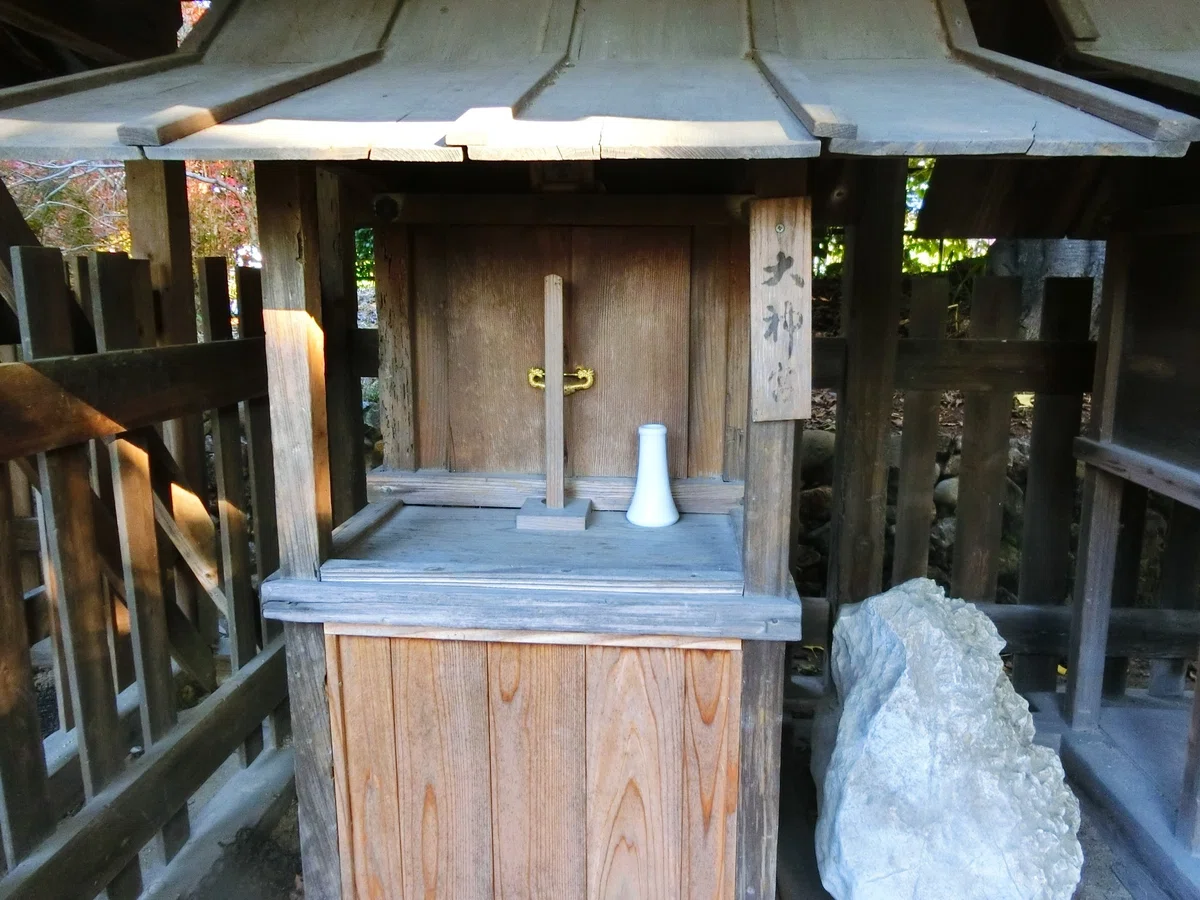
There are auxiliary shrines lined up to the right (east) of the main shrine building. The slightly larger shrine on the left is the "Hachiman-gu" and it has its own independent protective enclosure. The enclosure on the right contains three auxiliary shrines, lined up from left to right as "Daijingu," "Inari-sha," and "Muko Shrine."
→ "Hachiman-gu," "Daijingu / Inari-sha / Muko Shrine"
To the right of the main shrine building, the "Hachiman-gu" and the three shrines "Daijingu, Inari-sha, and Muko Shrine" are enshrined. The deity of Muko Shrine (my NOTE) is said to be "Ugayafukiaezu-no-mikoto"... It is of the Hyuga lineage. Wait? Perhaps the deity of Muko Shrine is actually "Ugayafukiaezu-no-mikoto"... Emperor Jimmu was also there...
Perhaps, due to the historical circumstances mentioned above, when this shrine was merged into Muko Shrine, they accepted the higher status and changed the deity. Was the revival delayed because they couldn't let go of that?



▼ Media Information
Any further updates will be added in the comments section below this NOTE.
▼ Travelogue
▼ Places to visit together
▼ Buddhist Statue Exhibition
#MukoShrine
#TsunomiyaShrine
#Otokuni-ni-imasu-ikarazuchiShrine
#RevivedKyotoAncientShrine
#NagaokakyoSeries
#OharanoSeries
#KyotoNishiyamaSeries
#ShikinaiShrine
#Otokuni-ni-imasu-ikarazuchi-no-kami
#KamoClan
#Ikarazuchi-no-kami
#Yamashiro-no-kuni-fudoki
#KamoShrineEngi
#Kamo-no-taketsunumi-no-mikoto
#Kamiyakako-yahi-hime
#Tamayori-hiko
#Tamayori-hime
#NagaokaTenmangu
#NagaokakyoCity
#OtokuniShrine
#Ikume-iribiko-isachi
#EmperorKeitai
#ShokuNihongi
#Rain-prayingDeity
#Inari-sha
#MukoShrine
#ShrinesAndTemples
#Shrine
#ShrineVisiting
#Yanmaa
#YanmaaTravelogue
#Travelogue
#YanmaaShrinesAndTemples
#MyTravelogue
#APlaceYouMustVisitOnce
#Humanities
#Kyoto
#KyotoTravel
#KyotoAutumnLeaves
#KyotoExpertSeries
#KyotoExpertSeries
#NagaokakyoSeries
#WelcomeToKyotoSeries
#Kamo
#Kamo
#KamoShrine
#AutumnLeaves
#YamashiroFudoki
#TravelAndOutings
#KyotoStrollingSeries
#KyotoShrinesAndTemplesSeries