
You'll regret missing this! Afro Buddha! Kangiten at Jūrin-in Temple! Stone Buddha Niche! Two-Headed Aizen Myō-ō [Naramachi Series]

The main image enshrined in the National Treasure main hall, which I had known about for a long time, is a stone shrine! A standing stone statue of Ksitigarbha Bodhisattva!! And it contains the super rare Buddha statue, the 'Afro Buddha,' also known as the Goko Shii Amida Nyorai seated statue!!!
However, the shock that exceeded that was even greater!!!! Two 'Kangiten' statues, which are considered absolute secret Buddhas in Esoteric Buddhism, are normally enshrined there!!!!! I thought they were only at Amano Shrine in Koyasan (my NOTE), Iwashimizu Hachimangu in Kyoto (my NOTE), and Toko-ji Temple, also known as Mondo Yakujin (my NOTE)... and the ' Two-Headed Aizen Myō-ō statue,' and the back-to-back Bishamon, the ' Standing Statue of Twin Bishamonten' (a blog that summarizes them)... I can't believe all these Buddha statues are gathered here.
In short, it is a wonderful temple that kept surprising me so much that I had to use many exclamation marks! Everyone, please go and pay your respects.
Revealed during the 'Rozi-bura' winter campaign held in February 2024, which involved strolling through the streets of Nara City!!
Change History
▼HP
▼Access
27 Jūrin-in-chō, Nara City
▼Deities, Main Image, and Attendants
※See '▼Highlights' below
▼Highlights
A temple founded by the imperial vow of Empress Genshō during the Nara period
Founded by Asano no Sukune Nakai, the eldest son of the Japanese envoy to Tang China, Kibi no Makibi
Asano no Sukune Nakai's mother was apparently from the Tang dynasty, so this might be an early example of an international marriage
Originally a sub-temple of Gangō-ji (my NOTE).
During the Kamakura period, the faith in Ksitigarbha Bodhisattva, who saves people who have fallen into hell, spread, and Jūrin-in Temple seems to have suddenly come into the spotlight as a temple enshrining a Ksitigarbha Bodhisattva statue from the Heian period.
The main hall (a National Treasure) houses a rare 'Stone Buddha Niche (Sekibutsu-gan) (an Important Cultural Property)' as its main image.
A 'niche' is a shrine for housing Buddha statues, and inside it are carved a standing Ksitigarbha Bodhisattva, a standing Shakyamuni Buddha, a standing Maitreya Bodhisattva, and others.
Fudō Myō-ō, the Nio guardians, the Seven Stars and Nine Luminaries, etc., are also carved in relief.
In the 1283 'Shasekishū,' Jūrin-in is introduced as a sacred site for Ksitigarbha Bodhisattva.
Although it seems to have lost its treasures due to the Haibutsu Kishaku (anti-Buddhist movement) of the Meiji era, the items from the Kamakura period that remain include the main hall, the stone Buddha niche, the south gate, the thirteen-story stone pagoda, and the log-cabin style sutra repository.
Leave Gangō-ji, head south, and turn east at the second corner to find the south gate.


A sub-temple of Gango-ji, which was an imperial prayer temple for Empress Gensho, who named the "Yoro Falls" in Gifu Prefecture. It is an ancient temple said to have been founded by Asano no Sukune Nakai, the eldest son of the Minister of the Right, Kibi no Makibi.
The "Main Hall" is a National Treasure, and the "Goma-do" houses the Fudo Myoo, which is an Important Cultural Property. Finally, there is something called the "Kofuku-ji Mandala Stone." This mandala depicts the Buddhas and the five-story pagoda enshrined in the various halls of Kofuku-ji (my NOTE), and it is interesting that it is carved into stone.

→ South Gate (Important Cultural Property)
The front gate standing in front of the Main Hall. I didn't realize it was an Important Cultural Property...


→ Main Hall (National Treasure)
The Main Hall is a National Treasure, built as a worship hall to pray to the stone Buddhas inside. The main image inside is a stone Buddha, which is rare, featuring a triad of the "Jizo Bosatsu" in the center with "Miroku Bosatsu" and "Shaka Nyorai" as attendants. It is generally only open to the public for a limited time.
It resembles the main halls of Toshodai-ji (my NOTE) and Akishino-dera (my NOTE) more than it does Gango-ji (my NOTE).

The Main Hall is where the main image is enshrined, and it seems the front part was added on, which is why it is a National Treasure. You can hear an explanation when you visit.


https://bunka.nii.ac.jp/db/heritages/detail/123507

The ceiling of the Main Hall is low, which feels a bit oppressive, but the heated carpet is warm!? This Main Hall originally only contained the main image, but an addition in the style of Heian nobility was built during the Kamakura period. In other words, the place where you pray is the added section.
Bruno Taut would have been surprised, too. I get it.
The renowned German architect Bruno Taut (1880-1938) stayed in Japan from 1933 to 1936, during which time he traveled around to see many Japanese buildings and spread the wonder of Japanese beauty to the world. He particularly praised Katsura Imperial Villa. Regarding Jurin-in Temple, he stated in his book 'Forgotten Japan' (Chuko Bunko), 'Generally, foreigners try to seek the source of Eastern culture in things praised by government-issued guidebooks or Baedeker. However, when you come to Nara, you should first visit the small but very old, simple, and elegant Jurin-in Temple to quietly contemplate its beauty, and also enjoy the simple streets in the vicinity to your heart's content.'

→Main Hall/Main Image 'Stone Buddha Niche @ Important Cultural Property'
You can hear an explanation if you visit.
Originally, the stone Buddha niche was outside, and the main hall was built later. It seems that a place for worship and a covering structure were added later, and a space connecting the main hall and the covering structure was created. In other words, in terms of a shrine, it feels like the main hall is a covering structure that protects the inner sanctuary.
The central figure of the Stone Buddha Niche @ Important Cultural Property is the 'Standing Statue of Ksitigarbha Bodhisattva.' The stone materials on the left and right feature relief carvings of a standing Shakyamuni Buddha and Maitreya Bodhisattva, representing the past, present, and future, which is the same as the Zao Gongen of Yoshino or the Nyorai Triad (Past: Yakushi Nyorai, Present: Shakyamuni Nyorai, Future: Amida Nyorai).
The main image enshrines Ksitigarbha, who continued to save people from the time Shakyamuni passed away until the baton was passed to Maitreya. In addition, other Buddhas such as Nio, Sahasrabhuja, Fudo Myoo, the Ten Kings, and the Four Heavenly Kings are carved, seemingly representing the world of Ksitigarbha Bodhisattva who wishes for the Pure Land. The keyword 'Six Realms' came up in the explanation.
The 'Ten Kings' on the side wall of the Ksitigarbha Bodhisattva are the judges who judge the dead in hell, and the high-ranking one is the famous 'King Enma,' who is considered to be a manifestation of Ksitigarbha Bodhisattva.
At the top of the stone Buddha niche, there are Sanskrit characters representing the constellations of the Big Dipper, the Nine Luminaries, the Twelve Zodiac Signs, and the Twenty-Eight Mansions. Since there are twelve and twenty-eight, I wondered if the Twenty-Eight Legions were also involved, so I asked, but I was told that was not the case.
In front of the stone Buddha niche, there is a stone called the 'Indo-ishi' (Guidance Stone) where the coffins or remains of the deceased are placed, and it is said that it may have been used by nobles and members of the imperial family several times.
→Other Buddhist statues 'Afro Buddha', 'Kangiten', 'Dual-Headed Aizen Myoo'
After the explanation of the main image ended, I was expecting an explanation of the Afro Buddha, but I was told, 'Well then, there are also treasures in that case over there, so please go ahead,' and the explanation ended. Could it be that I can't see the Afro...?

And when I went to the indicated place, there was the Afro Buddha (https://jurin-in.com/img/img_butsuzo01.png)!!!! Oh, it has an Afro flavor like the one at Todai-ji Temple! It's not large, but its presence makes it one of the top 5 Afro Buddhas.
The next moment, I let out a loud voice. 'Oh, Kangiten.' Yes, Kangiten, which is familiar in Esoteric Buddhism, is almost always a strictly hidden Buddha. Sometimes it says Kangiten, so when I look, it's an Eleven-Faced Kannon, which is disappointing. There is a temple that opens Kangiten only on June 6th (here), but it seems you can always see the Buddha here. Wow, I was surprised...
And next to it was the 'Soshin Bishamonten.' This is the second time... It is also the 'Seated Statue of Dual-Headed Aizen Myoo.' It was born from the idea that Aizen and Fudo are one, and I thought it was only at 'Koyasan Amano Shrine (my NOTE)', Kyoto's 'Iwashimizu Hachimangu (my NOTE)', and 'Toko-ji Temple (Mondo Yakujin) (my NOTE)', but to think it's here too... I have to add it to my other notes...
→Temple Grounds


As shown in the photo below, there is a kappa. For details, please refer to the temple's pamphlet and explanatory notes. It was located at the South Gate.


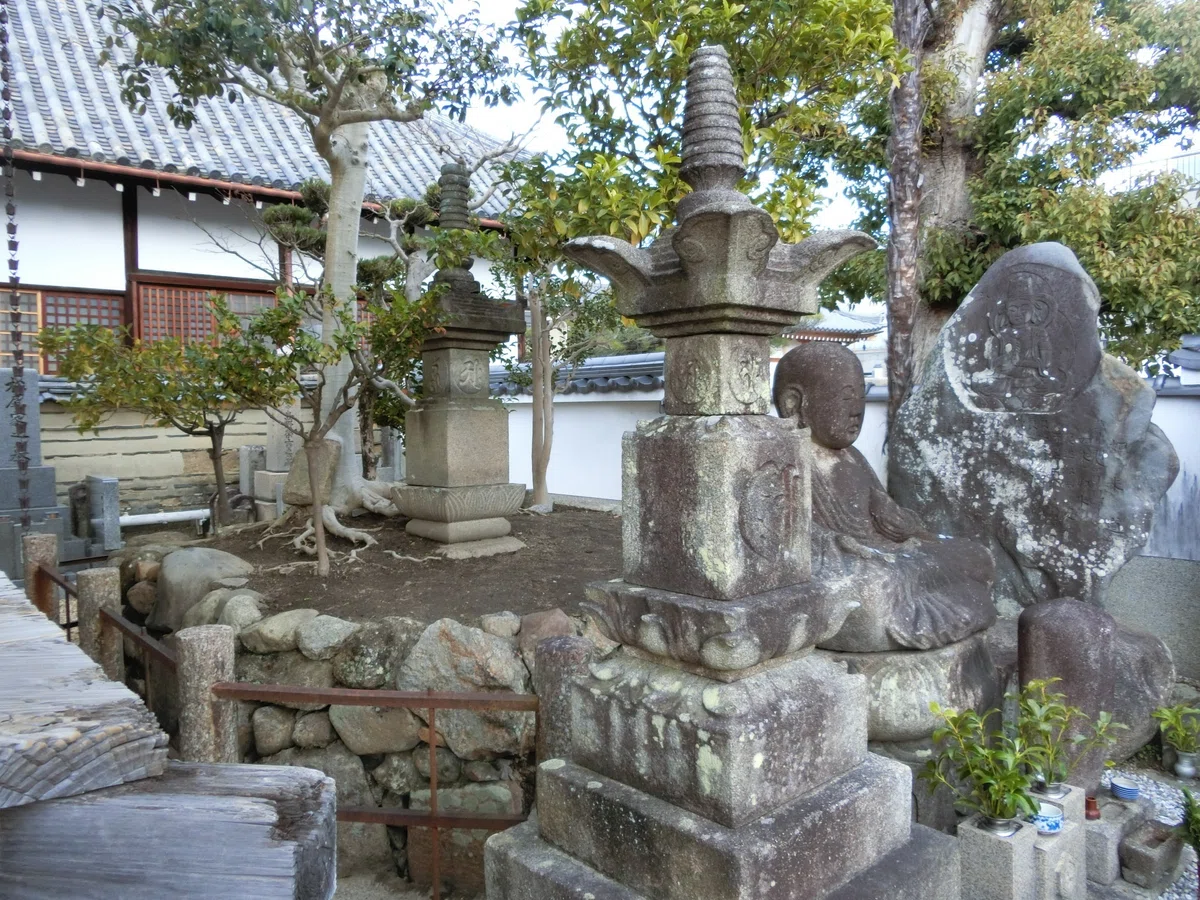
There are many stone Buddhas in the garden, and the Kamakura-period 'Stone Standing Statue of Fudō Myō-ō' is a highlight. I imagine the principal image was enshrined in a similar way in the past.


The 'Goma-dō' hall on the temple grounds houses the Fudō Myō-ō Triad.
The central figure is 'Fudō Myō-ō,' and the attendants appear to be 'Kongara Dōji' and 'Seitaka Dōji'.



▼ Media Information
I will add further updates in the comment section below this NOTE.
▼ Travelogue
▼ Places to visit together
#AfroBuddha
#Kangiten
#Jurin-in
#StoneBuddhaNiche
#TwoHeadedAizenMyoo
#NaramachiSeries
#NationalTreasure
#Ksitigarbha
#GokoShiyuAmida
#SoshinBishamonten
#NaraCity
#AsanoNoSukuneNagakai
#Shasekishu
#BrunoTaut
#ShrinesAndTemples
#Yanmaa
#YanmaaTravelogue
#Travelogue
#YanmaaShrinesAndTemples
#BuddhistStatue
#MyTravelogue
#APlaceIWantToVisitAtLeastOnce
#Humanities
#Nara
#NaraSeries
#NaramachiSeries
#TravelAndOutings