
Understanding the Depths of the Mind that Knows Jung's Synchronicity, "Meaningful Coincidence": Reading Katsuhiro Oimatsu's "What is Dharma Power? - The Impact of 'The Modern Kukai'"

Reading the book "What is Dharma Power?" by Jungian psychoanalyst Katsuhiro Oimatsu, "What is Dharma Power?" .
What is Dharma power?
Let us set aside the discussion of how to define the term Dharma power (or what other words to replace it with ).
In this book, Oimatsu, a psychiatrist and Jungian psychoanalyst, interviews a great Acharya of the Shingon sect (referred to as Monk X in the text) and those associated with him. The approach taken is to understand the words spoken there by Carl Gustav Jung 's analytical psychology theory.
While it is best to pick up the book and read the details yourself, it introduces surprising anecdotes (though if you read the book carefully, you will come to see them as not so "surprising") related to the "Dharma power" of "Monk X".
For example, several decades ago during the Cold War, there was an incident where a fighter jet from the then-Soviet Union flew to Hakodate Airport in Japan, and the pilot defected to the United States . This was the Belenko defection incident.
The aircraft Belenko was piloting was a state-of-the-art fighter jet that the West suspected at the time might have such terrifying performance that it would break the balance of military power between East and West. It seems the West scrambled to collect information on this aircraft, which was hidden behind a veil of secrecy, but could not learn its true nature. This is an incident where it flew all the way from the other side to Japan, Hokkaido, the front line of the West in the Far East.
*
You might wonder what this incident has to do with Dharma power. Surprisingly, at the very moment this Soviet pilot was gripping the control stick and flying toward Japan, slipping through the air defense surveillance of both the Soviet Union and Japan, Monk X was performing a "Esoteric Buddhist ritual" called "Kojo" (summoning) to lure this aircraft to Hakodate!
"The time given was six months. To summon and capture that fighter jet, I believed in the words of the sect's founder, believed in the wisdom of the sutras, believed in my own mission, believed in the power given to humans, and performed the Goma ritual by practicing the Three Mysteries of body, speech, and mind ."
Shingon Esoteric Buddhist prayer is involved in a major incident that momentarily heightened tensions between East and West in Cold War-era Japan.
"Wait a minute!
"Performing the Goma ritual while forming mudras, chanting mantras, and visualizing the Buddha" and
"a Soviet pilot gripping the control stick and flying straight to Japan"
is there any causal relationship between these two events?!"
Many people might think so.
Or,
"What on earth is the mechanism by which the monk's Three Mysteries and the fire of the Goma ritual transcended the distance of space to act upon the Soviet pilot's mind and body, making him grip the control stick?!"
Some people might think so.
It is a reasonable question.
This book answers that question.
Not aiming to elucidate the mechanism
Regarding the "mechanism" of Dharma power, Oimatsu writes the following:
"In this book [...] we do not intend to elucidate the mechanism of Dharma power , and we will not discuss content of the type that if you do this, that will happen. [...] The stance of not aiming to elucidate the mechanism is, in fact, not unrelated to the essence of the phenomenon we are trying to deal with. There are aspects that cannot be approached without such a stance ."
This is a very powerful message.
Do not aim to elucidate the mechanism.
And,it is precisely by not aiming to elucidate the mechanism thatthere is a wisdom that becomes visible—that becomes accessible. That is, wisdom based on synchronicity.
Beyond Cause and Effect
Following the passage above, Mr. Oimatsu writes further as follows.
“Originally, a mechanism means a mechanical structure. However, when it comes to Dharma power, that kind of scientific (natural science) aspect will not apply. [...] It is impossible to explain the summoningof a fighter jet using ordinary scientific logic, or in other words, to unravel it through causality. Because it transcends causality, it is called Dharma power.”
Let us first grasp this passage written by Mr. Oimatsu: "It is impossible to explain the summoningof a fighter jet using ordinary scientific logic, or in other words, to unravel it through causality."
The keyword I want you to pay attention to here is "causality".
Causality means that "a preceding event (cause) exerts an influence that causes a subsequent event (result) to occur".
For example, in the case of "taking a national exam without sleep on the morning after drinking all night and failing", drinking all night is the cause and failing the exam is the result. Because alcohol and staying up all night affect the brain nerves and leave one dazed, the information doesn't sink in when reading the exam questions, and one feels dizzy even trying to think of answers.
The point is that you cannot say something like "the Buddhist prayer ritual was the cause, and the arrival of the Soviet aircraft was the result" in the same vein as this.
Then, how should we understand and assign meaning to the connection between the Buddhist prayer ritual and the arrival of the Soviet aircraft?!
This is where Jung's concept of synchronicity comes in.
“Synchronicity (synchronicity) is one of the principles regarding the connection between multiple events. Another principle distinct from that is causality or the law of cause and effect, and causality and synchronicity are in opposition.”
According to Mr. Oimatsu, synchronicity is that we humans feel a "meaningful coincidence."
Synchronicity is a "principle" that stands in opposition to causality.
Things that can be explained by causality
Things that can be explained by synchronicity
Causality (the law of cause and effect) is the act of assigning two events, especially event A and event B that are temporally or spatially sequential, to the two opposing poles of "cause" and "result," and describing them as, for example, "Event A is the cause, and Event B is the result."
Event A / Event B
|| ||
Cause / Effect
In other words, the law of causality is the idea that one can establish a four-term relationship like the one above. Today, we tend to think that we have "understood the meaning of things" by sorting two events into the binary of "cause/effect" whenever something happens. Or rather, we are trained to do so. The binary opposition of cause/effect is superimposed onto the temporal distinction of before/after and the spatial relationship of adjacency to reinforce a sensory, pre-five-senses "certainty."
Event A / Event B
|| ||
Cause / Effect
|
Before / After
|
Past / Present
The law of causality is extremely effective for understanding things like the physical movement of objects, such as a cat kicking a ball of yarn (cause), which causes the ball to roll, the yarn to unravel and tangle, and the room to become a mess (effect). Not only is it effective, but because we were able to describe the movement of objects as a function of time and distance, we were able to predict the position of an object at a future time with high probability, and this has led to the dramatic development of science and technology.
Synchronicity
In contrast to this law of causality, synchronicity does not introduce the binary opposition of cause/effect.
“Synchronicity pays no attention to causes or effects. It is the basis for seeing that there is (a non-causal) connection between multiple events that occurred almost simultaneously. [...] Of course, this does not mean that everything that happens at the same time is connected. What connects one event to another is meaning; in other words, the principle of recognizing a certain connection between events through meaningful coincidence is called synchronicity. Thinking of meaningful coincidence as "just a coincidence" is because we usually overemphasize causality.”
When two events occur "almost simultaneously," one after the other, it is a situation where, even if it cannot be explained by "cause/effect," one cannot help but feel that there is "a connection" that has some deep meaning.
That is synchronicity.
For example, the common "coincidence" is this.
”You dream of an uncle who lives far away and whom you haven't seen in years, and then that night, you get a phone call from him.”
"A married couple having the same birthday"
These are examples. It is difficult to find a physical causal relationship between having a dream and an uncle calling you.
"Is there any principle other than cause/effect that explains (or can replace) the connection between multiple sequential events?!"
You might think so, but the very fact that we have become unable to think about the connections between multiple events using any binary opposition other than cause/effect is the blind spot of modern, scientifically and technologically advanced human intelligence.
*
We tend to be unable to rest unless we think about things like Hōriki (power of the Dharma) in terms of cause/effect. From this, the following often happens.
"When a phenomenon cannot be explained by normal causality, people cannot bear the anxiety of being left in limbo, and inadvertently assume magical powers and brandish a pseudo-causal theory. It is a magical causality that resembles scientific causality but is different from it."
Even if we try to understand a pair of two events by superimposing them on the binary opposition of cause and effect, if they cannot be placed on Newtonian coordinate axes (time and distance), we often imagine a different kind of causality than scientific causality.
The "cause" of the spread of a new virus, the "cause" of a mysterious yen depreciation, the "cause" of being rejected by thirty companies in a row, or the "cause" of why my shoulders have been stiff lately cannot be explained by Newtonian causality (if a cat rolls a hairball...), and even if explained, it is sometimes hard to understand. Therefore, the modern mind, which cannot stop seeking cause and effect, wants to place things like "a conspiracy by a dark organization", "a final decision by a dark leader", or "something ghostly" in the 'cause' position of the binary opposition of cause and effect.
We have a habit of thinking about cause/effect or cause/result for everything, but in reality, not everything can be explained neatly and simply by cause/effect. It is all like "if the wind blows, the barrel maker prospers."
At such times, if there were a principle that recognizes a certain connection between events, distinct from cause/effect, one would want to hear more about it.
* *
So, setting aside the binary opposition of cause/effect for a moment, what else connects the first event and the second event?
This is where 'meaning' and 'meaningful coincidence' come in.
"Meaningful"?!
Now, an interesting keyword has appeared here.
Meaning.
Meaning
Meaningful coincidence
Mr. Oimatsu also calls this "coincidence in terms of meaning".
*
I, the writer of this article, have a hobby of thinking about "meaning" here and there. Forgive me for taking the liberty, but let's think about it from the perspective of deep semantics and meaning articulation theory.
What is meaning is a process that draws a structure like the one shown in the diagram below (let's assume).

The explanation for this diagram is written in the article below, so please refer to it if you are interested.
Temporal before/after relationships (t and t+1), spatial positional before/after relationships and sequential relationships (x and x+1), and cause/effect relationships all take a pair of two terms, a binary opposition, as their smallest unit.
t / t+1
x / x+1
cause / effect
Δx / Δx+1
In the diagram above, these are the "Δ terms" represented by blue circles.
Δ terms are things that appear to our senses, empirically and simply, with the face of having been distinguished from others in advance as "that".
The Δ term always occurs at the position of one of the two opposing Δs, but we forget (or do not think about) this in our sensory experience, and can simply begin our discussion by assuming that a certain Δ exists.
A cause is a cause only insofar as it is a non-result in relation to an effect, but without saying such things, we can simply state, 'This is a cause,' just like that.
By arranging such Δ terms in a linear sequence one after another, our ordinary language (Δ1 is Δ2, Δ2 is Δ3, Δ3 is Δ4, etc.) realizes the act of meaning something.
We usually handle language only in the form of a linear arrangement of Δ.
*
However, what makes this chain of linear Δ arrangements possible is the β term represented by the four red circles in the figure above. The β term, for example, in the case of β1 in the figure above, is the position of 'neither Δ1 nor Δ2'.
If Δ1 is 'cause' and Δ2 is 'effect', then β1 is 'neither cause nor effect'.
Or, to rewrite it more clearly, if Δ1 is 'cause' and Δ2 is 'non-cause', then β1 is 'neither cause nor non-cause'.
Here, for example, a certain Δ is that Δ because it arises as something like the ripple pattern drawn by a vibrating β term at a position between any two β terms, where the relationship of the four β terms (a relationship where the four β terms are mutually different, yet at the same time not mutually different, and are mutually transformed) is in motion.
Eight-term (eight-pole) relationship and Mandala
Whether cause or effect, before or after, every individual Δ term manifests its form as one of the terms in the eight-term relationship consisting of these four β terms and the four Δ terms positioned between them.
In the case of Kobo Daishi, the center of the Mandala is exactly this eight-term relationship.
Also, Jung's Mandala allows us to see an eight-term relationship.

Jung's own hand-drawn mandalas can be seen in the beautiful printing of the book 'The Red Book'. This book is, in many ways, phenomenal or even shocking, and I highly recommend that those of you who have 5,000 yen on hand buy it. I am not affiliated with anyone, but it is interesting regardless.
Let's return to the topic.
To mean is to replace, paraphrase, and relate some Δ1 to another Δx, making it 'Δ1 is Δx'. Here, Δ1 is Δ1 because it is paired while being distinguished from non-Δ1, and Δx is Δx because it is paired while being distinguished from non-Δx.
'Δ1 is Δx'
When we can 'mean' something like that, there is
Δ1 / non-Δ1
||
Δx / Δx
This means that a four-term relationship, which pairs binary opposition relationships, is constructed.
To "mean" this can also be rephrased as superimposing a binary relationship upon it.
And I would like you to recall that cause/effect is also one such binary relationship, and by superimposing the cause/effect binary relationship onto the binary relationship of the first event and the second event, it was producing the 'meaning' that the first event is the cause and the second event is the result.
* *
Now, in order to escape from thinking dominated by causality, which attempts to replace every conceivable other binary relationship with the cause/effect binary relationship, it is good to keep in mind that cause/effect, like all other binary oppositional relationships, is just one binary relationship within a double quaternary relationship, an octonary relationship.
Furthermore, Jung's "correspondence in terms of meaning" which attempts to deal directly with synchronicity—this is just a personal hunch of mine as I write this—is, I suspect, related to freely generating or transforming the octonary relationship, the double quaternary relationship itself.
Because causality sets the cause/effect binary opposition as an absolute reference point, it becomes impossible to see the beta quaternary relationship that articulates this binary opposition itself.
*
Here again, it is Kukai.
In his work said to be the most difficult, the "Unjigi" (Meaning of the Hum Syllable), Kukai analyzes the algorithm of this double quaternary relationship, this octonary relationship, and places "all phenomena are devoid of an attainable cause" as the term occupying the position of the beta term in my schema.

Phenomena (shohō) are various existing things, terms delimited to one side of a delta binary relationship, and regarding such phenomena, such deltas, it is said that "cause" is "unattainable".
Unattainable, meaning it cannot be obtained. One cannot fundamentally bring in some term (a delta term) and say, "This is the cause," or "This is the cause."
Being able to discuss cause/effect is a story that comes "after" articulating the delta binary opposition of cause/effect. And if one asks why such a delta binary opposition can be articulated, it is because of the pulsation where four beta terms—four beta terms that are "neither something nor nothing" and do not pin down and solidify "what it is" by rephrasing it into one pole of a binary opposition—separate, combine, and separate again; a certain delta binary pair temporarily takes that value as something like the maximum and minimum amplitude drawn by that vibration.
* *
The "Collective Unconscious" described as a Mandala
Now, speaking of mandalas, there is Jung's collective unconscious.
Jung expressed our "mind" as a structure consisting of surface consciousness and deep unconsciousness. And the deep unconscious is divided into personal unconscious and collective unconscious.
The personal unconscious consists of thoughts and images that an individual has repressed from surface consciousness and kept from rising to the surface.
On the other hand, Mr. Oimatsu writes that the collective unconscious is "made of impersonal, transpersonal matters."
"It is an unconscious layer consisting of contents that everyone is born with in common from the beginning, regardless of era, place, race, or culture."
Just as the human body, for example, statistically has a majority of people who walk on two legs rather than four, there are also "typical patterns" of movement common to many people in the human "mind" as well (Katsuhiro Oimatsu, "What is Hōriki?", p. 108).
Overlaid upon this is the growth process of each individual, resulting in diverse individuals who differ culturally, historically, and linguistically.
One of the things in which these "typical patterns" of the collective unconscious indirectly manifest is "myth" and "mandala." Regarding myth, on this note account, I have been persistently reading Claude Lévi-Strauss's "Myth and Meaning" while superimposing it onto Kūkai's mandalas, but as for Jung's theory of myth, there is, for example, a book called "Symbols of Transformation," and regarding mandalas, there are the aforementioned "Red Book" and "The Secret of the Golden Flower," among others.
Jung considered the mandala to be something that surface consciousness and deep unconscious symbolizes a state where they are separate yet harmoniously united as a single whole.
*
By the way, to be a mandala is, in other words, to be an eight-term relation.
Also, taking the liberty, I will attempt to explain by forcibly connecting Jung's "structure of the mind" with the aforementioned eight-term relation diagram.
Jung's surface consciousness in the structure of the mind is, in terms of the eight-term relation, the Δ linear arrangement written as 1. "appears as a heavy, cold chain" in the diagram. There, "thinking" of the formula "A is the cause and B is the effect; this relationship is absolutely unshakable" runs rampant.
Among the deep consciousness in Jung's structure of the mind, the personal unconscious is, in terms of the eight-term relation, the β four-term pulsation of 1 in the diagram.
And, among the deep consciousness in Jung's structure of the mind, the collective unconscious is this eight-term relation (double four-term relation) itself.
Related to this is the concept of "individuation" by Jung, which Mr. Oimatsu discusses in conjunction with the collective unconscious.
Union with the Self / Individuation
Individuation according to Jung is the following process.
"From the initial totality as undifferentiated chaos, once consciousness separates and becomes independent and solid, one must then reunite the differentiated consciousness with the various elements of the unconscious to realize a higher-order totality. This series of processes is called individuation."
Our individual minds begin, when we are born, from an "undifferentiated chaos." In a baby's mind, the beta four-term relationship is pulsating, and there information such as basic sensations, tactile sense, intensity of light, intensity of sound, and the direction of Earth's gravity arises, and articulation and differentiation by the pre-five consciousness are nurtured. In this way, the beta four-term relationship and the delta four-term relationship become clearly distinguished. Eventually, a system of differences in language and sound covers them, and as the delta four-term relationship becomes more clearly solidified, the pulsation of the beta four-term relationship also becomes clearer.
As we grow from children into adults, and the relationship of paraphrasing between words becomes clearly prominent, the mind becomes dominated by the delta linear arrangement. The delta self and the delta other are clearly distinguished, and one becomes attached to one's own ego, attempting to firmly solidify a "delta ego" that is "separated and independent" from others.
And then, when we suddenly think, "I'm going to die sooner or later, so what have I been so attached to? It feels kind of empty...", our minds may loosen their grip on the delta linear arrangement we have clung to, and once again unconsciously remember the undifferentiated chaos, the beta pulsation. Of course, many modern people do not remember it, but if it goes well, one can enter the beta pulsation from the delta linear arrangement, and by mastering the beta pulsation, one can freely generate the delta linear arrangement.
This is the process of individuation.
Regarding the relationship between the process of individuation and the "mandala," Oimatsu writes the following.
"Maintaining an axis is also essential in the process of individuation. On the side of the ego, an attitude of negotiating with the Self while firmly asserting one's own position is required. [...] Just before reaching unity in this negotiation, the ego's way of being up to that point wavers, and it is about to be swallowed by the unconscious, but Jung calls the symmetrical geometric images based on circles and squares that are sometimes experienced spontaneously at that time a mandala, likening them to the mandalas of the East. A symbol of wholeness as the final order appears before the ego, which is facing a major crisis."
Oimatsu also writes that "individuation can also be rephrased as the discovery of one's own myth by the individual." Myth is also a bricolage of the delta linear arrangement of ordinary language, simulating a mandala-like eight-term relationship (a double four-term relationship).
Synchronicity, meaning, symbol
The structure of our mind, described as a double four-term relationship of a mandala. Within this, there is also synchronicity, a principle that connects the associations of things through 'meaning'.
The key is the "symbol".
A symbol is a relationship where "something symbolizes something else," but for example, when "the moon" symbolizes "love", or "an apple" symbolizes "beauty", by daring to short-circuit delta binomials that are far apart and separated in sensory experience, it evokes a "deep" feeling, a feeling of touching the deep beta pulsation; that is a "symbol."
" Symbols connect opposing things and make contradictions and conflicts compatible."
Symbols create ambiguous mediating terms.
An ambiguous mediating term that short-circuits two empirically opposing deltas and is in an ambiguous, vibrating state of being "both delta 1 and non-delta 1," which cannot be fixed to either of the two poles.
It places a certain word, a certain object, a certain delta—which has the appearance of one term within an empirical and sensory delta four-term relationship—into a relationship of "different but the same" with something else that is usually completely unrelated or diametrically opposed.
Here, the four-term relationship of the delta terms is distorted, shifted, and twisted. By doing so, it briefly brings to the surface of consciousness the shadow of the beta pulsation that moves in the "depths" of the delta four-term relationship and causes the delta four-term relationship to occur like ripples.

Cannot be explained scientifically -> What is "scientific"?
Now, let us return to the topic of magical power.
Magical power is something that cannot be described or explained scientifically, that is, through cause and effect. What Mr. Oimatsu writes in this book is that scientific cause and effect alone cannot comprehensively describe everything in this world.
"Is the principle of connection between multiple phenomena only the law of causality?"
After posing this question, he writes the following toward the end of the book.
"The objects we believe we understand are likely not nature itself. Even the law of causality, which seems to be such a powerful principle, only governs a very small part of nature. Every way we understand nature is merely an approximation, and only applies to the areas we have conveniently carved out."
The law of causality can only explain a "very small part" of the world.
When describing the relationship between various phenomena using natural science theories based on the law of causality, or when attempting to reproduce those theories in reality by manipulating the cause to bring about the effect, the "conditions" are always strictly questioned.
This is the power of natural science, and where science and technology are convenient and useful.
The primary conditions that make this law of causality possible are the planet Earth and the life form known as humanity. For example, it can be said that the physical time and space that appear to be determined by the law of causality are also conditions set by the human mind and body on Earth.
"The law of causality powerfully governs our familiar physical world. This is the world of so-called Newtonian mechanics [...]. Conversely, we are bound to time, and by extension space, by the law of causality. Since we usually cannot step outside the law of causality, when phenomena occur that seem to transcend this law, we call them miracles, mysteries, or coincidences."
The fact that time and space can be observed in this way is a matter of human perception; it has been revealed by recent theoretical physics, which can be called the essence of natural science, that they do not extend uniformly as such, independent of the observer, throughout the universe itself or even including the "outside" of the universe.
*
These topics are explained in an easy-to-understand manner in Carlo Rovelli's books, so please refer to them.
In other words, time is also a linear sequence of Δ, segmented into some minimum unit—seconds, minutes, t, t+1, t+2, ..., t+x—and distance is also a linear sequence of Δ, segmented into some minimum unit, whether in meters or anything else. The Δ time linear sequence and the Δ space linear sequence do not extend in a straight line forever to the ends of the universe, or even to the outside of the universe.
And as long as cause and effect are kept from moving as a fixed binary opposition, the cause is also Δ, and the effect is also Δ.
Summary
This is not to say that the law of causality is "bad." The law of causality is fine, the law of causality is okay, and the law of causality is convenient and wonderful.
However, causality "alone" is not sufficient.
The fact that "ramen is delicious" and "the belief that no other cuisine but ramen can exist are completely different matters.
When we can observe that an arbitrary second event, which is a probability following an arbitrary first event limited by the concepts, observational techniques, and observational equipment of natural science, occurs, we use the term "there is a causal relationship."
Furthermore, this observational equipment, observational technique, and the concepts used to draw their blueprints are things that hold true within a certain delimited and conditioned domain. In other words, it encodes, through yet another binary opposition, what series of binary oppositions can replace the binary opposition of cause/effect.
This function of "dividing while connecting" every possible binary opposition, including cause/effect, as a pair that opposes something and something else that has split into two sides and separated into two poles, is the beta pulsation. And "synchronicity" might be said to be the entanglement of shadows (symbols) cast onto the surface of consciousness by the vibrations of the beta pulsation referred to in this article. The "archetype," as a pattern of how the collective unconscious functions as described by Jung, is the typical form of transformation and metamorphosis between the delta terms caught up in this beta pulsation.
Synchronicity. That is, connecting events to events through "meaning", dividing while connecting terms that are distinguished as mutually different through the relationship of "meaning". The movement of events splitting and connecting in synchronicity is not imagined or verbalized as the solidification of a delta linear sequence in surface consciousness, but rather as the movement of beta terms excessively binding or excessively separating, pulsating while drawing amplitudes in the intermediate region between the deep unconscious and surface consciousness. Like a myth.
Mr. Oimatsu quotes the words from Kukai's "Sokushin Jobutsu Gi" (The Meaning of Becoming a Buddha in This Very Body), "The discrimination of delusion is what we call time", and "the fruit of the true word is entirely beyond cause and effect" (p. 86). "Sokushin Jobutsu Gi," like "Unjigi," also depicts a double four-term relationship, an eight-term relationship.
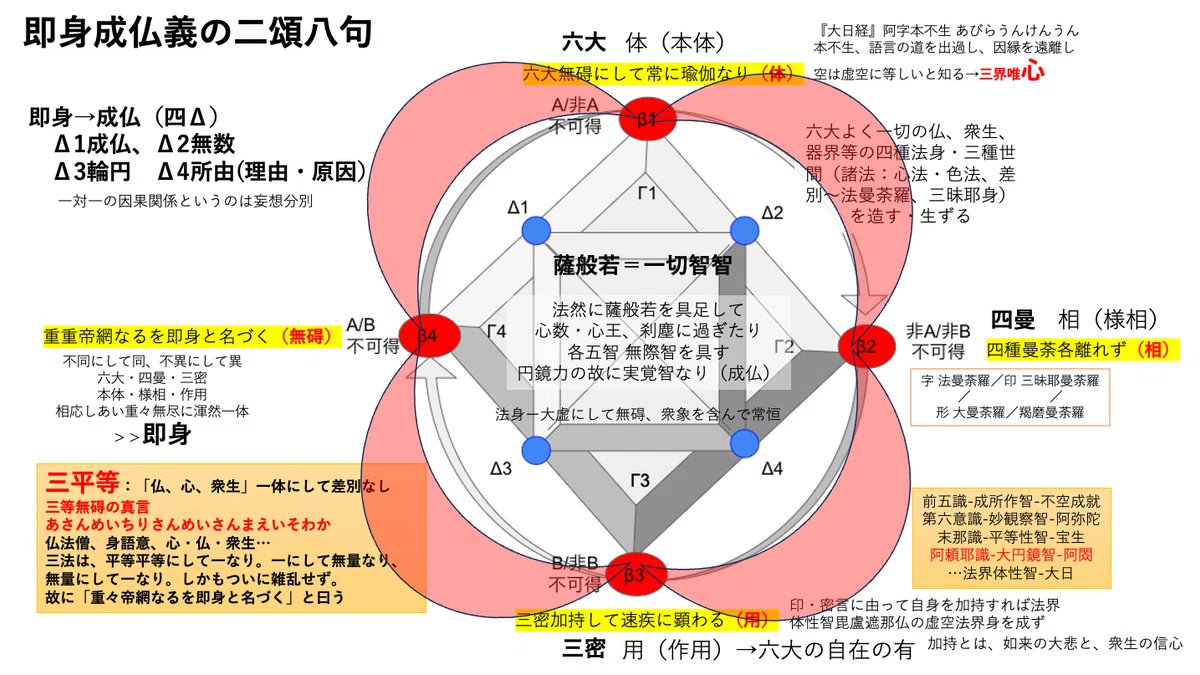
The discrimination of delusion is the solidification of a delta linear sequence by surface consciousness.
Cause and effect is also the solidification of a delta linear sequence by surface consciousness.
In contrast, if we observe through "synchronicity," where the relationship between the signifier and the signified repeatedly binds and separates freely from the beta pulsation, the world appears as a state of "the Indra's net of infinite layers is called the body itself."
Conclusion
As I write this, I have recently been reading Claude Lévi-Strauss's "Mythologiques" and thinking only about the beta pulsation, where ambiguous mediating terms climb up and down trees or play tag. For that reason, I have read Mr. Oimatsu's "What is Magical Power?" focusing particularly on his discussion regarding causality and synchronicity.

In "What is Magical Power?", the stories of the many magical powers of Priest X, which Mr. Oimatsu experienced and engaged with as an "immanent understander," are vividly depicted. I will not introduce the details here, so I hope you will pick up "What is Magical Power?" and read it for yourself.
Related Articles
いいなと思ったら応援しよう!
 最後まで読んでいただき、ありがとうございます。
いただいたサポートは、次なる読書のため、文献の購入にあてさせていただきます。
最後まで読んでいただき、ありがとうございます。
いただいたサポートは、次なる読書のため、文献の購入にあてさせていただきます。