
[Connected Travelogue #262] Late-Night Wandering, 'William Adams', and Ito

Last time, I enjoyed a tremendous paradise at the Izu Shaboten Zoo.
And now, I've returned from the Mt. Omuro area to the city center of Ito, but...?


I happened to come across a scene of people practicing on a stage over the river.
The building also looks incredibly historic and wonderful.


Then, I returned to the hotel to take a short rest.
Man, I really enjoyed Ito to the fullest today.
...But I wonder why.
Perhaps because I saw something good, my energy hasn't settled down yet.
Shall I go? Late-night wandering!!
Well, it's only 8:00 PM, so it's not really late at night, but being able to walk around freely like this at night is one of the good things about Japan.
(Though I've never been abroad)

...Oh, it seems the actual performance is taking place at the spot where I saw the practice session during the day.
I think I'll watch for a bit.

Is that... hula dancing...?
It seems like a different group from the fan dance I saw during the day, but this is elegant and nice in its own way.
Come to think of it, hula dancing looks easy at first glance, but apparently you have to constantly stay in a semi-crouched position, and I've heard that beginners' legs end up shaking uncontrollably.
Underneath those gracefully swaying skirts, trained legs are constantly maintaining a semi-crouched position, and that unseen effort is what creates that elegance.
It's just like a swan...!
...No, wait, I heard swans are just floating on the water taking it easy, so that might not be the best analogy.
Also, since 'hula' in hula dancing apparently means 'dance', it's a redundant name like 'Sahara Desert' or 'jjigae stew', but we shouldn't worry about that.
For things like this, clarity is what matters. Surely.


And then, we head towards Orange Beach.
For someone from a landlocked prefecture, going to the beach at night is a very rare experience.


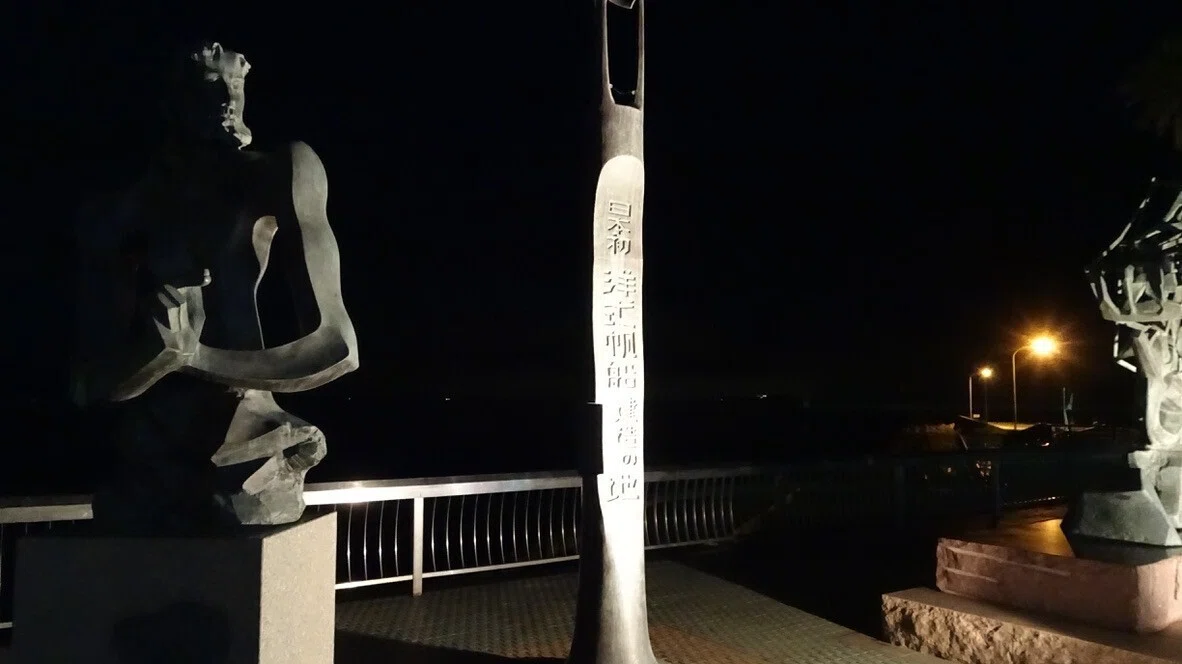
Now, as I was walking along the coast, I found a place called 'Birthplace of Japan's First Western-Style Sailing Ship'.
I never associated Ito with shipbuilding, so what could that mean?

Actually, the birth of Japan's first Western-style sailing ship involved an Englishman who visited Ito.
His name is William Adams.
Also known as Miura Anjin.

So, let's talk a little bit about him, who even ended up as the protagonist of a game in Japan.

William was born in southern England. Although he apprenticed to a master shipwright in his youth, he became more interested in
navigation than shipbuilding.
So, while William learned shipbuilding techniques, he did not become a shipwright, and after finishing his apprenticeship, he joined the navy and participated in the Spanish Armada as captain of a supply ship.
After the war, he worked for a shipping company as a navigator (captain), but one day there was a recruitment for a navigator for a fleet aiming for the Far East, and William applied. (A turning point of fate)
Of the five ships in the fleet aiming for the Far East, William was on the Liefde.
However,the journey of crossing the Strait of Magellan, traversing the Pacific Ocean, and aiming for the Far East of Japan was far too difficult.
Even if they wanted to resupply along the way, the South American continent was under the control of their enemies, Portugal and Spain, and there was resistance from indigenous people, not to mention scurvy and dysentery spreading on the ships—it was a hellish situation.
By the time they finally arrived in Usuki, Japan, the crew of the Liefde had plummeted from 110 to 24 members, and due to various circumstances, the fleet had been reduced to only the Liefde.

As for the timing, it was half a year before the Battle of Sekigahara.
To touch on the game I mentioned earlier, come to think of it, the time William arrived was exquisite; the Sengoku all-stars were mostly still alive, and major battles like the Battle of Sekigahara and the Siege of Osaka were still to come.
Since the start is in Usuki, Kyushu, it is easy to adapt the story to one where he travels around Japan and advances toward the Kinki region, the center of politics.
The Koei game creator who made William the protagonist might have been someone quite knowledgeable about history.
...
Let's return to the story.
It was fine that they arrived in Usuki, but since the Liefde was somewhat armed, their cannons and such were confiscated, and William and his men were detained.
At the time, Toyotomi Hideyoshi had already passed away due to illness, and while they sought instructions from Toyotomi Hideyori, in the end, Tokugawa Ieyasu decided to have the crew escorted to Osaka, and the Liefde was also sailed to the Kanto region.
Incidentally, the Jesuit missionaries who were in Japan at the time advised Ieyasu, saying, "You should execute these Englishmen immediately!! They are pirates!!," and Ieyasu initially thought that a pirate ship had drifted ashore.
However, as a result of William and his men explaining the conflict between Protestants and Catholics clearly, the misunderstanding was resolved.
Ieyasu ignored the opinions of the missionaries who continued to say, "You must execute them!," and invited William to Edo.
William told Ieyasu that he wanted to return home, but he was not allowed to because he was seen as talent that could be used in diplomatic negotiations, and he ended up being used as an interpreter and someone to teach various knowledge.
After that, Ieyasu became busy with the aftermath of the Battle of Sekigahara, and the Liefde, which remained moored in Uraga, sank. (Repairs had not been permitted.)
Upon learning of this, Ieyasu instructed William, "Then build a sailing ship."
Even though he was told to build one, it had been a long time since he had worked as a shipwright, so William naturally refused, but he could not defy Ieyasu's orders, so he built a shipyard in Ito and constructed an 80-ton sailing ship. (Ito finally appeared)
Ieyasu said, "You can build one after all!," and demanded that he build an even larger ship.
William spent three years building a 120-ton ship to answer this.
In recognition of this achievement, Ieyasu granted him a fief in Sagami Province (Hemi, Yokosuka City) and bestowed upon him the name 'Miura Anjin'.
…So, were you able to understand the connection between Ito and William Adams?
And because of this connection, the 'Anjin Festival' is held in Ito in the summer, and the fireworks display at Orange Beach is overflowing with a tremendous number of people every year.
Incidentally, the statue mentioned earlier is modeled after the 120-ton ship 'San Buena Ventura' that Miura Anjin built.

This ship also played an active role as the vessel that transported 300 crew members of the San Francisco—which had sunk off the coast of Chiba Prefecture at the time and whose crew had been rescued by the locals—to Nueva España (present-day Mexico, then a Spanish territory).
As a token of gratitude for this, the clock gifted to Ieyasu by the King of Spain still exists today at Kunozan Toshogu Shrine.
Well, since it was different from the Japanese calendar, it wasn't used as a clock, but that actually turned out to be a good thing.
Preserved as a sacred treasure even after Ieyasu passed away, this clock went 400 years without being moved much, becoming a timepiece that retains its original 16th-century parts almost completely intact.
There seem to be other interesting behind-the-scenes stories, so if you are interested, I also recommend the following PDF.
[Mechanism and Origin of the 1581 Hans de Evalo Table Clock Preserved at Kunozan Toshogu Shrine]
https://www.kahaku.go.jp/research/publication/sci_engineer/download/39/L_BNMNS_E39_1.pdf

My, my, I was able to gain some wonderful knowledge through my late-night wandering.
I thought that hiring a foreigner was something only Nobunaga did with Yasuke, but Ieyasu also borrowed the power of a foreigner named William Adams.
Incidentally, it is typical of Ieyasu's shrewdness that after building the 120-ton large ship, he banned the construction of large ships by the daimyo of western Japan. (To monopolize trade profits)
In any case, the land of Ito has deepened its charm for me once again.
Where shall I go tomorrow?
To be continued...!
いいなと思ったら応援しよう!
 サポートには感謝のコメントをお返しします!