
My Literary Flea Market Report @ Kyoto: Spending Until I Had Only 500 Yen Left

I accept the pamphlet handed to me by the woman standing next to me, who says, 'Please pass this on.' Having heard rumors of the success in Tokyo, I arrived at Miyako Messe 30 minutes before the doors opened, but a queue four people wide had already begun to form. I am overwhelmed by an enthusiasm that exceeds my imagination.
The Literary Flea Market, or 'Bun-Furi,' is an event where creators of novels, essays, poetry, and more gather to sell their work themselves. It features not only books distributed by major bookstores but also many items produced by individuals.
I myself had been aiming to have a booth at this event and had been working on several projects in parallel for a year, but none of them were finished in time. I decided to participate as a customer, if only to scout the location for next year.
I flip through the pamphlet I received. The exhibitor names are listed in tiny print across the entire spread, and it makes me feel dizzy. Since I had intended to be on the creator side, I had come without doing any research. Even if the doors opened, where should I go? While I was thinking this, the line grew longer and longer. There was no one else in a state of collapse like me; everyone looked like they knew what they were doing. I imagined being pushed and swept away by the crowd, unable to even catch a glimpse of a book cover, let alone buy anything, before being spat out of the gate. I felt like I wanted to go home before it even started. I felt disgusted with myself for thinking that, which only made me feel more depressed.
'Excuse me, do you come to events like this often?'
I try speaking to the woman next to me who had kindly given me the pamphlet earlier. She answers with a smile, 'It's my first time,' and after we share our surprise at the crowd, I feel calmer. Looking at the exhibitor list and the venue map again, I realize that booths are grouped by the genre of works they handle. This time, I decide to focus on essays and poetry.
We start moving forward slowly, and I wish her luck, saying, 'I hope you find the books you're looking for!' Now, into the hall.

First, I head to the booth of my acquaintance, the publisher Hokahi Shobo. I am a fan of hoka books, a bookstore run by the editor Mr. Shimada, and we are friends who have collaborated on a ZINE after I failed at being in a band.

I bought the second and third volumes of 'Tayasanai,' which I hadn't been able to get yet. It is a collection of essays where people who create and express things—not limited to the publishing industry—write about the history of their activities and their current situations, searching for hints on how to keep going. The covers, which change atmosphere completely with every issue, are cut and wrapped by Mr. Shimada himself. Beyond the content, I am captivated by the quiet passion with which he carefully nurtures and continues to publish them.
Having avoided the worst-case scenario of leaving without buying anything, I am relieved and walking around when I discover the booth of pha, author of 'Shinakoto Risuto' (The Not-To-Do List). I tell him that I had visited Kani Books, where he works as a staff member, when I visited Tokyo, and we talked about our favorite poets. While I was also drawn to 'Oyasumi Tanka,' I chose 'Tanka Gojusshu: Sukoshi Dake Tooku no Mise e' (Fifty Tanka: To a Shop a Little Further Away) because I wanted to buy a book without an ISBN code this time.

'I'll sign it for you!' he says, adding a loose, cute illustration and my name, which makes me soar.
Although I was worried that I wouldn't have the luxury of stopping in the crowd, choosing to go from the first thing in the morning until lunchtime paid off, and I was able to browse relatively leisurely. Talking to the creators was also fun, and before I knew it, I was stopping every three steps and opening my wallet as cheerfully as I was opening my mouth.
My eyes were caught by the leather-like cover of Akari Hoshino's poetry collection, "Stars Shine Because They Are Stars."
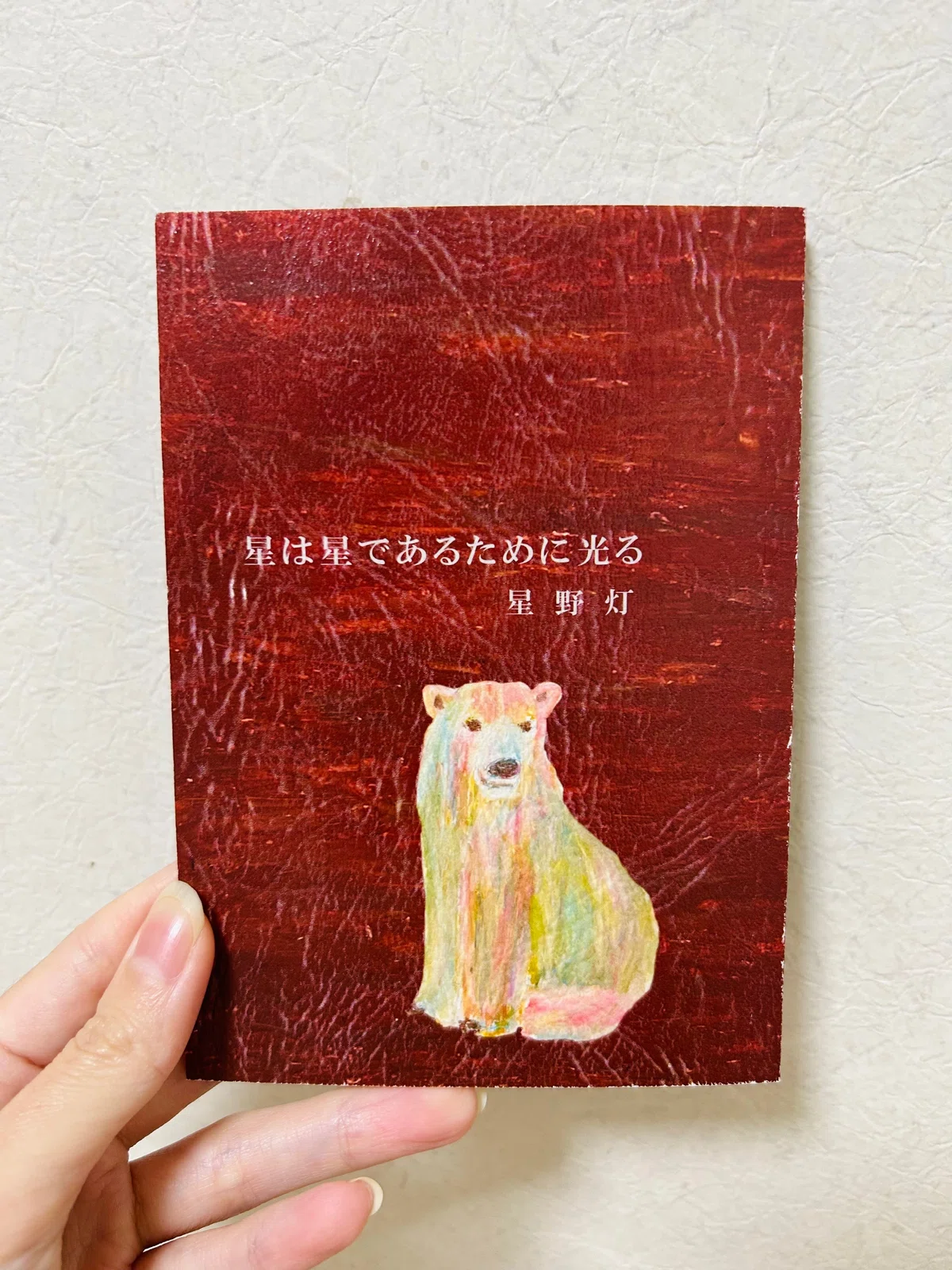
I was captivated by the 'one-of-a-kind in the world' feel, where each copy has different textures and irregularities, and I chose one that I intuitively liked from the stack at the booth. The sensation of my fingertips touching it while reading is also lovely. I am savoring it little by little, starting from the pages that drew me in.
I ended up wanting "Goodnight Tanka" (Koichi Masuno, pha, Fumika Sato), so I bought it at the Mishosha booth. With the theme of 'reading before sleep,' the three authors selected tanka poems and added their own thoughts and commentary. The rounded corners really tickle the heart of a book lover.

I also picked up "Respond, From Outside Kyoto Vol. 1." 'I really have to sell this one today. We can break even with 100 copies,' they said, candidly revealing their expense situation. The question of how many copies to print is a current worry of mine, so it doesn't feel like someone else's problem... Mishosha's books have a vividness that catches the eye at the storefront, while also having a color scheme that you never tire of even if you keep it on hand forever.
I got Jako Tani's "Hit and Parade" and "Hanshin Tigers, Thank You So Much!! ZINE," both of which I had stopped to look at every time they appeared on my timeline.

I was already head over heels for the covers and titles, but many of the poems have a momentum and pleasantness that make even small frustrations and anger fly away with a sense of humor, making me want to read more and more as I savor them.
Takuya Awano is also one of the poets I had been curious about.

"100 Days, 100 Poems" is a record of 100 days of diary entries and tanka. Being able to peek a little into the background of the works is a joy for a beginner like me, who likes reading tanka but isn't confident if I'm enjoying them properly. Of course, buying a poetry collection is probably best for both the creator and the reader, but being able to choose to experience it first at an affordable price is one of the charms of the Literary Flea Market.
"Karma Tsushin.zip()" (Ki Mizusawa, Utako Koto) was handed to me sandwiched in a clear file and clipped shut.

I thought, 'How thoughtful...' but when I got home and read the back cover carefully, I realized they were using the clear file to represent a zip file. The idea of removing the clip to 'unzip' it is quite clever. It's an exchange of poems and tanka born from two cities, Fukuoka and Kyoto. It's full-color on every page, so you can really enjoy the photos as well.
Mono Homie's "Mono Homie Line Art Collection 1".

I had often seen their cute illustrations in bookstores and on social media, so I was happy to be able to pick these up. Regarding the manga "A Little Story About Food," the author mentioned, "It's a story about food, but people don't really say it looks delicious..." which actually made me even more curious. It's true that it features ingredients and combinations I'm not familiar with, but it's fun to read while letting my imagination run wild and sharpening my sense of taste as much as possible.
I had been curious about "Reshipi 2" (Recipe/Poetry 2) after seeing it on Ryusuke Ushi's X account. It seems Akira Obata drew the illustrations based on Sakurako Shimada's poems, tanka, and recipes. There were other menu items, but I chose the strawberry tart, my absolute favorite, without hesitation.

Sakurako Shimada's words, which break down the boundaries between recipes and poetry, combined with Akira Obata's illustrations full of happiness. The sound of a rubber spatula cutting through dough and the sweet and sour scent of strawberries seem to reach me.
I started drinking hot water at the end of last year. I couldn't help but stop when I saw the words in Hiroko Nanbu's "Hot Water Newsletter."

Since she came all the way from Hokkaido, I asked her for some authentic (?) tips on staying warm, and I bought the first and third issues of the renewed newsletter. "The important thing is to keep doing it even when it gets warmer," she advised me as I was leaving, which gave me a start. She saw right through me—I drink it ice-cold in the summer!
I had to pick up Masaki's "Where Did Your Career Start? Mine Started with Getting Fired" because of the shocking opening line: "Fired two months after joining the company."

When I confessed, "I've also changed jobs a lot..." she flipped open the cover of the book and held it out, asking, "Something like this?" The first page was an introduction to her work history. Some jobs lasted less than a year from start to finish, and she went from non-regular to regular employment—wow, it's so similar to my own experience. We parted ways after promising each other, "Let's do our best to survive."
My mission for the day was to "buy a book about alcohol and go home." And so, I encountered "Sanshu Sanyo" (Shiori Asanuma, Guriko Saotome, Maiko Takehana).

An anthology by three writers who love alcohol. It also includes essays where each of them depicts the same day they spent drinking together from their own perspectives. It already sounds like fun. Lately, I've been sticking exclusively to Saizeriya, but I was floored by Guriko Saotome's next-level episode of "I was drinking at Saizeriya from New Year's Day." I shared her love and bittersweet feelings for spicy chicken, and my passion for Saizeriya has grown even more, but it might be nice to use this book as a primer and head out to explore some new places for a change.
When asked, "Do you like freedom?" I was intrigued by "Jiyu Nigate" (Bad at Freedom) by Shinjitsu no Hotate.

I'm always seeking it, but when I finally get it, I don't know what to do with it. Things that were once fun turn into "things I have to do." I end up restricting the freedom I worked so hard to get. When the author told me, "It felt like that when I was making this book too," I felt a sense of empathy and picked it up, thinking I should take some time to reflect on it myself.
I discovered "Tenshoku Bakkari Umaku Naru" (I Just Get Better at Changing Jobs), which I had on my wishlist! I felt a sense of sympathy and interest because we are the same age, she has experience as a bookstore clerk, and she has changed jobs more often than those around her.

To my surprise, the author, Megumi Hirai, was at the booth, so I had her sign my copy. I was so nervous that I made the blunder of forgetting how many times I had changed jobs myself, but I was moved by the connections made at the Literary Flea Market...!
The last thing I bought was "Man ni Hitotsu" by Man-ichi Yoshimura.

I had read Yoshimura's writing before, but I picked this up after Ayumi Nakamura, who edited it, recommended it to me, saying, "I also like the photos." Within the scenery of everyday life, there is something that stirs the heart. I haven't developed a keen enough eye to critique it, but I want to read it while carefully exploring what that something is.
I was so absorbed in choosing books that by the time I had gone through half the venue, I only had 500 yen left. In exchange for my empty wallet, the bag I received at the entrance was stuffed full. It's as if I never said I wanted to go home before the doors even opened.
I have some regrets, but there is nothing I can do, so I head outside. As the biting cold wind of Kyoto hits my cheeks, I realize the fatigue that has piled up beneath my sense of satisfaction.
It seems that buying books is surprisingly tiring. Everywhere I look, there are words, words, and more words. The sheer volume of information forced upon me makes my head feel fuzzy, and there were moments when I felt like I might just stand still. Books are things that are inevitably filled with conviction. That "strength" is more vivid than I am consciously aware of. Nevertheless, there is a fear that you won't know what a book is about unless you buy and read it. Even I, who used to work at a bookstore, feel that way.
What loosens that tension in my heart is conversation. I feel relieved when someone explains the content concisely, and when it comes across that the creator themselves is enjoying it, the pressure on the listener's side also eases.
If I were to open a booth next year, as someone who only operates on note, I would probably be seen by almost everyone as "Who is this person?" It might be important to hold back a little of the shyness I've cultivated over the years, as well as the enthusiasm I wanted to deliver by spending time and money, and instead have the composure to enjoy the encounters that come before me.
Another thing that left an impression on me was the last-minute resourcefulness of the creators who said things like, "It just arrived yesterday!" or "I didn't have a new book, so I made one in a rush!" While it's one thing that I couldn't finish a project I started a year ago, I keenly feel the lukewarm nature of my own lack of action. It seems necessary to categorize the projects I'm nurturing into those that require time and those that can be finished on a whim.
As a creator, I may have gained more than the money I spent. To make sure I don't lose anything, I adjust the weight of the bags on my arms and pass through the great torii gate under the clear sky.

いいなと思ったら応援しよう!
 頂いたサポートは書籍代に充てさせていただき、今後の発信で還元いたします。