
Ryohei Noguchi 'Biographies of Bakumatsu Figures: Expelling Barbarians and Opening the Country' Episode 2: Hikokuro Takayama (9)

← Continued from (8)
← Back to the magazine top for 'Biographies of Bakumatsu Figures: Expelling Barbarians and Opening the Country' by Ryohei Noguchi
9
Hikokuro, who entered the capital at the end of that year, discussed strategies for the Imperial Court to regain political power with like-minded individuals while staying with old acquaintances such as the merchant Hikokuro and the court noble Hikotaro Omura (Shirokiya) and Tomokazu Iwakura (1754-1823) while staying with them, and discussed strategies for the Imperial Court to regain political power with like-minded individuals (Kansei Kyoto Diary).
The Great Tenmei Famine was also shaking Kyoto. In June of the 7th year of Tenmei (1787), people gathered at the Imperial Palace one after another from the city and various parts of the Kinai region, praying to the Emperor for relief from the famine and a good harvest. The
Imperial Palace Thousand-Time Pilgrimage, which is said to have reached a peak of 70,000 people per day, was a political action disguised as a festival and an event that signaled the decline of the Shogunate's authority (two years before the French Revolution, which was caused by the cooling of the Northern Hemisphere).
In response to this, under the leadership of the young Emperor Kokaku (1771-1840), who possessed a strong sense of legitimacy, the Imperial Court requested famine relief measures from the Shogunate. The Imperial Court's intervention in Shogunate politics was unprecedented.
Hikokuro and his associates focused their interest on the Imperial Title Incident. The Emperor's biological father, Prince Kan'in-no-miya Sukehito, was, according to the Laws for the Court and Nobility established by the Shogunate, considered to have a lower status than the Five Regent Houses and the Minister Houses (see Editor's Note: 'Court Nobility Ranks').
The Emperor requested that his father be granted the title of Retired Emperor, citing precedents, but the Senior Councilor Sadanobu Matsudaira (1759-1829) rejected this.
Consequently, the Imperial Court strongly pressed for the realization of the title proclamation, and relations between the Court and the Shogunate reached a critical juncture.
Imperial Title Incident One example of Hikokuro's involvement in the was his association with Hironori Kakizaki (1764-1826), a senior retainer of the Matsumae Domain. Kakizaki was the younger brother of the domain lord Michihiro, and was also a painter known as Hakyō
. At that very moment, Shogun Tokugawa Ienari wished to grant his biological father, Harusada Hitotsubashi, the title of 'Ogosho'
. Sadanobu Matsudaira
had previously obtained immense backing from Harusada, who held hidden influence, when he ousted the former Senior Councilor Okitsugu Tanuma to become the head of the Senior Councilors, but he was wary of Harusada's expanding power and political intervention, and opposed the granting of the title. Hikokuro
seems to have approached Kakizaki, viewing Michihiro as being on the side of Harusada, who was in conflict with Sadanobu, in hopes of gaining lateral support. Kakizaki told Hikokuro that he had painted portraits of the 12 Ainu chieftains who had submitted to the domain after the Battle of Kunashiri-Menashi (the 'Ishu Retsuzō'), and showed him the preface. The preface articulated the political intent behind the creation of the portraits, which was to justify the pacification of the Ainu and check the Shogunate's intervention in the governance of Ezo.
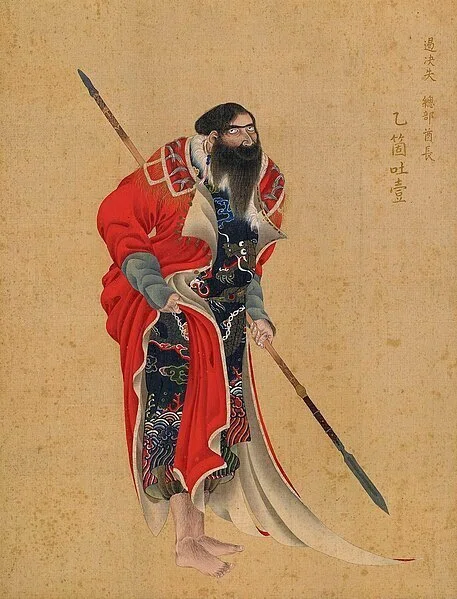
Ikotoy: Otona of Akkeshi
Source/Photographer http://memoirevive.besancon.fr/ark:/48565/a011464266742S0yq4g

Mautarake: Sō-otona of Urayasubetsu
There is no evidence that Hikokuro saw through that intent.
What is certain is that when Hikokuro begged Kakizaki for permission to cross to Ezo, Kakizaki immediately refused.
The fact that Hikokuro later saw the actual portraits and contributed to their presentation to the Emperor also seems to have involved some maneuvering, but looking at Kakizaki's subsequent response, it appears that it was Hikokuro who was being used.
..........
→ Continue to Hikokuro Takayama (10)
← Return to Hikokuro Takayama (8)
← Return to Hikokuro Takayama (1)(Author profile included)
→ To the top of the 'Biographies of Bakumatsu Figures' magazine by Ryohei Noguchi
← General Table of Contents for 'Biographies of Bakumatsu Figures' by Ryohei Noguchi
※ Header image: Kyoto Imperial Palace (photographed by the author)
.............................
◆ Click here for references ↓
.............................
◆ Regarding Copyright, etc.
・The copyright for all text belongs to the author (Mr. Ryohei Noguchi) (and the publishing rights belong to Keikosha Editorial Studio).
・Please refrain from reprinting or diverting photos and images marked with * (photographed by the author) or ** in the captions. Images without these marks are in the public domain.
(The image of Mautarake (麻烏太蠟潔) also had the photographer's information address attached, but since a 'connection dangerous' warning appeared when clicked, it was not included).
・Please notify Keikosha regarding the reprinting or citation of maps and genealogical charts (please include the source).
・Sharing, linking, and introducing the entire article is very much appreciated!! Thank you very much!!
(Editor)