
Koji Hayashi 'Biographies of Zainichi Korean Writers' 06 Ko Sam-myong (Part 1)

→Magazine: Koji Hayashi 'Biographies of Zainichi Korean Writers' Top
→Koji Hayashi 'Biographies of Zainichi Korean Writers' General Table of Contents
Ko Sam-myong—
Violence, Love, and Literature
—Living as a 'Pan-choppari' (Part 1)

(from left to right next to him, Soki I, Kim Sok-pom, and Ko Sun-il)
|Many people who know Ko Sam-myong probably know him as the author of 'The Meaning of Living'. And perhaps some may know him as the father who edited the poetry collection by Masashi Oka, 'I Am 12 Years Old'. Or perhaps there are those who think of him as a religious figure who preaches the teachings of Shinran.
Ko Sam-myong was a second-generation Zainichi Korean who walked a path of hardship as an underground activist for the Japan Communist Party after the war, and he made his debut as a writer with 'When the Night Darkens the Footsteps of Time', which was written using that experience as source material.
1) Born as a second-generation Zainichi
Ko Sam-myong's real name is |Kim Chon-sam.
He was born in Shimonoseki, Yamaguchi Prefecture, in January 1932. He was born as the second son of his father, |Kim Son-jin, and his mother, |Bae Gyeong-sun. Both parents were coal stevedores working at a coal storage yard. He had an older brother, |Chun-myong, who was three years his senior.
His mother died shortly after giving birth to a younger brother when Chon-sam was three years old. The younger brother was given up for adoption.
Chon-sam was born 12 years after the 'Japan-Korea Annexation.'
In Korea, a land survey project was carried out at the same time as the annexation, and modern land ownership was established. Because of this, government-owned land, village communal land, and land without landlords were confiscated as state-owned land. Farmers who had been deprived of their land became displaced people.
In that year, there were about 400,000 Koreans living in Japan.
Chon-sam grew up in a Korean village located in Enoura-cho, Hikoshima, Shimonoseki City. It was a row house without windows on the side of the coal storage yard.
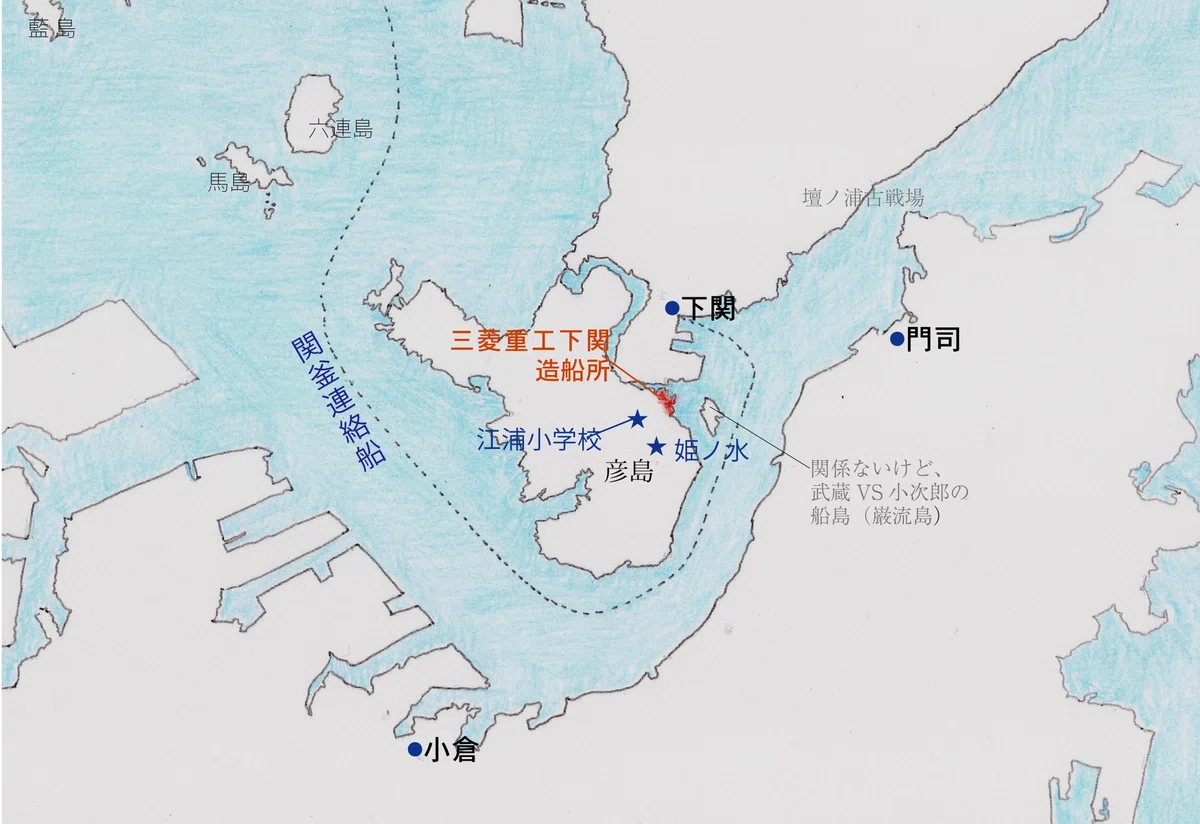
(The topography is modern)
The era was one of war. On July 7, 1937, the Marco Polo Bridge Incident occurred, and the Second Sino-Japanese War broke out.
The following year, Chon-sam entered Enoura Elementary School in Hikoshima, Shimonoseki City.
His brother wrote 'Kinoshita Takeo' on his name tag.
His classmates were wearing new clothes and were accompanied by their mothers. Only Chon-sam wore his brother's hand-me-downs and wooden clogs.
Because the straps of the clogs would break easily, his father used wire as straps, which caused the skin on the insteps of his feet and between his toes to peel off. Even when they bled, he kept wearing them, and the scars turned into calluses. The soles wore down until they became thin boards, and he wore them until they split.
His brother was an honor student, but Chon-sam lost his confidence and became a troublemaker. Because of this, he was a boy who frequently clashed with his strict father, wandered the streets at night, and was doted on by the local prostitutes.
→To Ko Sam-myong (Part 2) Continued
→Magazine: Koji Hayashi 'Biographies of Zainichi Korean Writers' Top
→Koji Hayashi 'Biographies of Zainichi Korean Writers' General Table of Contents
..............................
◆ Bibliography
◆ Author Profile
Koji Hayashi (Hayashi Koji)
Literary critic. Born in Saitama Prefecture in 1956. Former member of the Shin Nihon Bungakukai (New Japan Literary Society).
His latest book, 'Zainichi Korean Literature: Beyond the Literature of Antithesis' (Shinkansha, published November 2019), has been featured in media such as the Tosho Shimbun and has been well received.
Other works include 'On Zainichi Korean Japanese Literature' (1991, Shinkansha), 'On Post-war Non-Japanese Literature' (1997, ibid.), and 'Mani Mani' (2001, Shin Nihon Bungakukai Publishing Department).
In addition, he has written numerous papers.
The 'Gugin Blog' he has been keeping since 2011 http://kghayashi.cocolog-nifty.com/blog/ is a treasure trove! (Editorial Department)
..................................................
* The copyright of the main text belongs to the author (Mr. Koji Hayashi), and the publishing rights belong to Keikosha.
* Photo: Taken by the author