
Strength Training Vol. 3: Setting Load and Repetitions

This time, I would like to write about "setting the load and repetitions for strength training."
Continuing from last time, this is another strength training topic.
Thank you for your support.
■ Regarding strength training load and repetitions
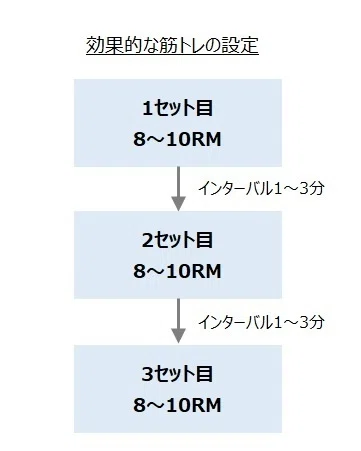
For those aiming for muscle hypertrophy or increased strength, it is effective to perform 3 sets with a load that reaches failure at 8–10 repetitions (8-10RM).
*RM:
Repetition Maximum, the maximum number of consecutive repetitions possible in strength training (repetition maximum)
If you can increase the total load volume by training to exhaustion, it is possible to maximize muscle hypertrophy regardless of the weight, gender, or body part.
Total load volume is expressed by the following formula:
Total load volume = Load (weight) × Repetitions × Number of sets
For example, if you do 3 sets of 10 repetitions of a 50kg bench press, the total load volume is 1500kg.
Recent research has shown that
there is no significant difference in muscle hypertrophy if the total load volume is the same for low and high weights
.
In other words, even with low weights, if you increase the number of repetitions to match the total load volume of high weights, you can achieve the same muscle hypertrophy effects.
*Low weight: Weight that reaches failure at 20 repetitions
*High weight: Weight that reaches failure at 8 repetitions
However, it is important to note that it is difficult to increase strength with low weights.
For those who want to increase strength and shorten training time, I recommend 10 repetitions × 3 sets!
Personally, I think what is more important than weight is
form and speed of movement.
No matter how heavy the weight you are handling, if your form or speed of movement is not correct, you will not stimulate the muscles.
It is a common occurrence among men to try to show off by challenging heavy weights, but I often see people doing ineffective training because their movements are too fast or their range of motion is too small.
High weights increase the risk of injury, so solidify your form before challenging yourself with a weight that suits you.
■ Regarding intervals between sets

Keeping the interval (rest) between sets to about 1–3 minutes is effective for muscle hypertrophy.
Short intervals increase the accumulation of anaerobic metabolites and hormonal responses that promote muscle hypertrophy.
However, for exercises with high training volume (such as squats or deadlifts), it is okay to take longer intervals of 3 minutes or more, as fatigue can easily lower training intensity in the next set.
I think it is important to use the time between sets to regulate your breathing and increase your concentration for the next set, rather than touching your smartphone.
■ Relationship between load intensity, RM, and strength training effects

That is all for this time.
Thank you for reading until the end.