
Crowds and Calm 《Animé et Calme》 #71st 2400 Years After the Proposal of 'Socratic Ignorance'

Dunning–Kruger effect

David Dunning (left) &
his student Justin Kruger
A cognitive bias in which people with limited ability in a specific field overestimate their own ability
One of the manifested human behaviors explained by the social psychology unit

② Although the excitement fades as learning progresses,
③ Learning forms layers, leading to a black belt level of mastery
Gaining positive learning 🎶
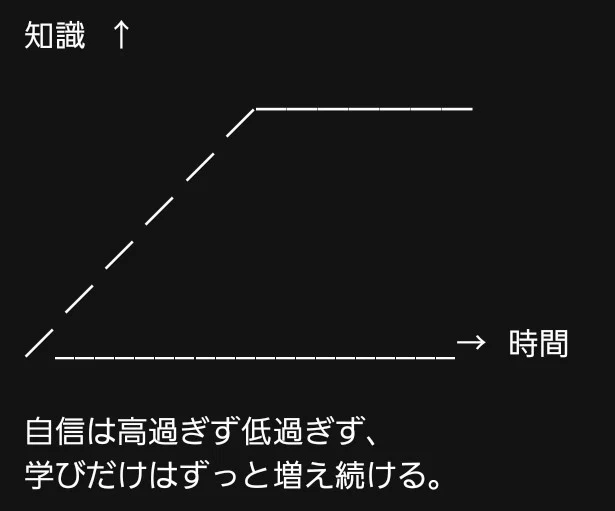
With moderate confidence, over the passage of time,
it is wonderful that learning continues to increase 🔔

Here, I am reminded of 'Socratic ignorance,' the idea of the great Western philosopher Socrates

c. 469 BC - c. 399 BC
Socratic ignorance 【Latin: ipse se nihil scire id unum sciat】
The stance of 'I know that I know nothing' is the position of Socrates
⛔ There is a limit to human knowledge
∴ Continue to be aware of what you do not know
Plato's 'Apology of Socrates' ⤵️
Socrates' friend Chaerephon asked the priestess of Apollo at the Oracle of Delphi, 'Is there anyone wiser than Socrates?'... The oracle replied, 'No one,' and there...
1️⃣ Socrates wanted to understand the meaning of this oracle, so he visited and spoke with politicians, poets, and craftsmen who were reputed to be wise
2️⃣ As a result, they had specialized knowledge, but they were just under the impression that they knew about other things as well
3️⃣ In short, they did not know that they did not know
4️⃣ If Socrates had any wisdom, it was only that he knew what he did not know
5️⃣ In other words, he knew only in the sense that he was aware of his own ignorance
6️⃣ True wisdom lies in the attitude of being aware of one's own ignorance and continuing to question
7️⃣ The philosophy that became the source of epistemology, which rejects the assertion of dogmatic knowledge and values critical examination, is 'Socratic ignorance'

8️⃣ He was accused of the charge of 'not recognizing the gods recognized by the state, introducing new daimonia (divine signs, inner voices), and corrupting the youth'
9️⃣ At his trial, Socrates proudly defended his philosophical mission, but was found guilty by a vote of 501 jurors ➡️ sentenced to death... Did cognitive bias occur during the jury deliberation?
🔟 His friends and students urged him to escape from prison, but he refused, explained the legitimacy of following the law, and died after drinking hemlock (koneion)
A little over 2400 years have passed since that tragic event
A summer where I acknowledge that the opposing axis of 'Socratic ignorance' is still cognitive bias