
"Train the Brain": Combining exercise and cognition to improve cognitive function

📖 Literature Information and Abstract Translation
Long-term beneficial impact of the randomised trial 'Train the Brain', a motor/cognitive intervention in mild cognitive impairment people: effects at the 14-month follow-up.
📕Sale, Alessandro, et al. "Long-term beneficial impact of the randomised trial ‘Train the Brain’, a motor/cognitive intervention in mild cognitive impairment people: effects at the 14-month follow-up." Age and Ageing 52.5 (2023): afad067. https://doi.org/10.1093/ageing/afad067
🔗 DOI, PubMed, Google Scholar 🌲MORE⤴ >>> Connected Papers
※ What is Connected Papers? >>> note.
🔑 Key points
🔹The beneficial impact of the Train the Brain intervention on cognitive function was maintained at the 14-month follow-up.
🔹The effect was greater in individuals with lower education levels compared to those with higher education levels.
🔹The beneficial effect was more pronounced in women than in men.
[Background/Objective] Currently, there are few reported treatments for elderly individuals with mild cognitive impairment (MCI) that can overcome cognitive impairment and delay progression to dementia.
[Methods/Results] 113 individuals were enrolled and randomly assigned to the intervention: MCI training group (n=55) and MCI no-training group (n=58). The "Train the Brain" program is an intervention combining exercise and cognition, and it was previously shown to significantly improve cognitive function in MCI patients compared to untrained MCI controls when evaluated at the end of the 7-month intervention.
✅ "Train the Brain" program: Combined physical and cognitive training
・Enrolled participants were assigned to mixed-gender classes of up to 10 people to promote social interaction, and performed 60 minutes of supervised cognitive training 3 times a week and 60 minutes of supervised aerobic physical activity 3 times a week for 7 months.
■ General effects of "Train the Brain"
The significant benefit of training on ADAS-Cog scores became evident at T7 and was confirmed at the T14 follow-up.
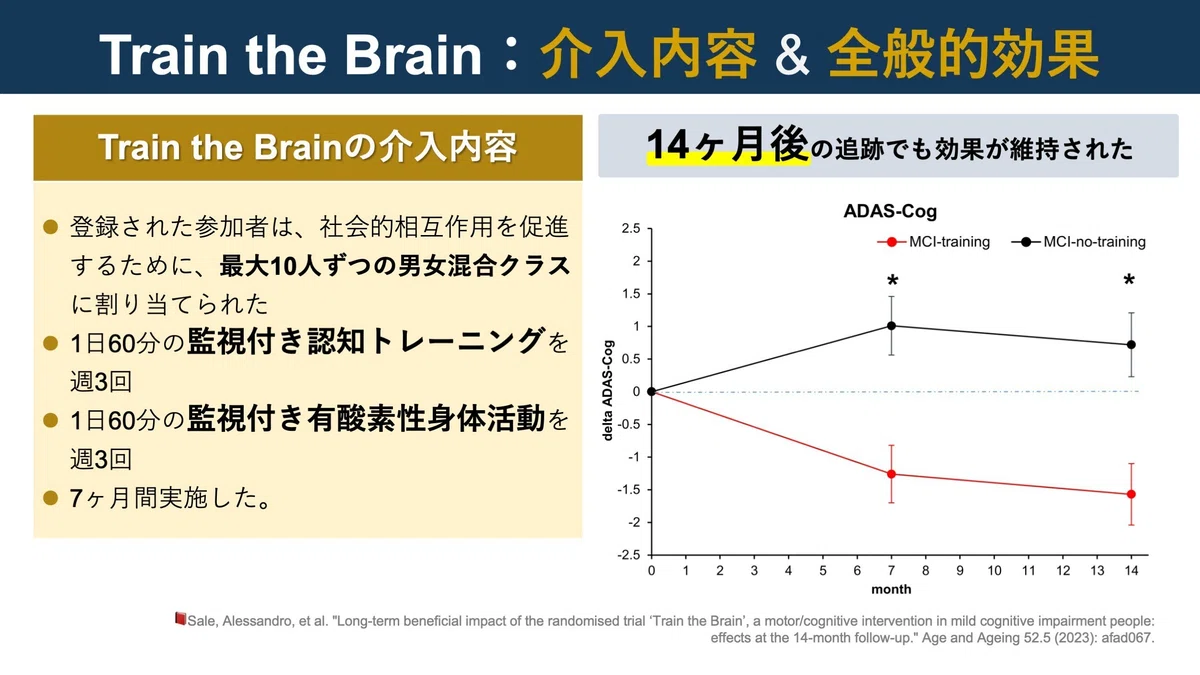
Here, we extended the previous analysis to include the long-term effects of the intervention and aggregated data by gender, education, and age of the enrolled participants.
■ Education and the effects of the "Train the Brain" program
・In a mixed-effects model examining changes in ADAS-Cog scores over time, the interaction between group × time and dichotomized education showed borderline significance (P = 0.0764).
・Training results were significant at both time points for both the high-education training group and the low-education training group, but were more pronounced in those with lower education (Figure b) than in those with higher education (Figure a).

■ Gender and the effects of the "Train the Brain" program
・Women (n=55, 48.7%) had significantly lower CDT scores than men at the screening stage (7.3 (SE = 0.3) vs 8.2 (SE = 0.2); P = 0.0354), but no significant differences were detected in MMSE and CDR.
・The interaction between group × time and gender was not statistically significant (P = 0.2710).
・However, the training results on ADAS-Cog scores appeared to be more pronounced in women (Figures a and b).

[Conclusion] The beneficial impact on cognitive function was maintained at the 14-month follow-up, with greater effects observed in individuals with lower education compared to those with higher education, and in women compared to men.
🌱 So What?: What did I find interesting?
"Cognicise" is a term that exists.
✅ Background knowledge: What is Cognicise?
・Cognicise is a coined term representing a general initiative aimed at dementia prevention, developed by the National Center for Geriatrics and Gerontology, which combines exercise and cognitive tasks (calculations, word chain games, etc.).
・It is called "cognicise" by combining the English words "cognition" and "exercise".
・It advocates for the necessity of incorporating exercise into dementia prevention.
・In this study, it is referred to as multi-component non-pharmacological interventions (MNPI) (there are cases where cognitive and exercise tasks are performed simultaneously, and cases where they exist independently within the same session, but we will proceed with the discussion without distinguishing between the two here).
・Figure: Conceptual diagram of how cognicise enhances cognitive function. Physical intervention strengthens the hardware, and cognitive intervention strengthens the software (Figure created by the abstract reader).

This intervention is exactly cognicise.
Personally, I think "cognicise" is a better name than "Train the Brain".
It fits into one word, and above all, it has strong impact and originality.
In this study, it was shown that cognicise not only maintains but improves cognitive function in MCI patients, and it was further revealed that it is more powerful for those with lower education and women.
It is becoming increasingly concrete.
⬇︎ Related note✨
○●━━━━━━━━━━━・・・‥ ‥ ‥ ‥
High-quality rehabilitation medicine-related English paper reading "ARI"
From here♪
↓↓↓

‥ ‥ ‥ ‥・・・━━━━━━━━━━━●○
#️⃣ #PhysicalTherapy #ClinicalResearch #Research #Rehabilitation #EnglishPaper #LiteratureReview #EnglishLiteratureReview #Evidence #Science #DailyUpdate #RecentLearning