
Thoughts on the Final Chapter of the Manga 'This Communication'

*Contains spoilers
Nice to meet you.
Are you familiar with the work called 'This Communication'?
Although 'This Com' recently reached its conclusion, for me, this was a manga that left me unable to sleep at night due to the shock of finishing it.
In particular, the way the final chapter was wrapped up was truly the best possible form, and I think it utilized the prepared settings and characters to their maximum potential to hit a limit value.
It has been a long time since a work has struck me this deeply, and I couldn't suppress the urge to create an account and shout about it on note.
Honestly, I am aware that I have a somewhat unique way of reading it, and there are parts that are 'impressions based on not fully understanding the story,' so I would appreciate it if you could read this with the feeling of 'Oh, there are opinions like this too.'
Synopsis of the final chapter of 'This Communication'
*The following contains complete spoilers for the final chapter
I wanted to use spoiler tags, but I didn't know how to do it on note... If anyone knows how, please let me know.
Due to a spatial annihilation that occurred during the battle with the Iperit, the six Huntresses went missing.
Deluha, judging that it was impossible for the Huntresses who had been taken into another dimension to return, gave up on the 'research facility where food production had become impossible' and decided to raid it.
He killed everyone in the facility, including the director, seized 14 days' worth of stockpiles—which amounted to 7.7 years' worth of food for one person, Deluha—and began building a new base that would be his final home.
Eight years later, having continued to eat three meals a day all by himself, Deluha finished the last of the food and committed suicide by slitting his own throat with an axe, exactly as he had done once before.
At that moment, the Huntresses, who had returned from the other dimension, discovered the fallen Deluha, but it was already too late.
Realizing that Deluha could no longer be saved, the Huntresses asked him at the very end if he had loved them.
Deluha, who had already lost consciousness from massive blood loss, did not understand what they were saying and reflexively squeezed their hands back in response to their voices.
However, the Huntresses 'misunderstood' the strength transmitted from the squeezed hand as affirmation, and they flew off, using the non-existent 'love from Deluha' as their emotional support.
And ten years later, the world was saved by them, who had continued to fight.
Deluha's abnormality
Initially, I thought it was appropriate to characterize Deluha as a person who simply pushed rationalism to the extreme, often seen (especially in the early stages of the serialization) as 'normal except for his bad habit of killing allies' and 'someone who has common sense and ethics, but will kill without hesitation if the benefits of murder outweigh them.'
However, Deluha's killing of allies was just the surface, and what was truly abnormal was
the complete absence of universally human desires such as 'wanting to live as long as there is life,' 'wanting to leave proof that I lived,' and 'not wanting to lose connections with others'
'that for Deluha, the only important thing was eating three meals a day; food was neither a goal nor a means, but life itself'
I was finally able to understand that these two points were the case because Deluha committed suicide at the end.
Regarding the former desire, it is more of a rule, instinct, or habit for humanity to prosper than a desire, and even in fiction, I think one reads with the premise that characters possess these desires unless otherwise mentioned.
If a character says, 'I don't have such things,' I interpret it as 'a guy who seems to have serious repression has appeared' or 'maybe he's not human' and continue reading.
Regarding the latter obsession with three meals a day, I only recognized it as 'being a glutton.'
When the Hitotsuki that had taken in Deluha's brain died in despair at not feeling hunger, if Deluha were merely a rationalist, he should have thought, 'I have overcome starvation,' but that was not the case.
Reading it back calmly, that is a scene that expresses Deluha's abnormality, but I took it as a gag and, along with the Huntresses, retorted, 'How much do you love to eat!'
Certainly, if you read the descriptions in the work accurately, you can only read it as 'Deluha is that kind of person,' but
wouldn't you normally not think that the protagonist is seriously that kind of person...?
If this were a normal protagonist, the direction in the final chapter would be 'to cut back on daily meals, prolong life for even one more day, and search for survivors or safe zones.'
They might even bet on the possibility that the Huntresses would miraculously return.
But Deluha eats three meals a day precisely, and when that becomes impossible, he commits suicide easily before starving.
He's less of a human and more of a devil you can contract with for three meals a day.... It was hinted at from the beginning, but especially as we approached the final chapter, the word "rationality" was given rubi (furigana) like "instinct" or "madness," which I think emphasized that Deluo is a being living by different rules than humans.
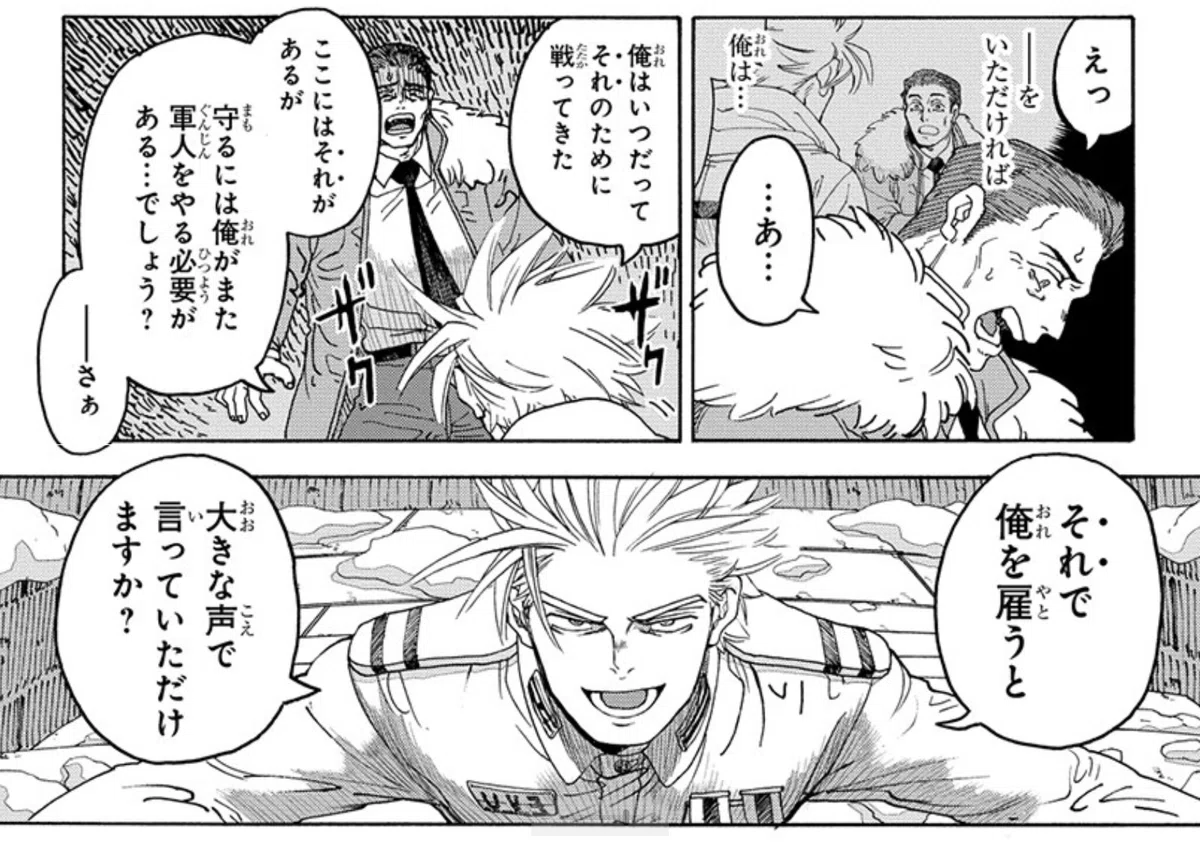
His reality is that of a devil,
his role is that of a devil,
he sometimes calls himself a devil,
and almost every character in the story has called him a devil at least once.
Is this guy really human?
Sometimes Deluo's actions make more sense if you think "because he's a devil" rather than "because it's rational"....
The only time I felt Deluo was human-like while re-reading was the scene where he gives Yoshinaga time to pray.
Deluo is relatively flexible when he has the leeway, but in the end, that's just to boost the morale of his allies, and there's no benefit in being considerate to Yoshinaga, whom he's about to kill.
(Postscript: Regarding this, I found a theory that "Deluo is only kind to those who are about to become obstacles that will disappear," and it was so evil I had to laugh.)
There are endless grounds for him being a devil, but so few grounds for him being human!
The readers also "misunderstood" Deluo
Well, the reader is me, actually....
As you can see, shamefully, I hadn't properly grasped the character of Deluo until I finished reading the final chapter.
I never imagined he was this crazy of a man!!
Is this what they call a 'discommunication'...(?)
I knew that three meals a day were more important than anything else, but I honestly didn't expect him to commit suicide without a shred of regret the moment that became impossible.
Even though he did the exact same thing in chapter 1....

Immediately after the final chapter was released, I saw many comments saying, "Well, for Deluo, there's no other way for it to end," but I only reached that conclusion after re-reading it once it was finished.
One chapter before the end, he crossed a clear line by slaughtering everyone at the research facility, which also meant throwing away the environment where he could maintain the Huntresses, and since it was explicitly stated that he wouldn't reunite with the Huntresses, I did expect he wouldn't have a normal end.
However, I never imagined he would just eat alone and commit suicide for eight years!
When I read the final chapter, I was genuinely surprised, thinking, "Wait, suicide?" and then the horror hit me later: "You were that seriously messed up of a guy...!"
The protagonist dies in the final chapter, and only then do you grasp the full picture of the protagonist's character.I experienced something like a narrative trick. Is this the right way to enjoy this manga...!?
Conversely, I think people who were easily convinced by this ending are amazing for accurately understanding the story rather than just reading it for the atmosphere.
But because I hadn't read it properly, my tension synced with the Huntresses in the final chapter, which actually increased the catharsis (I'm just rationalizing).
Also, this is half-meta speculation, but I thought Deluo would be forced to prove he was human at the very last moment.
As the title suggests, this work treats communication as a major theme.
No matter what calculations you have, you must not spare any effort. That is the most important thing to gain trust.This is one of the strong messages shown in this work, but that aside, isn't it the truth that ultimately saves people?That thought was always in the back of my mind while reading.
I also thought, isn't that what a climax is supposed to be?
Many of the works I've seen so far have been like that, and it's also a bit of my own ideology.
"No, if Deluo awakened to humanity at the very last moment, it would be a huge letdown," I understand that, but the thought, "Is it even possible to wrap up a story without this kind of classic rite of passage...?" was stronger.
It's fun to read when a character is consistently a jerk, but if you reach the final chapter by just pushing that one point, won't there be no punchline?
I thought Deluo would provide some kind of answer, and regardless of how it turned out, he would be tested on his human core.
Or rather, I thought that in chapter 47, Deluo choosing not to kill the Huntresses but to admit defeat and face them was exactly the moment his rationality was incorporated into the rules of affection.
Looking back, it was just a misreading, but perhaps it was an intended misdirection.
Anyway, I intended to empathize with the protagonist Deluo, but before I knew it, I was reading from the perspective of the Huntresses, wondering, "Will Deluo finally gain even a tiny bit of emotion without any profit or loss?"
"There's no way that would happen with Deluo"I was well aware of that, but still...?
I mean, it is the final chapter of a manga, after all...?
...To think it would end by proving he was a devil!!
'This Communication' might just be the ultimate hymn to humanity.
I think there are as many ways to interpret the ending of 'This Communication' as there are people, but I feel that the ending is the point that hits the hardest—or rather, it's the most extraordinary aspect of this work.
Even someone like me, who expected normal human decency from Deluha, is forced to realize in the final chapter that 'Oh, he really doesn't feel a shred of affection for someone he's shared so many trials and tribulations with...' but in complete contrast, the Huntresses make the world's kindest mistake by believing, 'We were loved by Deluha.'
This extreme contrast and the conclusion that 'a misunderstanding can even become a force that saves the world' was a message so beautiful and powerful, unlike anything I've ever encountered before.
In creative works, there have been many stories dealing with interaction between others since long ago, such as the Newtype theory in Gundam or the Human Instrumentality Project in Evangelion.
Many of them start from a place of despair regarding the act of human interaction, such as 'the impossibility of truly understanding one another,' 'the distortion of deceiving oneself to connect with others,' or 'contempt for the foolish creatures called humans born with such incompleteness.'The starting point is despair regarding the act of human interaction.

Because the starting point is despair, these works generally tend to take the form of a passive affirmation of humanity, such as 'let's try to accept others even while suffering,' 'love is living by complementing each other despite—or because of—our incompleteness,' or 'let's love foolish humanity anyway.'
If you broaden the scope a bit, I feel there are also quite a few that suggest 'what saves people is love from God (an omnipotent being).'
However, how did 'This Communication' handle it?
…Since before recorded history…
And from here on out as well
Love and affection are nothing more than misunderstandings
They are merely an overinterpretation
Of phenomena like the strength of a hand squeezed back
But that in itself
Is a fact that continues to bring things into the world
Like saving the world
Isn't this amazing?
The fact that love is a product of misunderstanding is just a premise.
Has there ever been a work that gave such a blunt story
this much persuasiveness!?
What 'This Communication' depicted at its end is, in other words,the ultimate hymn to humanity: 'People can turn even the words of a devil into the power of love.'That is how I interpreted it.
The term 'discommunication' refers to a state where communication is not functioning, but in fact, it is the strength of people that can create love from such a'discommunication' lacking in truth.
This is the first time I've seen a work that affirms the human condition in this way……or rather,
was it even possible to affirm the human condition in this way!
'Since love is a misunderstanding, there is no such thing as true love in the first place, but that's perfectly fine.'With this ending, I feel like I've seenthe continuationof the endings I've seen in works until now that offer hope, like 'surely one day people will find true love.'
In a way, it felt like my values regarding 'love' and 'stories' up until now were being shattered with a loud noise.
Until now, I only measured the quality of love stories by 'how many obstacles were overcome,' 'whether the love depicted in the work was inevitable,' or 'whether it had enough strength and persuasiveness to convince the reader.'
I feel like I'm finally graduating from being an otaku who pursues the ultimate human love.
Another thing I like about the final chapter is that the key points were already presented in past episodes.
It has been shown repeatedly from the beginning that Deluha holds feelings for food that are beyond common sense, like a dependency or a faith, and there are also clear statements like 'love and affection are just misunderstandings' and 'do I have the ability to feel more than what is actually there?'
I like foreshadowing that resolves unsolved mysteries, but
I also quite like this type of foreshadowing(?) where each description and word takes on a different meaning in later developments.
I thought Deluha's suicide at the beginning of chapter 1 was just an introduction, but after finishing it, it's also proof that Deluha is a 'devil of three meals a day' and that he hadn't changed one bit by the final episode.
It's great to have a manga where elements from the beginning are reused, like how he recreated the 'it's best to do this around 2' line from when he first cracked Yomi's head open.
It makes it fun to reread, and the more you reread it, the stronger your conviction becomes that 'it had to end this way.'
Man... I've truly encountered a wonderful work!
The end
And so, I thoroughly enjoyed 'This Communication'.
If it gets an anime adaptation, I would love to see Deruha and the others in motion.
Fans often say, 'There's no way you can broadcast a serial killer like this on TV!', but since the humor outweighs the cruelty from the second murder onwards, if you can get past the first one, you should probably be fine... I think!
In reality, the sight of Deruha-dono blowing his allies' heads off without a moment's hesitation or falling into a predicament of his own making actually has a high level of comedic power, so I feel like it could actually appeal to a wide audience.
(Though the broken Deruha in the final arc might be a bit much.)
The characters and the story are both charming and well-crafted, so I really want many people to read it.
That's all
By the way, my favorite character is Itsuka.