
A boss's job is to make things easier for their subordinates, and a subordinate's job is to make things easier for their boss

Good morning.
I have reached the halfway point of what I intended to pass on to my successors.

I have already posted 1552 articles, believe it or not.
Even I am surprised.
It hasn't even been two years yet, I believe. Originally, I had accumulated this know-how hoping that if I had subordinates, I could take the time to have them understand it thoroughly and apply it in various areas, including business. Since it seems there will be no opportunity to pass it on, I am writing it down like this, but I wonder when it will ever end.
I would also like to organize the short versions I write on Twitter and summarize them into articles on note eventually. Eventually.
Now, today's topic is about the somewhat ambiguous relationship and roles of "boss" and "subordinate."
Because the words "boss" (joushi - literally 'upper person') and "subordinate" (buka - literally 'lower person') contain characters for 'upper' and 'lower,' it is easy to focus only on the hierarchical relationship, but in reality, there is no such hierarchical relationship between a "boss" and a "subordinate."
There are only differences in roles, responsibilities, and authority, and a professional connection that exists once each person fulfills their respective role. It is merely that because they possess personnel authority (regardless of whether they have the competence to exercise it appropriately), it is misunderstood as if a relationship of domination and subordination exists.
In the first place, management is not a technique for a boss to manipulate subordinates as they please.
Management is something that a boss and a subordinate work on together.
A boss's job is to give subordinates the maximum amount of discretion so that they can achieve results, and a subordinate's job is to do their utmost for their boss to make it easier for the boss to achieve results.
Managing the boss means building a relationship of trust with them. To do this, the boss must be able to trust that the subordinate is performing work that aligns with their strengths and is taking defensive measures against their weaknesses and limitations.
Drucker is saying here, "If you want to build a relationship of trust between a boss and a subordinate, first make the boss believe that they are someone who provides an appropriate environment for the subordinate." In other words, he is saying that it is presumptuous for a boss who cannot do that to expect to gain the trust of their subordinates.
In this book, in short,
"Subordinates should just follow their boss's orders"
is not the case,
"Subordinates must manage their boss"
The authority on modern management has publicly stated that this is what a boss is.
A boss—in other words, a manager—does not personally contribute to the company to a significant degree. While they hold the responsibility for giving instructions and making decisions, and are in a position where those instructions and decisions have a major impact on contribution, ultimately, it is the subordinates who handle the practical work who contribute to sales and profits. It is impossible for a boss to contribute more than many of their subordinates.
When a boss gets promoted, it is simply because their subordinates' efforts and achievements have allowed them to be promoted.
A boss never wants a 'yes-man.' Of course, they are also troubled by contrarians who oppose everything and complain about everything. What a boss wants is sound, straightforward advice. A wise boss instinctively categorizes subordinates into three types: the 'sycophant,' the 'contrarian,' and the 'subordinate with a good sense of balance.' If possible, one should aim to be classified in this third category.
What kind of subordinate is one with a good sense of balance? And what kind of relationship should a boss and subordinate have with each other in the first place?
A superior and a subordinate have a relationship of mutual contribution. That is, what can I add to my superior? Conversely, what can I take from my superior that will be a plus for me? If this balance is lost, there is no meaning in being a superior or a subordinate.
This is how the relationship between a boss and a subordinate should be.
A boss must build a relationship of trust with their subordinates. Building a good relationship with subordinates is neither a spiritual matter nor a mere mindset. It is 'work' and a 'responsibility'.
Even if a boss is a working manager, they might contribute quite a bit through their individual activities, but even then, it is at most the achievement of one person. Even for a very talented person, the limit is probably two to three people's worth, and even for someone with very high productivity, four to five people's worth.
However, there are several to several dozen times more subordinates than there are bosses.
If they can achieve results not just as one person, but at 1.2 times, 1.5 times, 1.8 times, etc., of their current level, you can see that the degree of contribution realized by a boss alone is like a drop in the bucket.
That is precisely why the results brought about by the organization change significantly depending on
'how much the boss can be trusted'
'how easy the environment (physical, human, and process-related) is to work in'
and as a result, this also affects the evaluation of the boss's ability to manage the organization, which in turn relates to promotions and the like.
Therefore, for a boss, the most important mission is to 'make it easier for subordinates to work,' and subordinates are required to help such bosses get promoted further, so that they themselves can make it even easier for them to work.
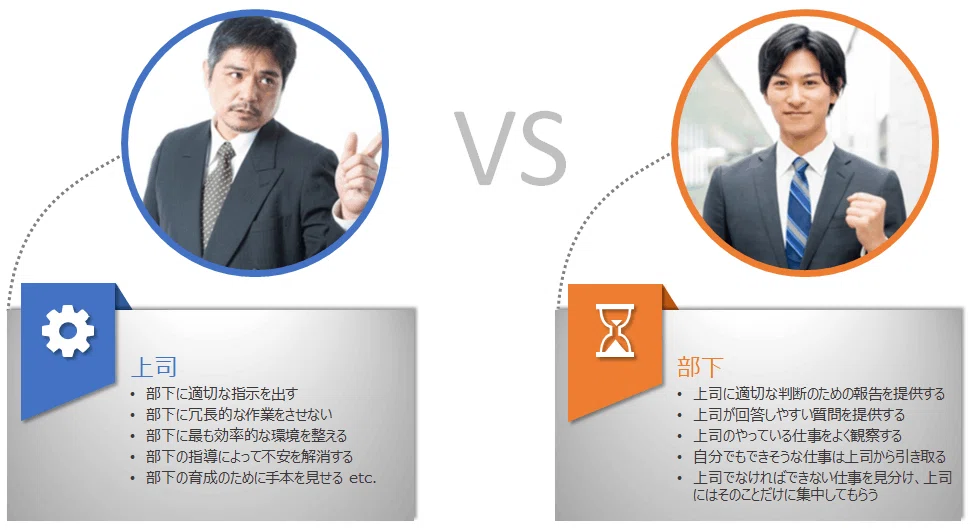
If a boss can prepare an appropriate environment and maximize the ease with which subordinates work, then it is the subordinates' turn to reward the boss who provided such a wonderful environment, and to control the boss's surroundings to make it the easiest form for them to work in.
For young employees
When you are young, you should focus on not placing a burden on your boss in your interactions with them. The best example of this is appropriate 'Ho-Ren-So' (reporting, communicating, and consulting).
・Provide information (report/communicate) at the timing the boss wants it
・Provide information (report/communicate) in the form the boss wants it
・Find and practice ways of asking questions and consulting that do not place a burden on the boss
It is just that simple. If a boss has the necessary and sufficient information, they can make appropriate decisions and provide the most effective instructions. In some cases, they may even provide guidance and training.
However, for this to function organically, it is essential to bring the situation to a point where it is easy for the boss to do so. This is where the handling of "information" becomes important. And the interface for handling information is, nine times out of ten,
communication
Continue your efforts to make this ideal. Once communication reaches a certain level, a boss will be able to manage very smoothly. In fact, it is no exaggeration to say that it depends on how a subordinate handles information whether they can enable their boss to manage well.
When you are a fully capable professional
Once a person has reached a certain level in how they handle information and communicate, the next thing they should do to "create a situation where they can work most easily" is
take over tasks from your boss that you can handle yourself
identify tasks that only your boss can do, and have them focus solely on those
By doing so, the boss will have more breathing room, and they can use that extra capacity to improve the environment for their subordinates (provided, of course, that you have a decent boss). You could say that a hidden role of a subordinate is to manage their boss's tasks so that this happens.
However, the things you must be careful about at that time are
not to neglect your own assigned work
not to take on tasks by saying "leave it to me" without any basis
These two points only.
If you are a fully capable professional, I don't think you would fail to do these things, but you must also understand that if you do fail, the tasks around you will end up collapsing, which will conversely cause trouble for your boss and leave them with no capacity to focus on other things.
Reducing a boss's burden does not just mean reducing their tasks. Preventing your boss from having to deal with unexpected, unnecessary trouble (caused by you) also contributes significantly.
Some people might think, "Why should I have to think about my boss's work?" but if you are looking at staying in your career for a long time, it will never be a waste.
This is because that work might eventually become your own work as it is.
When you are not in a proper boss-subordinate relationship
People outside of this circle are, so to speak, liabilities and risks to the company.
A situation where managers and subordinates lack the will, thought, and effort to fully perform their respective roles, and where the organization is not meshing well, is undoubtedly a state where unnecessary costs are being incurred. It is only natural that things would go wrong when they are endlessly running in low gear, whereas other organizations where "everyone is fully performing their roles" might be achieving several times the results.
You will likely feel a sense of discomfort, like driving with the accelerator wide open in first or second gear. In a car, this would undoubtedly put a strain on the engine and gears, leading to a breakdown.
In an organization, the burden first falls on the subordinates.
In some cases, just as car parts wear out, the subordinates may experience exhaustion, fatigue, dissatisfaction, and friction, leading to mental health issues or people quitting because they can no longer handle the stress.
If the company is of a decent size, it might be able to achieve numerical targets such as sales and profits. That would be the case if you only look at superficial KPIs (Key Performance Indicators).
However, if you look at the reality, it is not uncommon for subordinates to be constantly replaced, resulting in a hand-to-mouth operation. In fact, if you were to account for the switching costs involved in changing personnel, as well as the recruitment costs that would not have been incurred if they hadn't quit in the first place, you would see that the KPIs are significantly worse.
It might pass under a manager who can only see one-dimensional KPIs, but sooner or later the distortions will grow, and by the time you realize that the liabilities are indeed liabilities, it may be too late.
いいなと思ったら応援しよう!
 いただいたサポートは、全額本noteへの執筆…記載活動、およびそのための情報収集活動に使わせていただきます。