
The World of Broadcasting Technology: The Editorial Department Infiltrates the Site Where Broadcasts Are Delivered!

As the name "Satellite Broadcasting" suggests, SKY PerfecTV! sends radio waves directly from broadcasting and communications satellites to each home to deliver a variety of programs, including movies, sports, and live music.
To send radio waves from a satellite, the signals of the recorded programs must first be transmitted to the satellite.
The role of handling this is played by the SKY Perfect Tokyo Media Center (commonly known as TMC), and the employees in charge of broadcasting technology.
In this series, I would like to share content that focuses on such broadcasting technology while interviewing the employees in charge!
So, for this installment, note editorial department member Tantan has infiltrated the SKY Perfect Tokyo Media Center.
I would like to report on what exactly goes on inside!
(Actually, I didn't know anything about it either, so I headed there with zero knowledge (whispering))
The person I interviewed
Mr. T

・An employee in his 5th year (we are in the same intake!)
・He also appeared as a Rakuten fan in a previous Pacific League roundtable discussion.
First, I asked for a rough overview of what is done at TMC.


Mr. T: First, the video and audio signals for each channel arrive at TMC.
Once the signals arrive, they are first assembled according to a playlist (a blueprint for the program, such as what to play at what time, when to enter commercials, etc.) to make a single program.
These signals are in a very high-quality video and audio state, and the data capacity is very large, so they cannot be launched to the satellite as they are.

Mr. T: Therefore, it is necessary to compress the capacity so that it can be launched to the satellite.
Also, after compression, we add program guide information and apply a "key" so that only those who have subscribed to that channel can watch it.
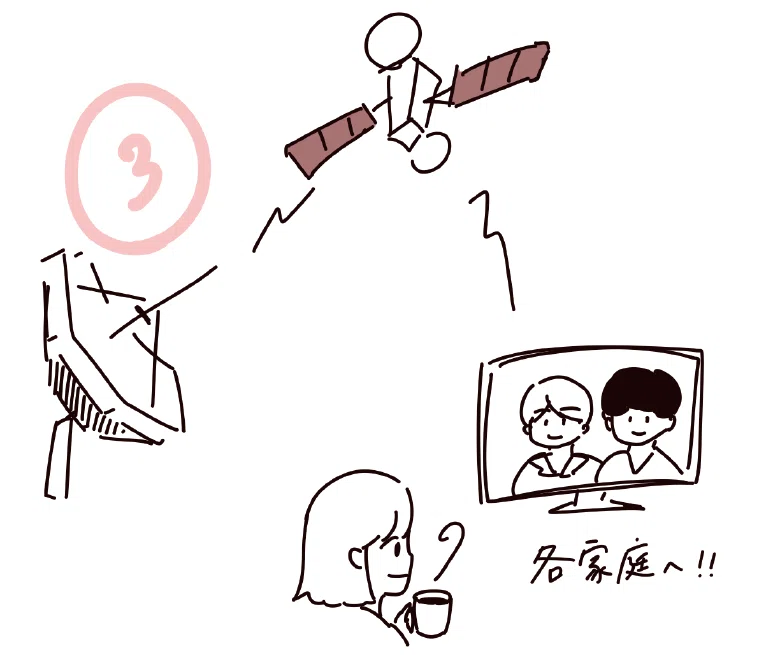
Mr. T: Once all the processes are finished, the signals are converted into radio waves and sent from the TMC antenna to the satellite.
Then, it is transmitted from that satellite to each home. By doing this, the programs can be watched.
―I see... Among all that, what exactly is your job, Mr. T?
Mr. T: The team that oversees all of the processes mentioned earlier and immediately recovers when something goes wrong is called the "Master" team, and my job is to operate and manage that Master team.
―Do the Master team members check things 24 hours a day, 365 days a year?
Mr. T: Yes. Whether there is a typhoon or snow, they are operating 24 hours a day, 365 days a year.
―Broadcasts are always running, after all. I have a vague image of it now, but... it's still a bit fuzzy (lol)
Mr. T: It's hard to imagine just by hearing about it. I couldn't understand it at all at first either. (lol)
Let's go see how this flow actually happens inside TMC.
So, off into TMC we go.

First, we arrived at the studio.
Basically, programs that have finished production at each channel arrive here, but depending on the channel or program, some are filmed at TMC.
―Do you ever pass by performers who have come here for filming?
Mr. T: Comedians, former professional baseball players, and idols often come here, so I do pass by them quite often.
―Wow! I'm jealous.
Next, we came to a room where some kind of program video was playing.


Mr. T: This is the place where we check the "pre-compressed" signals transmitted from various bases such as stadiums.
―Isn't it quite difficult to check everything to see if there are any problems?
Mr. T: While we manually check if the signals are coming from where they should be and if there are any abnormalities in the incoming signals, an alert will sound if there is any anomaly, so the flow is to check based on that.
―I see.
Mr. T: In that case, let's go see the equipment that compresses these programs next. Oh, that's right, please change into slippers.
―It's starting to feel like a factory tour. I'm nervous.

Mr. T: These machines compress the programs from earlier and add information.―There's a "On Air" sign posted. So the fact that we can watch broadcasts on SKY PerfecTV! right now is all thanks to these black boxes working hard...! It's deeply moving.
Mr. T: Next is this room.


―Looking only at the screens, it looks similar to the room where we checked the pre-compressed programs earlier.
Mr. T: This room is for the process of assembling according to the playlist and checking the "post-compressed" programs that are being processed in the black server room from earlier.
We also check the quality of streaming services and fiber-optic television distribution services (FTTH).
―Indeed, there is someone checking while looking at a smartphone. That person must be in charge of streaming.
Mr. T: That's right. And the programs that have been checked in this way are delivered as signals from the antenna to the satellite. Shall we go see the antenna too?


―Wow, the antennas are huge whenever I see them.
Mr. T: That's right. At TMC, there are 10 antennas with a diameter of over 6 meters.
They are pointed at the satellites that deliver the SKY PerfecTV! service and the Premium service, so their angles are slightly different.
―I see. Even if I understand the mechanism, it's still mysterious that many programs are flying away as signals from the tip of this antenna... and it's dreamy!
Interview with Broadcasting Technology Employees
We also asked T, who showed us around the TMC, about their own work.
―Thank you for the tour. We've walked all around the TMC, but do you have a favorite spot within the TMC, T?
T: Having operated and managed it myself, I do have a soft spot for the Master Control Room (the room where the process of assembling programs according to the playlist takes place, and where the 'post-compression' programs are checked).
―I suppose you feel attached to it since you're in and out of it so often as part of your duties! Now, among all your experiences so far, what has been the most challenging task for you, T?
T: Let's see... I suppose it would be when the 'SKY PerfecTV! Program Distribution' service launched the October before last. Since it was a new service, we had to build the system monitoring and service monitoring structure from scratch.
―So you had to build the 'if this happens, do this' protocols from scratch?
T: That's right. Those things just come up infinitely (laughs).
It was tough to logically deduce and think through every single possibility of 'if this happens, this system will need to be addressed'... It was tough, but I think it was a good experience for me.
―'Good'?
T: Yes. The broadcast systems have been running for a long time and are easy for us to manage, but since the distribution side is a cloud service, there were many unexpected elements even while we were designing the operations.
Every time that happened, we had to think, 'Okay, we need to do this instead,' and keep cycling through PDCA, so it was rewarding.
―A few years have passed since then, and I imagine things have settled down compared to the start, but are there any things the current department or the TMC is planning to do moving forward?
T: There's a lot of information that's limited to the department or the division... (laughs).
I might not be able to talk about things that haven't been released yet.
―I see! (laughs) If there is anything that has already been released that you can talk about.
T: In terms of what we have focused on as broadcast technology,the 'IP conversion of broadcast equipment'would be it.
Moving toward IP conversion is currently one of the trends in the broadcasting industry, and our company has been working on it since around 2019.
―What is the IP conversion of broadcast equipment?
T: It means replacing the communication standard of conventional broadcast equipment (SDI) with a communication standard that performs communication over the internet (IP).
It is considered to have advantages such as 'long-distance, high-capacity communication,' 'seamless signal processing,' 'cost reduction,' and 'space saving.'
―So many benefits! Does that mean you were doing this ahead of other companies?
T: I am proud to say that we are one of the companies that considered and implemented IP conversion at an early stage in the industry.
It might also be because our company loves new technology (laughs).
―That might be our company's strength as a broadcast technology provider! Did you want to be involved in broadcast technology from the time you joined the company?
T: Yes. I wanted to be involved in communications, so there was no gap between my expectations and reality after joining.
―Is there anything you would like to do in the future?
T: Since we are a company with satellite communication technology, I hope to keep thinking about the possibilities of what we can do in the future, not limited to broadcasting, when we return to that foundation!
In the first installment of our broadcast technology series, we covered how satellite broadcasting is viewed in every home, and what kind of place the SKY Perfect Tokyo Media Center, the technical facility that supports it, is!
Even at this very moment, the TMC continues to operate to ensure that you can watch programs in high quality.
It seems like new initiatives are also underway...? I look forward to the day I can report on them!
Stay tuned for the next installment of the broadcast technology series!
(Reporting/Writing: Tantan)
Click here for the article on the professional baseball roundtable discussion featuring T, focusing on the Pacific League.