
A story about honing my ability to distinguish the gender of Haniwa at a solo museum visit

Can you, instantly tell if a Haniwa is male or female just by looking at it?This is a story about how I pursued ways to distinguish the gender of such Haniwa.
I started watching 'Solo Katsu Joshi no Susume,' which has been adapted into a TV drama starring Noriko Eguchi, and it somehow became my latest obsession. Then, I thought, I want to try it too!! So I decided on a solo museum visit. My destination: the Tokyo National Museum in Ueno Park. This was my first time going on a solo activity pilgrimage.
I arrived at Ueno Station at a level of ignorance where I wondered, 'Does the Tokyo National Museum even exist in Ueno Park?'
If the song 'Since I got off the night train from Ueno...' starts playing in your head, does that make you a Showa-era person? Besides, I didn't even get off at Ueno. I was actually still on the train.

As the population density suddenly increased, I headed toward the Tokyo National Museum. Everyone was heading in the same direction, so it felt like we were all shuffling along. Shuffling along. And then, I arrived at the Tokyo National Museum.

The line was incredible. I had come with high aspirations to appreciate art, but after seeing the sign that said 'Wait time: ● hours,' I decided to give up immediately.

Thinking that Tokyo is amazing, I switched to exploring the park instead.

I've seen the one at the Kyoto National Museum, so I think this is the second one I've seen in Japan. I wonder what he's thinking about.
I realized while walking that the Tokyo National Museum is huge. There are many exhibition halls, including the Honkan (Main Gallery), Toyokan (Asian Gallery), Hyokeikan, Heiseikan, The Gallery of Horyuji Treasures, and the Kuroda Memorial Hall, so it seems impossible to see everything in one day.


And since my goal was the special exhibition at the Heiseikan, it wasn't the line I saw earlier after all. That's a relief.

Actually, I'm the same age as Hello Kitty.

I was surprised to find that the Tokyo National Museum has restaurants and food trucks, and there were even spaces inside the museum where you could eat and drink freely. I thought eating and drinking were forbidden in art museums, so I was grateful for the drink corners and terraces. Maybe the experts bring their own food. Since I'm a beginner, I had a bento box that was for sale.
There were also plenty of coin lockers, which was great because I could leave my bags and enjoy the exhibits. Plus, they were generous lockers that returned your 100 yen. You can take your time looking around empty-handed.

I'll save my thoughts on the special exhibition for another time, and decided to see the permanent collection that also appeared in 'Solo Katsu Joshi no Susume'.
This was the one at the entrance.

According to the explanation, while most female Haniwa are half-body figures, full-body Haniwa are rare.
It says she is wearing:
・A sleeveless garment with a wave pattern over a plain-patterned short-sleeved garment, and
・A skirt called a 'mo' with a vertical striped pattern.
That is what it says.
Isn't layering clothes a sign of a fashion expert?
Considering that people wore one-piece dresses in the Yayoi period, a two-piece outfit was apparently a new style. Moreover, she has earrings, a necklace, and bracelets. Her hairstyle is a Shimada-mage, an attire suggesting she is a person of high status. She has her hair tied up and secured with a vertical comb, and is wearing a headband...
Wait? A headband?
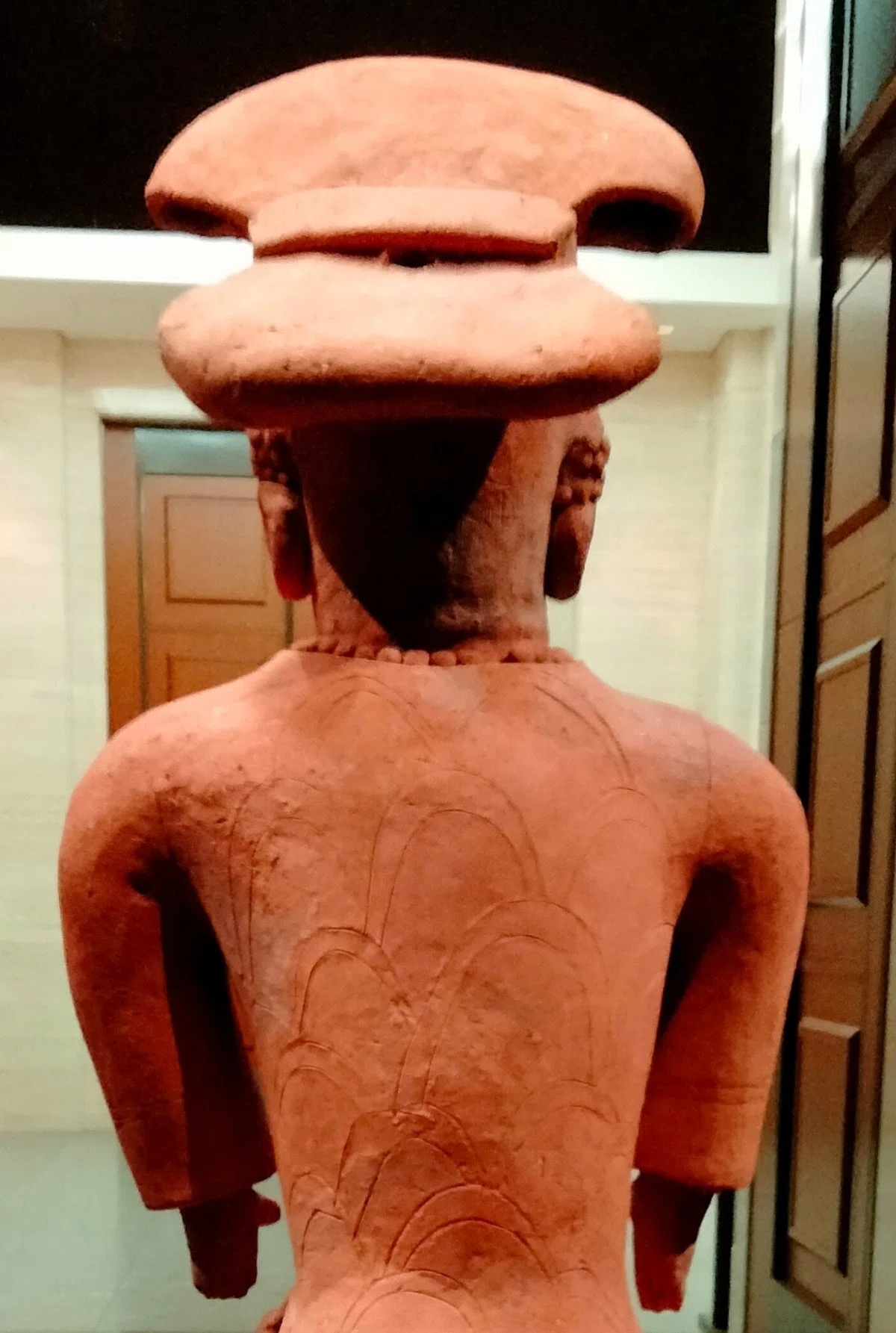
This is apparently a headband. I wonder why she is wearing a headband. I thought maybe it had some meaning, but I couldn't really figure it out.
Is it for fighting spirit, or is it for fashion? Or was it simply to keep her hair from spreading out? While thinking about hypotheses for which I don't have the answer, I thought it was simply amazing that I could imagine the culture of that era from Haniwa.
It might not have been the original purpose, but isn't it amazing that, as a result, Haniwa have become a way to preserve memories from an era without photographs?

I was healed by this space and was gazing at various Haniwa in a trance.


The human Haniwa had titles such as 'Woman raising both hands,' 'Man raising one hand,' and 'Laughing man.' As I was casually looking at the titles, a simple question welled up.
How do they distinguish between men and women?
The Dressed Woman at the entrance was wearing a skirt-like flared garment, so one could think that those with hems that flare out are women, and those that don't are men.
Are women those whose body shape has a cinched waist and expressed breast curves? Are men those who look more cylindrical? That's about all I can think of.
When I asked AI-sensei about it,
Many males have a hairstyle called mizura (hair parted and tied on both sides of the face).
Many females are depicted in formal attire, with their hair tied up on top of their heads, adorned with a comb on their forehead, and wearing necklaces and earrings.
That was the answer I received. I wonder if I can assume that Haniwa with necklaces and earrings are female? I'm starting to get the hang of it, but my accuracy rate is probably still around 60%. I felt like I wanted to do a little more research.