
Innovation in New Ammonia Synthesis Technology Developed by Idemitsu and Others and Its Impact on the Semiconductor Industry🚀

Announcement Date: July 4, 2024
Introduction
Idemitsu Kosan,The University of Tokyo,Osaka University,National Institute of Advanced Industrial Science and Technology (AIST) joint research team has announced that they have achieved the world's highest performance in continuous electrolytic ammonia synthesis at room temperature and pressure!
In this article, I would like to introduce this new technology developed by the joint research group of Idemitsu and others, as well as discuss its impact on the semiconductor industry🌱
Proposed New Ammonia Synthesis Technology⚡
The conventional Haber-Bosch process produced ammonia by reacting hydrogen and nitrogen under high-temperature and high-pressure conditions. While this method has a history of over 100 years, it has the challenge of unavoidable CO2 emissions during production, resulting in a high environmental burden.
The results of this research apply the University of Tokyo's Professor Yoshiaki Nishibayashi and his team's developed molybdenum catalyst to realize a technology that continuously produces ammonia from nitrogen and water at room temperature and pressure.
With this technology, the ammonia production rate per unit area of the electrode has improved to approximately 20 times that of conventional technology, achieving the world's highest performance📈.


Overview of the Molybdenum Catalyst 🧪
The molybdenum catalyst is a groundbreaking catalyst with the potential to revolutionize the world of ammonia synthesis. The characteristics of this catalyst are as follows:
Structure: Molecules called ligands surround a central molybdenum atom 🔬.
Reaction Conditions: Ammonia synthesis is possible under mild conditions of room temperature and pressure 🌡️.
Reactants: The reaction proceeds in the presence of nitrogen, water, and samarium iodide (a reducing agent) 💧🌬️.
Innovation: Compared to the conventional Haber-Bosch process, ammonia can be synthesized in a much more environmentally friendly way 🌿.

Electrolytic Synthesis Technology Suitable for Molybdenum Catalysts ⚡
To make the most of this innovative molybdenum catalyst, the research team is developing electrolytic synthesis technology from the following three aspects:
-
Catalyst Improvement (Led by the University of Tokyo) 🔬
Development of more efficient and stable molybdenum catalysts
Research aimed at extending catalyst life and improving activity
-
Optimization of Electrolytic Synthesis Reaction Field (Led by AIST and Idemitsu Kosan) ⚗️
Design of electrolytic cells and selection of electrode materials
Search for conditions to maximize reaction efficiency
-
Development of Reducing Agents (Led by Osaka University) 🧪
Search for new reducing agents to promote electrolytic synthesis reactions
Development of more efficient and environmentally friendly reducing agents
Through this comprehensive approach, we have maximized the performance of the molybdenum catalyst and achieved the world's highest performance in continuous electrolytic ammonia synthesis at room temperature and pressure 🏆.
Impact on the Semiconductor Industry
I would like to consider the impact of this new technology on the semiconductor industry✨
1. Supply of High-Purity Ammonia
In the semiconductor manufacturing process, high-purity ammonia is used for the production of gallium nitride (GaN)-based compound semiconductors. Conventional industrial ammonia has a low purity of about 99.9%, and as it is, it cannot be used in semiconductor processes.
Currently, it is necessary to increase purity using purification equipment, but if the new technology enables the direct production of high-purity ammonia, it will lead to a stable supply for the semiconductor industry.
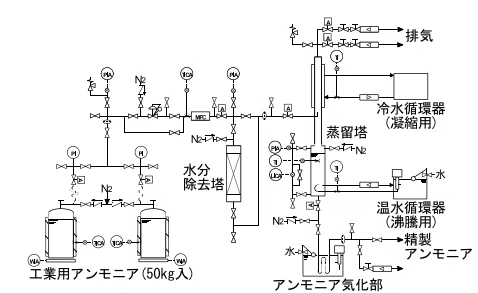
2. Cost Reduction💰
High-purity ammonia for semiconductors is traded at 20 to 50 times the price of regular industrial ammonia. If high-purity ammonia can be produced within semiconductor factories using the new technology, significant cost reductions can be expected💰.

3. Reduction of Environmental Impact
By enabling carbon-free ammonia production, it is possible to reduce the environmental impact of the entire semiconductor industry. This will be a major step toward realizing sustainable semiconductor manufacturing processes🌍.

4. Possibility of On-site Production🚢
Compact production equipment using the new technology may enable on-site production of ammonia within semiconductor factories. This is expected to lead to reduced transportation costs and stabilized supply.

Future Outlook
This innovative ammonia synthesis technology has the potential to influence a wide range of fields, not limited to the semiconductor industry, such as fertilizer production and use as a hydrogen carrier. The research team plans to proceed with development aiming for the establishment of cost-competitive mass production technology.
A stable supply of high-purity ammonia can lead to improved efficiency, cost reduction, and reduced environmental impact in semiconductor manufacturing processes, potentially contributing to the competitiveness of the entire industry.
I look forward to seeing how this technology develops further and what kind of transformation it will bring to the semiconductor industry and other industrial sectors✨
Innovation in ammonia synthesis technology is expected to contribute to both the realization of a sustainable society and industrial development🌟
Summary
Continuous electrolytic synthesis of ammonia at room temperature and pressure achieved world-leading performance.
Development of electrolytic synthesis technology suitable for molybdenum catalysts has resulted in an ammonia production rate per unit area of the electrode that is approximately 20 times higher than conventional technology.
Impacts such as cost reduction for the semiconductor industry, reduction of environmental impact, and acceleration of new material development are expected.
The focus now is on whether it can transition from lab-level synthesis tomass production level
If you found this article informative, please give it a like!😍
I will continue to bring you information on the latest technology, so don't forget to follow!👍 Thank you for reading until the end! See you again!👋
#AmmoniaSynthesis #SemiconductorIndustry #TechnologicalInnovation #CarbonFree #IndustryAcademiaCollaboration #HighPurityAmmonia #Sustainability
Recommended Articles
References
https://www.idemitsu.com/jp/news/2024/240704.pdf
https://www.tn-sanso.co.jp/Portals/0/resources/jp/rd/giho/pdf/23/19.pdf
いいなと思ったら応援しよう!
 よろしければサポートもよろしくお願いいたします.頂いたサポートは主に今後の書評執筆用のために使わせていただきます!