
Unable to walk in just 2 days? Evaluation and intervention methods for ward rehabilitation to prevent "HAD"

When we step into a ward as rehabilitation professionals, we are fighting not only the "disease itself" but also another invisible, massive enemy. That is **Hospital-Associated Disability (HAD)**.
"My pneumonia is cured, but I can't walk anymore." "My heart failure is stable, but I can't eat by myself." To break this paradox of "treatment success, rehabilitation defeat," let's organize the weapons we should have now.
【Today's Questions and Conclusions】
HAD (Hospital-Associated Disability): The "Silent Crisis"

HAD refers to the loss of ADL (Activities of Daily Living) ability due to the "process of hospitalization itself," rather than the worsening of the primary disease. Muscles are surprisingly honest. If a healthy elderly person spends 10 days in bed, about 1 kg (equivalent to about 5 thick-cut steak slices) of lower limb muscle mass can be lost. Moreover, muscle strength declines even faster, being whittled away by up to **about 1–1.5%** per day.
Shocking Evidence: The Second Day is the Watershed for Independence
The incidence of HAD is said to reach 30–60% in elderly hospitalized patients aged 70 and over. What is noteworthy is its speed. Some studies report that a decline in ADL or walking ability was observed in around 20% of elderly patients in the early stages of hospitalization (the first few days), and the first few days after admission, especially the **"second day," can be a critical watershed for maintaining independence.
An even crueler fact is that it has been reported that a significant number of patients who had declined ADL at the time of discharge cannot return to their pre-admission levels even after one year. We are fighting against "time" from the very first day of admission.
Why does HAD occur? Identifying the culprit and the weapon

The factors that cause HAD are broadly divided into three layers.
-
Deconditioning (Engine performance decline)
A state where cardiopulmonary function and the autonomic nervous system weaken due to bed rest, causing the body to overheat even with slight movement. Orthostatic hypotension is also induced by a decrease in plasma volume.
-
Disuse syndrome (Part deterioration)
Physical deterioration where muscle atrophy, joint contractures, and osteoporosis progress due to "not using" the body.
-
Environmental/Iatrogenic factors (External factors)
Excessive bed rest instructions due to "fear of falling," delirium in an unfamiliar hospital room, and malnutrition deprive patients of opportunities to move.
HAD and PICS: The "Price of Hospitalization" that are similar but different
For patients who have experienced an Intensive Care Unit (ICU), the even more complex **Post-Intensive Care Syndrome (PICS)** is superimposed.
Item Hospital-Associated Disability (HAD) Post-Intensive Care Syndrome (PICS) Main TargetGeneral elderly patients ICU admitted patientsScope of impairmentMainly physical function/ADL Three elements: physical, cognitive, and mentalImpact on familyIncludes mental disorders in family members (PICS-F), which are often overlooked
We must not forget that patients who have moved from the ICU to a general ward are in an extremely high-risk state, facing a 'secondary disaster called HAD' while bearing the 'deep wounds of PICS'.
The Golden Rule for Success: 120 Minutes and 900 Steps

To stop HAD, we need to be aware of clinical 'benchmarks' derived from observational studies and other sources. It is known that the average number of steps taken by elderly hospitalized patients is extremely low, at around 700 steps. The following figures serve as one indicator for practical target values to break through this current situation.
The '120-Minute Barrier'
This barrier cannot be overcome with just 40 minutes in the rehabilitation room. Collaborating with ward staff and figuring out how to convert 'daily living movements' like eating and excretion into activity is where the skill of rehabilitation professionals truly shines.
💡 Clinical Action: How to 'Grittily' Achieve 120 Minutes
Before giving up by saying, 'There isn't enough time to get them out of bed for 120 minutes,' let's break down and reconstruct their daily time.
Meals (sitting in a wheelchair): 20 minutes × 3 times = 60 minutes
Excretion in the toilet: 5 minutes × 4 times = 20 minutes
Washing, changing clothes, and grooming: Morning and evening combined = 10 minutes
Rehabilitation intervention time: = 30 minutes
Total = 120 minutes achieved!
Even without creating special training slots, you can overcome the barrier to preventing HAD simply by 'replacing daily activities performed in bed with anti-gravity positions (sitting, standing)'.
Intervention Strategy by Phase: A 'Two-Pronged' Approach of Defense and Offense

We must shift our intervention gears according to the patient's overall condition.
〈Defensive Rehabilitation (When the overall condition is poor)〉
When the general condition is poor and catabolism (decomposition) is progressing, 'training' is counterproductive. Here, let's adopt the perspective of mechanotransduction (mechanical stimulus reception). Basic research suggests that moderate mechanical stimulation may be involved in the intracellular homeostasis maintenance mechanism (autophagy).
Forward-leaning lateral positioning, positioning, and gentle ROM exercises provide 'appropriate strain' to the cells. This acts as a switch, aiming to activate autophagy, which is the intracellular cleaning function. By cleaning up intracellular debris (such as denatured proteins), you prepare the foundation to accept nutrition and stimulation during the later 'offensive' phase.
☑️ Defensive Practice Checklist
〈Offensive Rehabilitation (When general condition is good)〉
Once inflammation has subsided and nutrition is being absorbed, switch to an offensive stance all at once. To break through the 'anabolic resistance' of the elderly, prescribing 'low-load, high-repetition (until exhaustion)' under appropriate management is effective.
With a load of about 30-50% of 1RM, repeating until the limit (All-out) where they can no longer move aims to promote muscle protein synthesis equivalent to high-load training. Furthermore, by combining it with isometric contraction like MMT, you can powerfully wake up the dormant nervous system (motor units).
☑️ Signs to identify the offensive 'limit (All-out)'
〈Transferring rehabilitation to 'daily life'〉
Connect the results in the rehabilitation room to ward ADLs.
The selection of wheelchairs (tilt/modular type) and adjustment of cushions are not just 'environmental maintenance' but 'therapeutic interventions to support 120 minutes of activity.' Only after a stable sitting position is secured can the patient devote energy to active tasks such as 'desk work' or 'self-feeding.'
From defense to offense: When to flip the 'switch'?
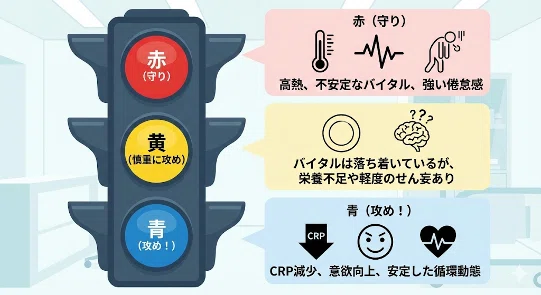
'Is it still time for rest? Or should I move them?'
When we are unsure of this judgment, we must discard our subjectivity and return to objective medical standards.
The peak-out (downward trend) of CRP levels, stability of heart rate and blood pressure, and the patient's own motivation. How can we avoid missing these 'green lights' and switch to 'offensive rehabilitation' as quickly as possible? For specific judgment criteria and risk management, please refer to the detailed column below.
In conclusion: Our hands change the 'future'
HAD is a disability that has a high potential for risk reduction through appropriate intervention.
Trust in autophagy at the cellular level to 'protect,' aim for physiological limits to 'attack,' and make the most of the ward environment to 'utilize.'
Your professional intervention and down-to-earth collaboration with ward nurses will create a future where patients can 'cross the threshold of their own homes on their own two feet.' Now, let's complete the puzzle of activity levels during your ward visits starting tomorrow.
[Notice]Solve the problem of rehabilitation effects not lasting! 'Thinking Positioning' based on scientific evidence
[Disclaimer]
The information posted in this column is for general information and educational purposes only and is not intended as a diagnosis, treatment, or medical advice for any specific individual. When preventing Hospital-Associated Disability (HAD) or implementing rehabilitation, always follow the instructions of the attending physician, fully assess the individual patient's general condition and risks, and make decisions under the responsibility of a professional. Please note in advance that the author and this site cannot be held responsible for any direct or indirect damages resulting from the use of the posted content.
*Images generated by AI (Gemini)
[References]
Covinsky, K. E., et al. (2011). "Hospital-associated disability: 'anti-hospitalist' programs and middle-ground programs." JAMA.
Kortebein, P., et al. (2007). "Effect of 10 days of bed rest on skeletal muscle in healthy older adults." JAMA.
Sager, M. A., et al. (1996). "Hospital admission functional status and the risk of institutionalization or death." JAMA.
Agmon, M., et al. (2014). "The life-space of older adults 1 month after hospitalization."
Fisher, S. R., et al. (2011). "Ambulation and length of stay in hospitalized older adults."
Lasevicius, T., et al. (2018). "Effects of different training intensities and volumes on muscle architecture and strength." Frontiers in Physiology.
Sandri, M. (2013). "Autophagy in skeletal muscle." FEBS Letters.
Needham, D. M., et al. (2012). "Improving long-term outcomes after discharge from intensive care unit: report from a stakeholders' conference." Critical Care Medicine.
#PhysicalTherapist #OccupationalTherapist #Rehabilitation #EarlyMobilization #DisuseSyndrome #HAD #WardManagement
いいなと思ったら応援しよう!
 よろしければサポートお願いします! いただいたサポートはクリエイターとしての活動費に使わせていただきます!