
[Case Study] Significant Efficiency Gains by Shifting from Traditional On-site Support to Remote Support (Ricoh Japan, Saitama Branch)

Today, I would like to introduce a real-world case study where significant efficiency gains in customer support operations📈 were achieved using the remote support tool "RemoteCall"👀. This is a case study from Ricoh Japan's Saitama Branch, which provides extensive support for corporate digitalization🥳
At Ricoh, the solution sales department was engaged in on-site support activities, primarily involving PC installation, operational support, and network environment construction. While they diligently provided support via phone or on-site visits whenever there were issues with the PCs or network environments they helped install, they faced challenges in wanting to improve efficiency.
🏢Ricoh Japan Saitama Branch
With remote support, the number of customer support requests handled per day has increased by 1.5 to 2 times! Customer satisfaction has also improved significantly✨

1. Motivation for Implementation
The main challenge was simply the travel time required for on-site support. Since we travel by company car, transportation costs weren't that high, but we felt there was an issue with efficiency, as the time spent at the customer's site was short relative to the travel time. In Saitama, the area covered by a single office is large, and if traffic is heavy, a round trip can take nearly three hours. No matter how long the travel time was, there were cases where the trouble could be resolved in just three minutes, such as simply forgetting to turn on the power or failing to configure a specific setting.
Therefore, no matter how much we adjusted our schedules, four visits per day was the limit for our on-site activities. Also, when time is taken up by travel, the number of requests we can handle and the time we can spend on customers—such as creating estimates and proposal documents—inevitably decreases. There was also a company-wide policy to increase sales productivity and the number of customer contacts while creating a better working environment for employees, so we decided to use IT tools to increase productivity.

Most customers who call are in a situation where they are currently struggling, and we often hear them say, "I want you to solve the problem as soon as possible." However, even though we would like to visit immediately after receiving a call, we cannot do so if our schedule is already full. In the end, we would keep the customer waiting, and in some cases, it would lead to complaints.
Also, when we actually visit, it is not uncommon to find that there are other issues besides the current contract. For example, we might receive requests on-site for maintenance services or the introduction of other software. Based on these challenges, we began considering the introduction of a tool that could remotely support customer PCs.
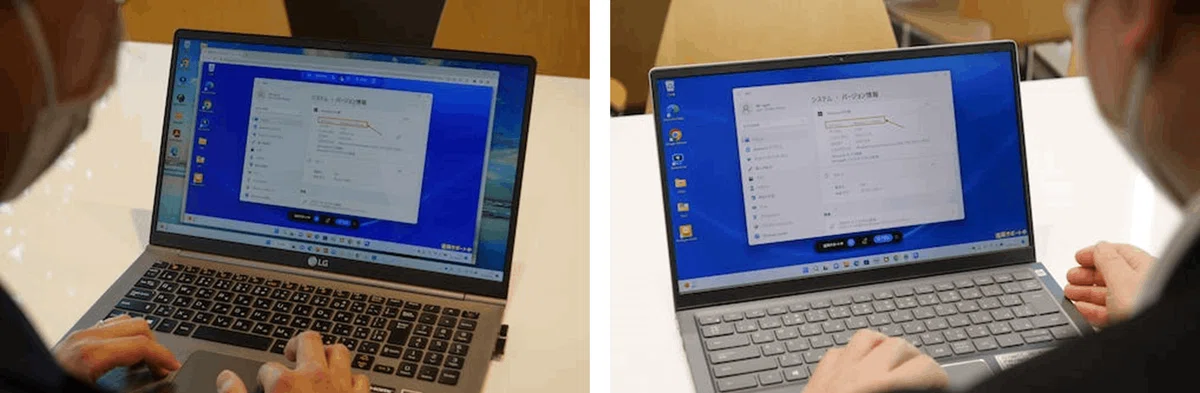
A scene of customer support using RemoteCall
2. Key Reasons for Choosing RemoteCall
Within the "Work Style Reform Solution" service that we provide to our customers, there is a scrum package called "Telework All-in-One Pack" that provides the tools and environment necessary for companies to introduce telework. One of the services in this package is the PC remote control tool "RemoteView," developed and operated by RSUPPORT, and because of that relationship, we were also aware of "RemoteView", and we were also aware of "RemoteCall". We started considering tool implementation just as the number of customer requests began to increase, and we compared and considered several tools, including RemoteCall. However, other companies' tools did not meet our requirements, either because their intended use did not quite fit or their support systems were insufficient.

Since we are asking customers to use a remote support tool, we believe that the security and reliability of the tool are extremely important factors in order to give customers peace of mind. Therefore, we decided to avoid free tools, tools developed by companies with no track record, and tools from companies without post-implementation support systems. We were well aware of RemoteCall's security and implementation track record from our work with RemoteView, so we conducted a trial with the intention of implementing it. We also obtained internal agreement on cost-effectiveness, so the budget was successfully approved.
3. Results After Implementation
Travel time has been reduced, and the number of requests handled has increased by 1.5 to 2 times. We have been able to earn high praise without placing a burden on our customers.
For cases that seem easy to resolve, we have switched from on-site visits to remote support via RemoteCall. As a result, the travel time that used to take 1 to 3 hours per case has been eliminated, and the number of requests we can handle per day has increased. Specifically, the number of requests handled, which was about 4 per day, has increased to 6 to 8, which means it has increased by 1.5 to 2 times.
By increasing our daily customer touchpoints, we have more opportunities to propose new services along with support, which has indirectly contributed to increased sales. In addition, the ability to make proposals remotely and the time secured to create estimates and proposals have been highly rated by field staff, and we have also received positive feedback from managers at each branch.
It is also very well received by customers. Since we introduced RemoteCall to one customer, they have started requesting, "I would like to request remote support for the next support session as well.". Also, when we only did direct visits, it used to take one or two weeks from the time a customer made a request until we could actually visit their office, but now, if there is an opening in our schedule, we can assist them immediately after they call. The fact that we have reduced the wait time for resolving their concerns is a major achievement.

4. Conclusion
For companies like the Saitama branch that provide DX support to a wide range of customers or offer IT services, this is highly recommended. It is also a great fit for the IT department of companies with multiple office locations. Internal IT support can also benefit from using RemoteCall.
Currently, the solution sales team at the Saitama branch is primarily using and leveraging it, but we believe that if the server maintenance and inspection team also adopts it, we can achieve even greater efficiency across the entire office. I think RemoteCall is a service with a wide range of applications, so we would like to continue using it actively.
Thank you, Ricoh Japan Saitama Branch! 😀
For more details on this case study, please see here!
Remote support tool RemoteCall is available for a 14-day free trial! Please give it a try👇