
(310) Types of No Motor Vehicles (Combined)


Overview
A regulatory sign that prohibits traffic by combining the types of vehicles subject to the regulation. The regulation selects two types from the following six regulatory signs. However, since "motor vehicles other than two-wheeled motor vehicles" includes trucks and buses, there is no combination of (304) and (305)/(306). Also, there may be two types of the two patterns depending on which one is on top. Therefore, the number of types of regulatory signs is 6 x 5 - 2 x 2 = 26 types, and the number of regulatory patterns for the signs is half that, at 13 types.

Common vehicle combinations seen in the city
As described, while there are theoretically 26 types of regulatory signs, some have been confirmed in the city while others have not.
The following are those whose existence has been confirmed and are relatively easy to find.

From the left,
● When you want to restrict all motorized four-wheeled and two-wheeled vehicles from outside in narrow residential areas,
● When you want to restrict the passage of large vehicles,
● When you want to restrict the passage of light vehicles on overpasses, underpasses, etc. (There are patterns where the bicycle and cart icons are either on top or bottom; the cart on top/bicycle on bottom is more common),
regulatory signs are sometimes installed for reasons such as these.


Combinations where the bicycle is on top are relatively rare. Furthermore, while this sign is typically used for point-based restrictions, it is used here as a section-based restriction. It is believed that this is used as a section-based restriction because simply restricting the entrance and exit, such as with an overpass or tunnel, would not be enough to prevent entry.
Relatively rare vehicle combinations
The following have been confirmed to exist, but they are quite rare regulatory signs.

From the left,
No entry for motorcycles, mopeds, and bicycles: Used when you want to restrict two-wheeled vehicles, regardless of whether they have an engine, in places like underpasses with frontage roads on arterial highways (patterns exist with either the bicycle or motorcycle symbol on top; the motorcycle on top/bicycle on bottom is more common) - however, there are organizations that oppose two-wheeled vehicle restrictions, so not everything can be restricted.
No entry for large motor vehicles, etc.: While the restriction itself is common, there are only about three reported cases nationwide where the bus is on top. (Examples: Yamanashi Prefectural Road Route 10 Shiroyama Old Road, Fukudamachi Intersection, Miyagino Ward, Sendai City, Miyagi Prefecture, Restriction warning sign in Kowakicho, Higashiomi City, Shiga Prefecture)
No entry for large freight vehicles, etc., motorcycles, and mopeds: Used when you want to restrict the passage of large trucks and motorcycles that cause noise.
No entry for motor vehicles other than two-wheeled vehicles and light vehicles other than bicycles: Used when you want to limit the vehicles that can pass through a narrow railroad crossing.
Regulatory signs are sometimes installed for reasons such as these.
Motorcycle and bicycle combinations in underpasses with bypasses

There are two types of grade-separated roads that pass under roads, railways, rivers, ports, etc., so-called "underpasses": those with bypasses and those without. In the case of roads and railways, motorcycles, mopeds, bicycles, and light vehicles can be routed through frontage roads, making it possible to prohibit passage on the underpass side.
Passage through underpasses with frontage roads is often restricted, especially for low-powered mopeds, bicycles, and light vehicles. Motorcycles have more horsepower, and the recent trend is not to restrict them unless it is extremely dangerous, such as having sharp curves. There are also underpasses with frontage roads where only mopeds are prohibited without explicitly restricting bicycles or light vehicles.
It seems that in many cases, the symbol mark has the motorcycle on top and the bicycle on the bottom.

Because there is a sharp curve inside the tunnel, passage is prohibited including for motorcycles.
The symbol mark has the motorcycle on top.

Restriction on the viaduct. Mopeds are fine, but is it unreasonable to try to restrict small special motor vehicles and light vehicles with this sign!?

Mopeds and bicycles are restricted. Motorcycles and light vehicles can pass.
Other underpasses on the National Route 17 bypass have similar restrictions.
The symbol mark has the bicycle on top.

A bypass with a tunnel and a viaduct.
The symbol mark has the motorcycle on top.
Truck and motorcycle combinations exist in only one section nationwide

As of 2021, there is only one section in the country where a truck and motorcycle combination (specific medium freight, large freight, large special, two-wheeled) restriction exists. (You can check where two-wheeled vehicle restrictions are, and what other vehicles are restricted in combination with them, here.)
The only section in the country is the road connecting Daikyo-cho Intersection and Shinanomachi Station Intersection in Shinjuku Ward, Tokyo. Here, from 10:00 PM to 6:00 AM the next day, traffic for specific medium-sized trucks, large trucks, large special vehicles, and motorcycles is restricted.


Incidentally, if you include variable signs, one also exists at the entrance to Mount Hakodate in Hakodate City, Hokkaido.

Variable signs show a combined traffic restriction sign for trucks and motorcycles.
Unfortunately, standard signs have separate no-entry restriction signs for large cargo vehicles, etc., and motorcycles.
*
Furthermore, in the past, there were two other locations where a combination of trucks and motorcycles was restricted. One was in the Kamiyoga area of Setagaya Ward, Tokyo, where it was restricted by zone during the night from 10:00 PM to 5:00 AM, but the restriction in the Kamiyoga area is now limited to trucks only as of 2021. There is also a report that it existed on the Yahiko Skyline in Niigata Prefecture. Currently, restrictions for motorcycles and four-wheeled vehicles are applied separately.
Looking at Google Street View, at the 'Setagaya Seiso Kojo-mae' intersection on Kan-pachi Dori in Kamiyoga, Setagaya Ward, Tokyo, a combined restriction for trucks and motorcycles was in place from 2009 to April 2015, but it had switched to trucks only by March 2016, so it is thought to have changed sometime between April 2015 and March 2016.

Both the traffic lights and traffic signs were updated. The content of the no-entry restriction was updated at the time the traffic signs were updated.

If you include 'voluntary restrictions' in Yamagata Prefecture, there is also a regulatory sign hung on the suspension bridge at the entrance to the Shimotazawa Katakuri Garden in Tsuruoka City, Yamagata Prefecture.
山形県に入ると道路標識に自主規制ってのよく見かける。というかこの吊り橋二輪は駄目だけど普通自動車いけるのか?歩いてめっちゃ揺れたけど。 pic.twitter.com/uq6XG9Hq3A
— ないで@MSPday1 (@Naide_Moto) September 10, 2023
An example of a traffic regulation standard, but an extremely rare combination

Although the combination of symbols for four-wheeled vehicles and light vehicles other than bicycles is introduced as an example in the Traffic Regulation Standards, it is an officially recognized extremely rare sign. Its existence had not been confirmed for a long time, but it was confirmed to be installed at a JR Utsunomiya Line railroad crossing in Tako, Kamikawa-machi, Kawachi-gun, Tochigi Prefecture.
Combinations of vehicles whose existence has not been confirmed
The following have not been reported on the internet, and their existence has not been confirmed. Some patterns exist, but the top and bottom symbols are reversed. While some combinations might seem plausible at first glance, when you think about it carefully, there are many that seem to have 'no need for such a restriction' (for example, restricting only large buses and oxcarts, only large trucks and bicycles, only large buses and motorcycles, etc.).
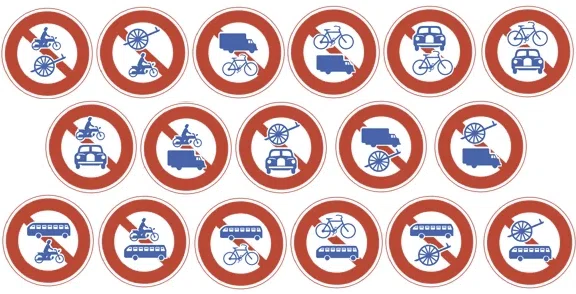
Therefore, it would be interesting to look for rare signs, and perhaps even extremely rare signs that might exist, in your own neighborhood. If you find an extremely rare sign, please post it in the comments section.

As a restriction for the viaduct, large trucks and bicycles are restricted by separate signs. It is an opportunity to combine them into one, but that has not been done.
*
Please take a look at this as well.