
Arimatsu Shibori: How 'OSOCU' Opened the Door to Regional Craftsmanship

Just because a technique has been around for a long time does not mean it leads to commercial success. Even so, Arimatsu Shibori is one of the few traditional craft techniques that still maintains a certain scale of production and continues to thrive today. At 'OSOCU', we have been planning Arimatsu Shibori items little by little since last year.
'Reading to Know OSOCU' is a project where a writer interviews us to share reflections on 'OSOCU' since its inception in April 2024, the future we want to realize, and the stories behind how our items are made.
In the fourth installment, 'OSOCU' representative Mr. Tani talks about his encounter with 'Arimatsu Shibori', which opened the door to regional craftsmanship, and its appeal. The interviewer is Ryuta Sato from Tsumugi Co., Ltd.
'Arimatsu Shibori' was the catalyst that opened the door to regional craftsmanship
Sato: First, please tell us about 'Arimatsu Shibori'.
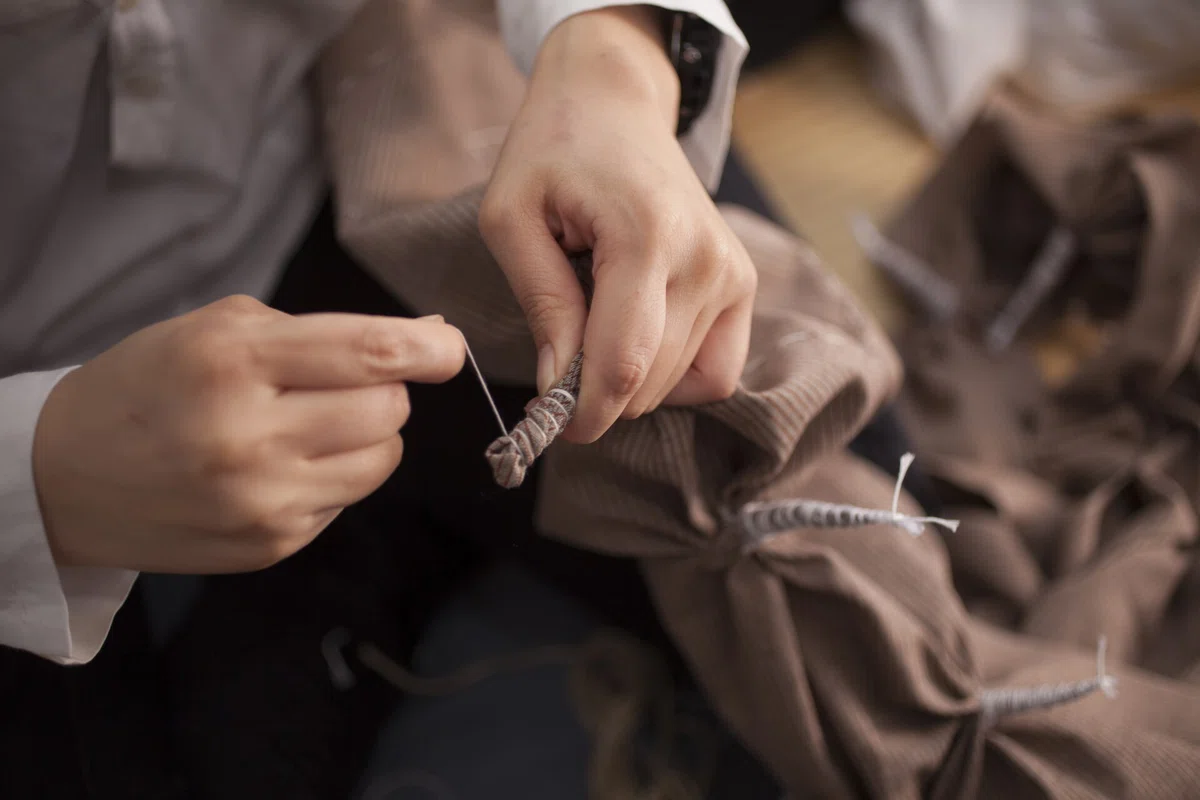
Tani: 'Arimatsu Shibori' is a dyeing technique that has been passed down for nearly 400 years in the area around Midori-ku, Nagoya City, Aichi Prefecture. Its official name is 'Arimatsu-Narumi Shibori', and it is designated as a national 'Traditional Craft'. It is characterized by the binding technique used before dyeing, and while it is said that there are over 100 types, there were many more in the past, and some are said to be impossible to reproduce today.
Regarding 'Arimatsu Shibori', there is an explanation of the craft and its techniques on the cucuri page that has helped us in many ways, so please take a look if you are interested.
Sato: Thank you. Next, please tell us about your encounter with 'Arimatsu Shibori'.
Tani: It was when I participated in an 'Arimatsu Shibori' workshop in 2014. To my shame, it was at this event that I learned that Nagoya City had a traditional craft in the textile industry. My first impression was simply that it was interesting. Even now, I feel there are various possibilities in the uniqueness of Shibori.
Sato: By the way, what kind of presence does 'Arimatsu Shibori' have for 'OSOCU'?
Tani: It is the presence that opened the door to activities of making things in the region. Although the number of clothes incorporating 'Arimatsu Shibori' in 'OSOCU' is not large right now, I personally consider it a significant presence. There are many brands and creators, including cucuri, that utilize 'Arimatsu Shibori'. Although not along the old highway, we also have a workshop in the Arimatsu area, so I feel a sense of closeness to it.
'OSOCU' as a gateway to learning about 'Arimatsu Shibori'
Sato: Please tell us about the characteristics (good points) of the clothes incorporating 'Arimatsu Shibori' planned by 'OSOCU'.
Tani: It is that the individuality of each piece stands out clearly. For example, if you want to add a pattern to a shirt, it is common to use fabric that already has a pattern. Shibori dyeing, which allows patterns to be added later, is one of the few methods that can do this. Whether it is the binding process or the dyeing process, 'Arimatsu Shibori' always results in individual differences due to the manual work involved. While it may not be suitable for modern, uniform mass production, I think that is precisely why so many people love it.
Sato: Since 'Arimatsu Shibori' clothing uses traditional techniques, is it delicate to wash?
Tani: As for washing the clothes planned by 'OSOCU', it is fine to wash them normally. If you are worried about color fading, it is safer to put them in a laundry net and wash them as delicate items. In the first place, whether washing is delicate or not largely depends on the fabric and dyes. If they are delicate, you must be careful. For example, indigo dye fades easily, and silk is weak against friction. Sato: Do you have any plans to increase the number of 'Arimatsu Shibori' items at 'OSOCU' in the future?
Tani: Since artisans make them one by one, I think it is physically impossible to increase the number significantly. I think it would be better to increase the variety without mass-producing them, taking advantage of the fact that they can have strong individuality, and treating them as special or one-of-a-kind items.

White or black clothes are universal and do not really choose the wearer, but I do feel that clothes incorporating 'Arimatsu Shibori' only appeal to those who like them. In that sense, it seems suitable for artwork or made-to-order production.
Sato: It's true, it might not resonate with people who just wear clothes for the sake of living.
Tani: That's right. The 'Arimatsu Shibori' clothing we plan for 'OSOCU' now is processed one by one by artisans, so it's not suitable for mass production. Therefore, I think it's better to plan periodically for those who like one-of-a-kind or very small-batch production. It would also be interesting to incorporate the essence of 'Arimatsu Shibori' when collaborating with other companies. I want to continue incorporating it into our projects in some form in the future.
Sato: So it's an existence that should be preserved.
Tani: Yes, I think so for the region as well, but there are people who are more deeply rooted in Arimatsu and active there than we are, so I think it's enough if 'OSOCU' can serve as a gateway for people who don't know about 'Arimatsu Shibori' yet. From the perspective of revitalizing the region, I would like to support it, even if only in a small way.
For those who become even more interested from there, I can introduce them to other companies, so I want them to experience the various worlds of 'Arimatsu Shibori'.
The New Possibility of Side-Job Artisans

Sato: Do you have any thoughts on the future use of 'Arimatsu Shibori'?
Tani: I feel potential in side-job artisans who dye while working other jobs.It's a form where they stabilize their income with another job while challenging themselves with the dyeing they truly want to do. If they have skills they've learned, I think it would be interesting to create an environment where they can earn income doing what they want. It's a coincidence, but we have a former Arimatsu Shibori company dyeing artisan dyeing a few pieces a month in their own studio as a side job. (Not shibori dyeing, but plant-based dyeing)
Sato: So, the foundation of income is earned through a main job to solidify the base of life, and then doing what you want on top of that.
Tani: That's right. It's an initiative that just started recently, and although it's not an 'Arimatsu Shibori' product, everything made by the side-job artisan is selling out, partly because it's a small quantity. It's only about 10 pieces so far. If everything sells, it's easier for both sides to continue, right?
Sato: It's certainly nice to be able to earn income doing what you want to do.
Tani: It's not an era where you have to make a lot, either. If you try to do dyeing as a business or a main profession, the level of hurdles definitely changes. I think sales and management skills are essential.
Sato: It seems like it would be good to try it out as a side job or secondary business before making a decision.
Tani: Exactly, I think having a side job is a good mechanism as a first step to doing what you want to do. There are no plans yet, but I think it would be interesting if we could do that with 'Arimatsu Shibori' projects as well.
Sato: Is there anything else you are thinking about?
Tani: Yes, there are two things. Neither is about the short term, though. One is that I'm secretly hoping to do something in the future with cucuri, who has been very helpful to us. It was Mr. Yamagami from cucuri who introduced and connected us to the current Arimatsu workshop.
Sato: So he's a key person.
Tani: Yes, speaking for myself, looking back, he has helped me at every turning point (laughs).
Sato: What is the other one?
Tani: I want to make the most of the individuality of 'Arimatsu Shibori'. So, I have a desire to expand into Tokyo and overseas, where there are more unique people than in Nagoya. Actually, we are in the process of moving forward with a Tokyo company, and when we tried it out on a trial basis, the response seemed positive, so it's one of the initiatives I'm looking forward to in the future.

The fourth installment of 'Reading and Knowing OSOCU' presented the possibilities that 'OSOCU' discovered in 'Arimatsu Shibori'.
'OSOCU' sells clothing that incorporates 'Arimatsu Shibori'. The 'About OSOCU' section on our official online store also details the vision that 'OSOCU' holds, so please take a look if you are interested.
We plan to continue releasing 'Reading and Knowing OSOCU' on a monthly basis, so please look forward to it.
Interview and text: Ryota Sato (Tsumugi Inc.)
