
There is also 'Mukaegana' (leading kana)

'Mukaegana' (leading kana) was angry.
The object of its anger is 'Okurigana' (trailing kana).

In school and social life, only 'Okurigana' is dealt with.
In the first place, the overwhelming majority of people probably don't even know that 'Mukaegana' exists.
This article was written to understand the feelings of 'Mukaegana' and to tell everyone,
'Mukaegana is actually convenient, you know.'
that is what I wanted to convey.
About this article ⬇️⬇️

1. Reconfirming 'Okurigana'!
Before talking about 'Mukaegana', I first want to confirm what 'Okurigana' is.
I assume you know that 'okurigana' refers to the following.

To explain 'okurigana' concisely,
it is the hiragana added to kanji when writing words in kanji
is what one could say.
'Okurigana' appears frequently in both school education and the Kanji Kentei, so I believe everyone has studied it.
↓ For those studying 'okurigana' for the Kanji Kentei
こんばんは☺
— cacao99% (@PqdecOPPBkuSf69) June 5, 2023
漢字検定の勉強終わりました✏
今日は送り仮名と誤字訂正の問題を
メインに解きました!
失敗してもなんのその😉
また明日復習します😊
今日も一日お疲れさまでした🌛 pic.twitter.com/hAtND6nX0V
With that said, here is a brief summary.


❷ What is 'mukae-gana'?
"What is a 'leading kana'?"
I hear that question, so I would like to explain.
Let's take the word '三重' as an example.

As it is, '三重', it is unclear whether to read it as '三重' or '三重'.
Therefore, we add 'サ' before '三重'.

With this, we know to read it as '三重'.
This 'サ' is called a 'leading kana'.

Let me give you other examples.


What is a "leading kana"?
It is something added above (or to the side of) a kanji to determine the reading of the kanji.
That is what it is.
【補足】

「振り仮名みたいなもの?」と思った人。
その解釈で合っています。

振り仮名と迎え仮名は、”役割の面で”似ています。
As for the image of "leading kana" versus "trailing kana",

perhaps it is something like this.
"Hmm. But can't you tell the difference between 'sanju' (triple) and 'Mie' (Mie Prefecture) from the context?"
Some people might think that.
Certainly, looking at the two sentences below, it seems possible to judge from the context.
◆ Wrap it in triple layers with cushioning material so the container doesn't break.
◆I went to Ise Jingu in Mie
Well then, how about the next sentence?

This sentence can be interpreted in two ways.
◆"An unpopular amusement park"
◆"A deserted amusement park"
However, if you use "okurigana"...

You can read it smoothly as "a deserted amusement park"!
"But, you can still judge it by the context, right?"
I am aware that there are people who say that.
I want to deliver the finishing blow to such people.
Looking at the following expression, can you determine who it refers to in two seconds?

With this expression,
◆Former Prime Minister Kan (Naoto Kan)
◆Former Prime Minister Suga (Yoshihide Suga)
it is unclear which one it refers to.
However,

if you use "trailing kana," you can tell in an instant that it refers to former Prime Minister Suga.
Even for readings that can be interpreted in two ways, if "trailing kana" is used, the reader can judge immediately.
Essayist Yoko Kishimoto states the following regarding having one's writing read in "Nihongo Bunsho ga Wakaru" (Understanding Japanese Writing) (Aera Mook).
The reader is in a completely different situation and has a different thought process than the writer when they are in front of the written text. Thrusting what you have written at that reader and asking them to read and understand it is demanding effort from them.
Asahi Shimbun Publications
November 1, 2002
Expressions that are difficult to understand or can be interpreted in two ways end up demanding 'a high level of effort' from the other party.
However, by using 'mukaegana' (welcoming kana), you can reduce the burden on the reader (the burden of distinguishing between kanji readings).


❸ The jealousy of mukaegana
'Okuri' (sending) and 'mukae' (welcoming) are words often used as a set.
◆ Use the shuttle bus
◆ Picking up and dropping off children
◆ Company farewell and welcome party
However, when paired with the word 'kana', only'okurigana'is used.
In contrast, 'mukaegana' is angry.
It is losing its patience.

'Mukae-gana' decided to fight.
There, what 'Mukae-gana' remembered were the words of Sun Tzu, famous for 'The Art of War'.
This was because 'Mukae-gana' liked classical Chinese literature.
If you know the enemy and know yourself, you need not fear the result of a hundred battles
(If you know the enemy's true strength and current situation, and fight while being aware of your own, you can win no matter how many times you fight)
To defeat 'Okuri-gana' (trailing kana), one must first know the opponent.
'Mukae-gana' immediately looked up the meaning of 'Okuri-gana' in a dictionary.
Then, a shocking fact was revealed.
(Below, the emphasis dots in the quoted sections were added by me)
[Okuri-gana]
Kana added after a kanji to clarify how to read the kanji. (Nihon Kokugo Daijiten, 2nd Edition, Vol. 2, 'Okuri-gana' entry)
'Okuri-gana' entry
[Okuri-gana]
Kana added after a kanji to clarify how to read the kanji, especially to clarify the end of a word.
'Okuri-gana' entry
[Okuri-gana]
When writing Japanese using a mix of kanji and kana, something added to the kanji to clarify how to read it (omitted below).
Edited by The Linguistic Society of Japan (Tokyodo Shuppan) 2018.10
'Okuri-gana' entry
Yes, "okurigana" are things that determine the reading of kanji.
For example,

Take this kanji "細".
It can be read as "hoso" or "koma".
You cannot tell the reading from "細" alone, but
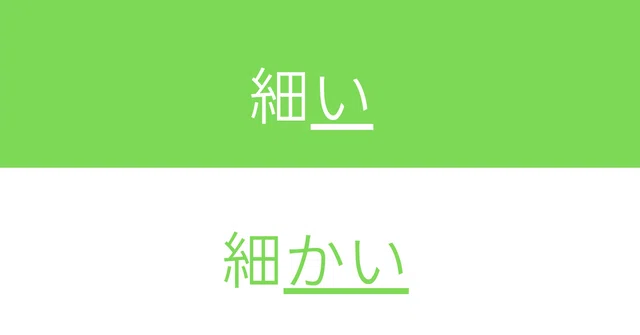
if "okurigana" are attached like this, it is immediately obvious.
◆細i
◆細kai
You can determine the reading.
Other examples include,
"哀"
◆哀shii
◆哀re
"行"
◆行tta
◆行natta
※You can also attach okurigana as "行tta".
and so on.
As someone who likes classical Chinese, "mukae-gana" reminds me of high school classes.

The character '過' is used in both Classical Chinese A and Classical Chinese B.
As it stands, it is impossible to know what is written.
However, if we add 'okurigana' here...!

The reading of each '過' is,
◆To make a mistakete
◆To exceedgitaru wa
as we can see.
From this, we can confirm once again that
'okurigana' is what determines the reading of kanji
is something that can be confirmed once again.
Knowing this, 'mukae-gana' thinks.

And...!
In this way, 'mukae-gana' is a guy who 'will understand if you talk to it'.
Furthermore, it is also a 'reliable' guy that 'makes sentences easier to read'.
Why not try using these "okurigana" in your daily life?
[June 15, 2023: Update!]
In the comments,
"Since almost no one knows what 'okurigana' are, shouldn't you raise awareness before using them? ☺️"
I received this opinion.
I completely agree, haha 😅
First, we need to create opportunities to learn about "okurigana" in places like schools!!

/
This is the magazine that contains this article 👇👇
\
いいなと思ったら応援しよう!
 出版を目指しています!
夢の実現のために、いただいたお金は、良記事を書くための書籍の購入に充てます😆😆
出版を目指しています!
夢の実現のために、いただいたお金は、良記事を書くための書籍の購入に充てます😆😆