
Twitter is a 'Road' & a 'Marketing Venue'. An Interview with Popular Editor Shunsuke Takemura on 'New Corporate Communication Created with note and Twitter': Practical Edition

The 'New Corporate Communication Created with note and Twitter' event discusses tips for using note and Twitter in combination. For this practical edition, we invited editor Shunsuke Takemura.
After working at companies like Diamond, Inc., Mr. Takemura established WORDS Inc. He is a popular editor who has produced a string of hits, including 'The Magic of Memos' by Yuji Maeda and 'Managing Fukuoka City' by Soichiro Takashima.
Mr. Takemura has also written various articles on how companies can utilize note. We asked him about techniques for writing notes that get read by more people, as well as ideas and tips for increasing your readership on Twitter.
Guest
Editor
Shunsuke Takemura

What is an Advisory Editor?
--Mr. Takemura, you refer to yourself as an 'Advisory Editor.' Could you tell us about the work and role of an 'Advisory Editor,' and what its characteristics are?
Takemura The job of an 'Advisory Editor' is to interview corporate executives and summarize their thoughts in a clear and interesting way.
Working on the note of entrepreneur Hironao Kunimitsu was what led me to start working as an 'Advisory Editor.' When Mr. Kunimitsu was launching a web service called 'FiNANCiE,' he asked me to help him properly convey his thoughts and feelings to everyone.
When I actually edited Mr. Kunimitsu's note, the response was quite significant. It has over 3,100 'likes' (as of May 30, 2022). I realized that editorial skills are also in demand in the world of management and business.
--Publishing that article in March 2019 was perfect timing. It was just when Instagram and Facebook were starting to lose their luster, and by publishing that article, Mr. Kunimitsu established a solid position in the web world. Now, Mr. Kunimitsu is seen as a standard-bearer for 'Web3.'
Takemura Originally, Mr. Kunimitsu's ideas and his background were extremely interesting. I just organized them and turned them into text in an easy-to-understand way.
When executives want to summarize company history, convey a vision, or launch a new service, they need text that is summarized clearly. Furthermore, if they want to reach more people, that text must be content that readers actually want to read.
The role of an Advisory Editor is to act as a bridge, converting what the executive 'wants to convey' into what the reader 'wants to know.'

Traditionally, editors were on the side of media outlets like television, publishing, and the web. Executives would be interviewed and have articles written about them. But with this approach, the media's intentions were strongly reflected, which could lead to good points being cut, or the media failing to grasp the executive's true feelings, meaning what the person actually wanted to say wasn't covered.
However, with note and Twitter, by having an editor on the sender's side, executives can communicate their true feelings in a controllable state.
Prioritize 'Who' over 'What'
--Specifically, how do you proceed with the editing process?
Takemura I first ask about the executive's purpose for communicating and decide on a policy.
The key point here is to firmly establish 'who is saying it' before 'what is being said.'
If someone you don't know well suddenly starts talking about their company's services or organizational theory, no one is going to be interested in listening, right? Therefore, we first create content that serves as a self-introduction so that people can understand who that person is.
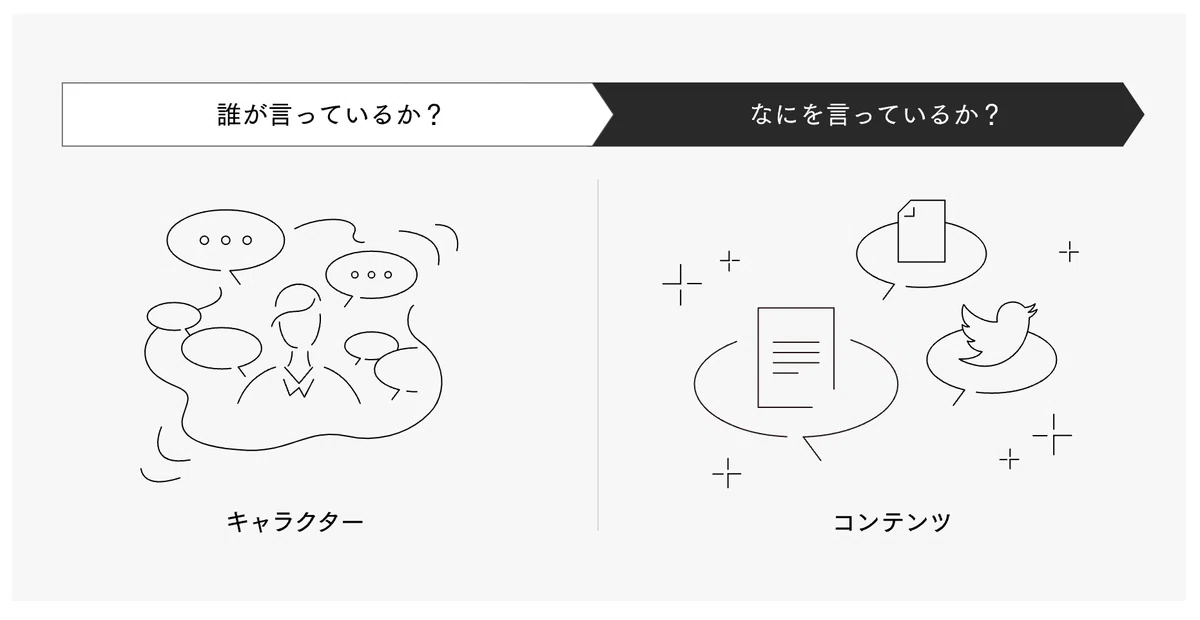
I interview business owners two or three times a month to help them articulate their thoughts and organize their thinking. Basically, all the business owners have to do is answer our questions.
We don't start by talking about business models. Our characteristic approach is to focus on the 'human being' by asking questions like, 'What did your parents do?', 'Were you good at school when you were a child?', and 'What clubs were you in?'
No matter how high-ranking the executive is, we ask that PR staff or secretaries not be present during the interview, and we try to talk one-on-one as much as possible.
People who read articles don't necessarily want to hear 'what an executive has to say'; they want to know 'interesting stories' or 'something useful to them.' Executives always have such things in their experiences and thoughts, and these are easier to draw out when the person is speaking in a pure state.
Our job is to convey what the executive said in their natural state to the readers in an easy-to-understand way. Even if an article goes viral, it's not because we are amazing. It is the result of that person's inherent value being properly conveyed to everyone.
note doesn't need 'pretentiousness'
—Could you tell us about a successful note case study that left an impression on you?
Takemura It's the case of Taichi Kudo, the second-generation president of a printing company. Mr. Kudo runs a company that supports corporate internal branding, but he came to our company for advice because his passion for that work was difficult to convey to the world.
As I listened to his story, I learned that Mr. Kudo is actually the second-generation president of a printing company. However, the printing industry has an image of being a 'sunset industry,' and sales were actually falling. So, he decided to take on internal branding for large companies as a new business model. This is socially significant, and if they take on the production and printing of internal newsletters as part of internal communication, it will also lead to sales for the printing business.
When he introduced his company, he said he 'didn't want it to smell like ink,' but the foundation of Mr. Kudo and his new business is the printing company his father built so well. So, I suggested to Mr. Kudo that he push that to the forefront. The first note that resulted was 'The story of how I became the president of a printing company at 36 and managed to turn around declining sales.'
As a result, many people read it. It also has over 3,700 'likes' (as of May 30, 2022).
People today are very sensitive to Web information. They can immediately spot 'lies' or 'fabricated' content. Besides, they aren't looking for glamorous stories.
I think of note as a medium that is at the 'very center of life.' When I interview people as an advisory editor, I try to ask about the 'life of the person right in front of me.' 'Pajamas over suits,' 'purity over pretentiousness.'
I think the secret to getting more people to read your note articles is to write honestly about your own experiences and thoughts, rather than writing in an 'executive-like' tone.
Twitter is a 'Path' and a 'Marketing Venue'
—What is the position of Twitter for you, Mr. Takemura?
Takemura I think of Twitter as the 'path' for readers to reach note articles. I think there is a lot of browsing within note, but to attract people from outside of note, it's better to have a path.
Also, I consider Twitter to be a 'marketing venue.' If you scatter a lot of small content on Twitter, you can understand to some extent things like 'talking about leadership gets a good response' or 'posts related to self-improvement get a lot of reactions.' It's efficient because you can grasp in advance where you should focus your efforts when writing a note.
As an advisory editor, I also advise business owners to use Twitter in that way.
--How do you think about measuring the effectiveness of communication via note and Twitter?
Takemura: The examples I discussed today are ones that received particularly good reactions from readers. Of course, not every article gets 3,000 or 4,000 'likes'. However, that doesn't mean there's no point in writing them.
I believe there is meaning in the process of business leaders putting their company's values, their own thoughts, and their passions into words and accumulating them as content. Since note allows you to keep things permanently, high-quality content that accumulates becomes an asset.
I also think that having my own note, which I wrote a long time ago, introduced here today has become an opportunity for new people to read it.
--Finally, could you give some advice to those who are planning to start communicating via note and Twitter?
Takemura Content that is read by many people consists of stories and know-how. It is best to divide stories into past, present, and future, as well as ongoing ones.
Past stories are like creating a resume for a company or a business leader, such as self-introductions or company history. If there was a breakthrough event, I think it's good to summarize that. These are the secret stories behind the birth of a product or service. Everyone is very interested in secret birth stories.
Ongoing stories are like NHK's 'Project X', stories about projects you are currently working on.
Stories directed toward the future are 'visions'. It is good to summarize your thoughts on 'what kind of world you want to create'. In that case, it is good to include the business leader's original experience. Since it conveys to the reader why you came to think that way, I think it will be easier for them to become interested.
Know-how should also be divided into individual, team, and company know-how. For individual know-how, it could be 'work techniques' or 'thinking methods'; for team know-how, it could be 'team techniques', 'leadership theory', or 'communication theory'. For company know-how, it would be 'strategy', 'management', or 'business models'.
However, it is difficult to suddenly become a content creator, and it becomes painful if you don't keep it up, so why not start by writing down what you thought about at this event today in your own words? I might 'like' or retweet it, and that might expand your connections and your platform for communication.
--Thank you very much for today.
*Titles omitted
*At this event, we also talked about other note article examples that Mr. Takemura worked on as an advisory editor (from around 38:20). For details, please see the video archive below.
Guest Profile
| Mr. Shunsuke Takemura
Representative Director, WORDS Inc.

Representative Director of WORDS Inc.. Advisory editor for business leaders. Went independent in 2018 after working at Diamond Inc. and other companies. Has edited and written numerous hit works such as 'The Magic of Memo' by Yuji Maeda, 'Managing Fukuoka City' by Soichiro Takashima, and 'Kashiwa Sato's Meetings' by Kashiwa Sato. Currently exploring 'conveyable writing' in the SNS era. Author of 'Writing is Painful' (PHP Institute). Likes potato salad.

interview by Motohiko Tokuriki text by Megumi Ito