
I Had AI Build Music Tools | When I Asked 'Can I Restart?'... | AI Utilization Journey #7

In episode 5, I wrote about making a music video for vegetables, and in episode 6, I wrote about making a story-based music video. In both episodes, I only wrote that I struggled with video production, without detailing exactly what I had trouble with.
Today, I want to reveal the secret. What I struggled with most wasn't the character designs or the background atmosphere, but something much more mundane and troublesome.
If the lip movement is off by even 0.1 seconds, they look like a different person
In the music video, there are scenes where the characters move their mouths to match the singing. This is what's known as lip-syncing.
This was extremely strict. If the voice and the mouth movements aren't perfectly aligned, it creates a sense of discomfort, making the viewer think, 'Something is wrong.'
Even if it's just slightly off, it can sometimes look like someone else is talking. It seems humans are creatures who look at others' mouths with that much sensitivity.
To eliminate this discomfort, there were two things I absolutely needed.
One was cutting the music accurately.
A music video is made by connecting short video clips. If you don't specify and extract exactly which minute, second, and millisecond of the song to use, the seams between the video and the music will be misaligned.
The other was vocal separation.
If I used audio that still had the accompaniment mixed in, those sounds would get in the way, sometimes causing the AI to create lip-syncing at the wrong timing.
I desperately wanted these two things: a 'tool to split music at specific times' and a 'tool to extract only the vocals'.
'Wouldn't it be faster to just have AI build this instead of searching for it?'
At first, I thought about searching to see if I could manage with existing apps or services. There are various audio editing tools in the world. One of them should have been enough.
But while I was searching here and there, a thought suddenly popped into my head.
'Wouldn't it be faster to just have AI build this instead of searching for it?'
It was half an idea and half a resignation. Because of my job, I think I've dealt with computers and IT to a certain extent. However, writing programs myself is a different story. I had written a little bit of shell script for work in the past, but I thought I was at a level where I couldn't build anything anymore.
Even so, by this time, I had become completely accustomed to consulting with Gem. As an extension of that, I thought, 'Well, why don't I just have it build a tool specifically for me?'
That's when I encountered a service called Antigravity.
Antigravity was not a consultant
Antigravity is an agent development platform provided by Google. It was released in November 2025 and is free to use. I used the IDE version, and getting started was as simple as downloading and installing it.
The moment I touched it, I realized it was a completely different kind of tool from the Gems I had used before.
Gems were strictly 'partners to consult with.' I would throw a question at them, and they would return an answer. Whether it was health management, investment advice, or songwriting, it was always that kind of interaction, and it was always me who had to do the actual work after receiving the answer myself.
But Antigravity was different.
In response to my instructions, it actually performs the work on my computer. It creates files, writes code, tests them, and fixes them if they don't work. It handles all of that.
What I thought was a consultant had, before I knew it, turned into a partner that actually does the work right in front of me. That was the feeling.
The first instruction I threw at it was only one line.
This was the only instruction I gave when I had it build a tool to split music.
Can you split an audio file at a specified time (down to the millisecond)?
Just that. And it wasn't even an imperative command like 'Please build me a...', but rather a question: 'Can you do...?' Even reading it back now, it's so short that I'm worried if it really conveyed what I wanted.
It wasn't a case of 'throw one line and it's done'
However, it's not as if a finished product appeared just by throwing that one line. When I gave the instruction, it sent back a confirmation. It was a consultation on how to build it, such as whether it would be okay to make it as an app that runs in a browser. So, we discussed together what the best way to build it would be. At this point, 'consulting' and 'having it build' were already mixed together.
That's how the first version was completed. It worked, sure. But when I actually tried using it myself, there were parts that were difficult to use as they were. So, from there, I started giving orders.
I want you to make it Japanese
I want you to allow specifying by minutes, seconds, and milliseconds
I want you to add a button to download the split files
Looking at them now, they are closer to mere impressions than orders. Even so, if I said it, it would fix it exactly as requested.
In other words, that first line wasn't a spell to summon a finished product, but the entrance to a consultation. From there, it would ask back, I would answer, I would touch what was made, and then I would give more orders. It took shape through that back-and-forth.
Looking back now, this might have been the biggest discovery. There was no need to write perfect instructions from the start.
I think there are probably many people like me who think, 'I can't get started because I don't know how to ask properly.' But in reality, it was fine to start by just asking casually.

Actually, I also had it create an audio merging feature at the same time

A tool to extract only the vocals
Next, I asked for a tool to extract vocals. For this one, I provided conditions from the start.
Can you extract only the vocals from a music file specified by the user?
In addition to this request, I provided five conditions.
Do not change the volume of the vocal track
Do not change the length of the song
Keep it entirely local to ensure high security
Allow the user to specify the filename after conversion
Allow the user to download the converted file
I used this vocal extraction tool on my own songs created with Suno—that is, the original songs I've written in previous installments. It was not created to extract vocals from someone else's music. I want to state this for the record.
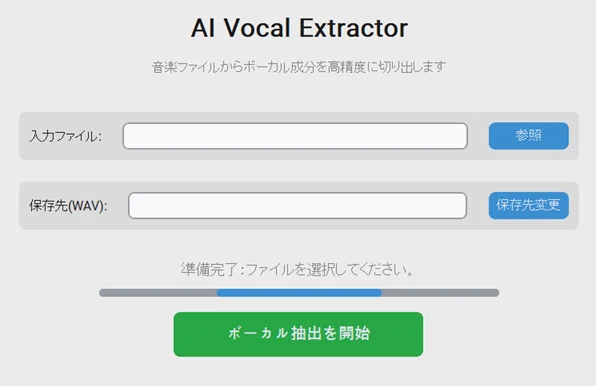
The AI also proposed the tools to use. ffmpeg for cutting music, and Demucs for vocal extraction.
I hadn't heard of either, so I verified they were safe before installing them. Just because it was an AI suggestion didn't mean I accepted it blindly.
The time it took, including the installation of Antigravity itself, was about half a day. The vocal extraction tool took shape in a few hours after that. I, who thought I could no longer write programs, had acquired two tools in less than a day.
A PATH error and, 'Can I restart?'
In the middle of the work, an error occurred related to Python. It was the classic 'path not found' issue. Having seen screens like this at work, I had a hunch that the PATH might not be set correctly.
Sometimes, restarting fixes things in these situations. With that in mind, I suggested, 'Should I restart the PC?' Then, Antigravity replied with something like, 'Yes, please.'
I don't have the chat log left, so I can't reproduce it word for word, but there's no doubt that was the nuance.
I went ahead and restarted the computer.
When it booted back up, the program was finished.
At that moment, I had a strange feeling. The computer was definitely mine. Yet, because the other side was the one actually doing the work, I was asking for permission every time I needed to restart.
I felt like a colleague who, despite being the owner, was asking a coworker who was in the middle of a task, 'Do you mind if I take a break?'
Of course, I didn't just trust and use what was made as is. I ran it myself to verify if the music could be cut as specified and if the vocals could be extracted cleanly.
What surprised me was that it was 'already finished,' not that I was able to use it without checking.
I always try things myself before using them. That was the one rule I didn't break.
From consulting to having it build
The two tools I obtained this way ended up being very useful in the subsequent MV production.
I became able to cut music and extract vocals with the precision I had imagined. Above all, I was able to create cuts exactly as I envisioned.
This brings us to around March 2026. It hadn't even been a few months since I started using AI properly.
A person who couldn't even use the free version of Gemini properly had reached the point of having an AI build custom tools for them.
When I was consulting with Gem, I was always the one who had to take action after getting an answer. But this time it was different. After I gave the instructions, it was Antigravity that was doing the work.
From 'consulting' to 'having it build.' It was an experience where I felt that level of change within myself.
The first tool I wanted an AI to build for me was a very simple, plain tool just for cutting music.
What is the tool you want most right now?
If you'd like, please let me know in the comments.
Thank you for reading this far.
This series starts from a point where I couldn't use AI at all.
The first step is here.
▽ Episode 1: To those who don't know how to use AI
https://note.com/noted_rascal/n/n7e593ea898fb
▽Read the series in full
https://note.com/noted_rascal/m/m7e760770580b
いいなと思ったら応援しよう!
 気に入ってもらえたら、コーヒー一杯分くらいの応援をもらえたら嬉しいです。次の話を書く励みになります。