
The "Snake Gourd" I found in midsummer—isn't its appearance a bit too scary?🐍🌿

It is the sweltering month of August every day.
How is everyone doing?
When you go outside, the sun beats down mercilessly.
In the middle of midsummer, when the only words that come out are "It's hot...", I came across the name of a rather strange plant.
Its name is—
"Snake Gourd"
...Snake Gourd?
When I first heard just the name,
"Wait, a snake?"
I felt a shiver go down my spine.
And it's a plant, at that.
Just from the name, it feels somewhat ominous.
But when I looked it up...
It turned out to be a more interesting plant than I had imagined.
🐍 It really was "like a snake"
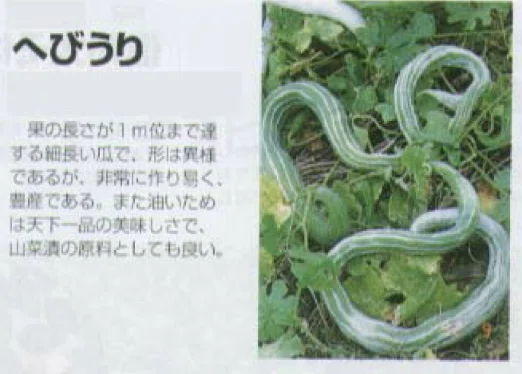
The snake gourd is an annual vine plant in the Trichosanthes genus of the Cucurbitaceae family.
Its scientific name is Trichosanthes cucumerina.
It is a plant native to tropical Asia and other regions, and it grows by extending its vines.
And what seems to be the origin of its name is—
It is a fruit.
It is long and thin.
It is incredibly long and thin.
And, it is not necessarily straight.
Wriggling.
Coiling.
Sometimes, it looks just like something is crawling.
According to the data, the fruit can actually grow to be 30 to 180 cm long.
……180 cm?
That is the height of a person.
It is a plant 'fruit'.
When I first learned this, I thought,
'No, no, wait a minute💦'
That was my reaction.
If something like that were hanging from a vine...
Even if I knew it was a gourd, I think
my heart would stop for a second😅
Here is the scene...!
↓
↓
↓
No mosaic, proceed with caution (lol)

……😱
I have a feeling that seeing it swaying in the wind would give me trauma (lol)
🌿 And what's more, it gets even scarier when fully ripe
The young fruit is a greenish-white color.
However, as it matures,
it changes from orange to dark redin color.
I believe I read in a biology book that such vivid colors and patterns are called warning colors (aposematism)...?
And the fruit, which is already long, slender, and prone to bending, becomes even more twisted.
In other words,
Just when you think there are giant green snake-like fruits hanging there,
they turn into giant reddish snake-like fruits.
If several of those were hanging from a garden trellis on a midsummer night...
Doesn't just imagining it make you feel a bit cooler?😂
Actually, no.
I might run away before I get a chance to feel cool.
The scene is right here...!!
↓
↓
↓
※Are you mentally prepared...?

………😱
Are these many snakes rejoicing in the sunlight?
Its presence, which doesn't seem like a gourd at all, is very dazzling...
🌸 However, the flowers are very beautiful
……Everyone, thank you for your patience up to this point.
Let's take a break from the nail-biting thrills here,
and catch your breath.
While it is a plant that bears such "snake-like" fruits, its flowers are surprisingly beautiful.

Fine, thread-like structures extend from the edges of the white petals.
It's just like,white lace.
Or perhaps,a snowflake.
It is a completely different world from the eeriness of the "snake" one imagines from the plant's name.
Moreover, this plant is known for opening its flowers and releasing a fragrance at night.
In other words,
During the day, it's a "snake-like fruit."
At night, it's a "white lace-like flower."
It is a truly mysterious plant.
It resembles the flower of the Japanese snake gourd (Trichosanthes cucumeroides), but since you can see the flowers during the day, that is a major difference from the night-blooming Japanese snake gourd.
🍛 And surprisingly... it is edible
Here, I was even more surprised.
The snake gourd was not just a rare ornamental plant.
The young fruit is edible.
According to materials from JIRCAS (Japan International Research Center for Agricultural Sciences), the young fruit is boiled and eaten with dip sauce or added to curries.
In other words,
“It looks like a snake and it's scary!”😱
The thing I thought was,
is actually served on the dinner table as a normal vegetable.
This is interesting, isn't it?
Because of its shape, I didn't have the slightest desire to eat it, but
it is certainly a type of gourd.
Like with 'abalone,' I wanted to praise the courage of the brave person who first decided to eat this (lol).
Since there are dishes that use snake gourd in Indian cuisine and the like,
“Perhaps I might have eaten it without knowing?”
That might even be the case.
🥒 What does it taste like?
So, about that snake gourd.
What on earth does it taste like?
I was very interested and looked it up,
since the young fruit is used as a vegetable, rather than a strong-flavored delicacy, it seems to be treated asa light-flavored vegetable that absorbs the flavors of the dish.it is treated as.
Putting it in curry, or boiling it and pairing it with sauce.
When I hear that,
“Even though it looks like a giant snake, the taste is surprisingly normal.”
I feel a little relieved.
It's strange how, when you slice that long fruit into rounds, it looks just like any other gourd vegetable.


It seems there is a type of dish in South India where snake gourd is finely chopped and stir-fried with coconut, and I'd love to try it.
If I were to cook it in Japan,
I might stir-fry it with miso,
simmer it in dashi broth,
or put it in miso soup.
If you cook it like luffa or winter melon, it might actually fit into a Japanese meal quite well.
🌱 'Is it protecting itself by mimicking a snake?'
At this point, a question suddenly popped into my mind.
Could it be—
'Is it making itself look like a snake to avoid being eaten by animals?'
Plants have all sorts of 'wisdom for survival'.
That's why I want to imagine things like that.
However, as far as I've looked into it,
'it is a form of mimicry to protect itself from predators by resembling a snake'
I couldn't find any evidence for that.
Rather, it seems that growing into a long, winding fruit is simply the natural characteristic of this plant.
Humans saw that,
'It looks like a snake!'
and gave it that name. That seems like a more natural way to think about it.
But for those who love snakes, it might be a 'reward plant' rather than a scary one (lol).
🪨 Still, plants have their own 'ingenuity'.
However, there is an interesting story here too.
There are varieties of snake gourd that produce long, thin fruits.
That is exactly the one people talk about.
And, if you want to grow the fruit straight—
Believe it or not,
you hang a weight from the tip of the fruit
apparently.
It's not that the plant is trying hard,
'I must become straighter!'
It's not that.
It's that humans attach a weight to make the fruit grow straight.
For some reason, I found that a bit funny.
If left to nature, it's all wiggly. (It really gives me the creeps...💦)
When humans intervene, it's straight.
The 'snake-like' nature of the snake gourd might actually be its most natural form.
🌏 A hardy plant that lives in hot countries
The snake gourd is native to tropical Asia.
It is a vine plant that grows in hot regions.
It uses supports to climb higher and higher, hanging its long fruits down.
For those of us living in Japan in midsummer,
'It's so hot I don't want to move anymore...'
is how we tend to feel, but plants are busy growing even in such heat.
Moreover,
they produce fruits that are as tall as a human.
they produce fruits that are as tall as a human.
When you think about it that way, you're somewhat overwhelmed by the vitality of plants.
It has something in common with the suffocating appearance of summer grasses in thethick, humid airof midsummer.
🐍 From 'scary' to 'interesting'
At first,
'Snake gourd, what an unsettling name...'
I thought.
But when I looked it up,
it blooms with white, lace-like flowers,
bears long, long fruits,
turns red when fully ripe,
and its young fruits can be eaten and even put into curry.
And, at least according to the materials I could verify, its snake-like appearance is not 'to mimic a snake and protect itself'.
The more I learn,
from a 'scary plant', even if just a little bit,
'what an interesting plant it is'
It changed into.
Plants are truly just too mysterious.
🌿 A story that will give you a little 'chill' in midsummer

Midsummer in August.
When you're tired from the heat,
a cold drink is nice, but sometimes, with a story about a plant like this,
a 'yikes!'
might not be so bad (laughs).
If, in a midsummer garden or botanical garden,
you happen to see something long and thin hanging from a tree—
first, please stay calm.
It might just be,
not a snake, but a snake gourd.🐍
……That said.
I would probably check from a distance.
'Even knowing it's a gourd, this is scary...😅'
Thinking that, this summer,
I learned about one plant whose name I didn't even know.
And someday, I also have the desire to see where a snake gourd is actually growing.
If possible...
During the day.
If possible...
From a distance where you won't mistake it for a snake.
That was a small summer discovery.
Thank you for reading this far.