
The Intersection of New-Era Branding and Thought Leadership: An Interview with Noriko Sato of Interbrand Japan, a Key Figure at One of the World's Largest Branding Firms

A marketing approach that creates new customers and markets by presenting innovative ideas to the world and attracting stakeholders to co-creation through "empathy""Thought Leadership". This is the fifth in a series of interviews with experts to examine its importance from multiple perspectives. Our guest is Noriko Sato of Interbrand Japan. Interbrand is one of the world's largest brand consulting firms, founded in London, UK, in 1974, and Ms. Sato leads its Japanese division. Against the backdrop of the COVID-19 pandemic and social instability, the direction of corporate branding has changed significantly. Companies are under pressure to clarify their stance on social changes and issues and to demonstrate that they are "implementing" this in their activities. We asked her about the area where branding and thought leadership overlap.
It is important not only to talk about a vision but also to ensure it is "implemented" within the organization
—How has corporate branding evolved?
Sato It is said that the original etymology comes from the Old Norse word "BRANDR," which means "to burn." It was a mechanism for branding a mark on cattle to differentiate them from others. Along with changes in society, it has evolved from its traditional role as a "symbol" to a term that today refers to activities that convey the worldview of a company or product to society and communicate unique values.
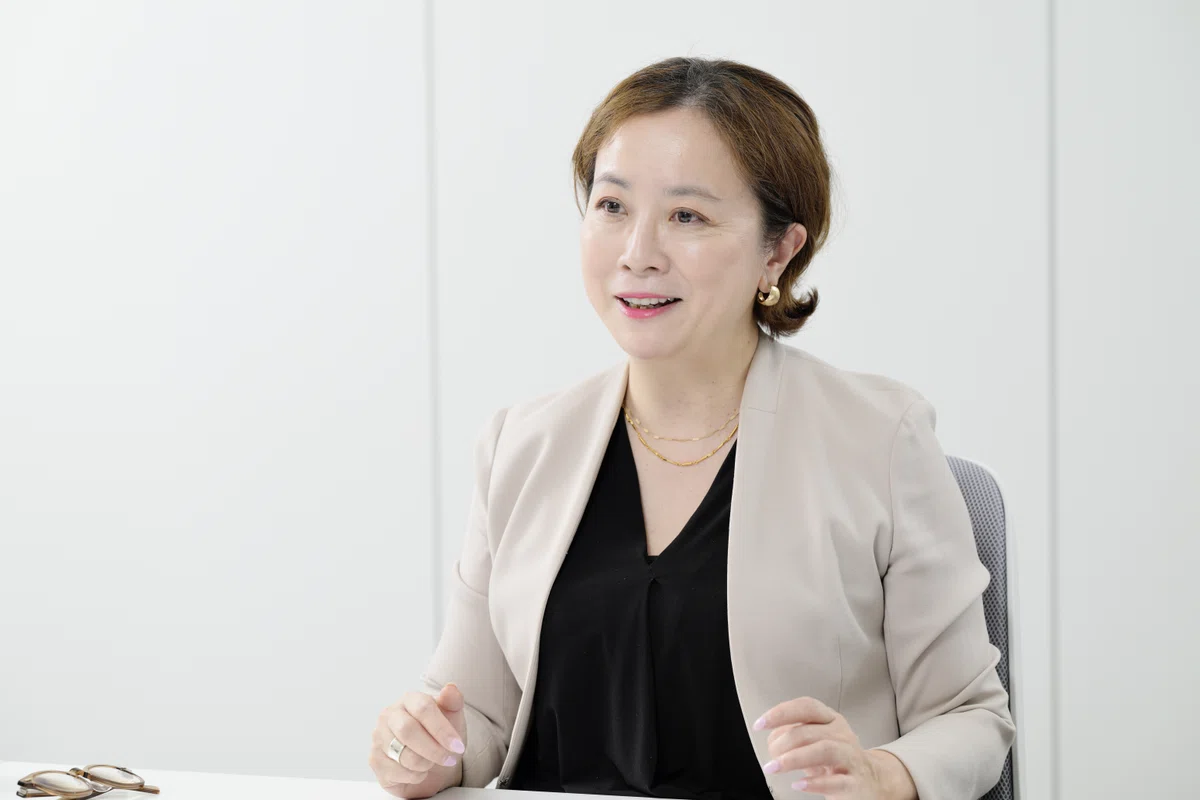
Ms. Noriko Sato
Recently, it has become important not only to promote products and services but also to communicate a company's philosophy and future vision. The image is close to "perception." It means "awareness" or "way of seeing things."
In other words, the goal of branding until now was to "change impressions" of consumers. I feel that it is now shifting toward "changing perceptions."
—What is the background behind such changes?
Sato There is a rapid change in the business environment. The emergence of GAFA was one trigger. Subsequently, social anxiety accompanying the COVID-19 pandemic and international conflicts has occurred one after another, and the social climate has changed significantly.
As mentioned above, branding has evolved from promoting products and services to communicating a company's philosophy and vision. However, in recent years, people's interests have changed significantly. Even if a company talks about its philosophy and vision, that alone is no longer enough to gain "empathy."
It is becoming important not only to put forward a philosophy and vision but also to demonstrate concrete actions. What position is the company taking in response to the swell of a changing society? What kind of ideology is it expressing, and how is it connecting that to concrete actions? It is required to make these things clear.
The response to consumers is also changing. Until now, it was said that brands that unearthed consumer needs through market research and responded to them firmly were strong. However, today, it is necessary to preempt consumers and propose new value from the company side. As one method for this, thought leadership is attracting attention from the perspective of branding as well.
"Rather than talking about the distant future, I want you to capture the present" The market's sense of expectation is rising. Companies and brands are expected to notice and approach the underlying pain points that consumers have not yet realized.
—What do you mean by "capture the present rather than talk about the future"?
Sato The foundation of branding remains "future-oriented." Talking about the future is, of course, important. However, with the increasing uncertainty due to the COVID-19 pandemic, international conflicts, and climate change, even if someone says, for example, "We predict 2030 will be like this, and we will act like this," no one knows what will actually happen.

While companies talk about their future vision, can they concretely put forward the "present" and "actions," such as "That is why we are acting this way now"? That is where the interest of consumers and investors is gathering. What are they "implementing" as concrete actions? That is what is being watched especially closely now.
The challenge for Japanese companies is "not being able to establish a clear position"
—What is thought leadership in your opinion, Ms. Sato?
Sato It is one of the methods that supports differentiation strategy in branding. Our company has the theme "Brands as acts of leadership." It means "a brand is leadership itself."
The background is the social change mentioned above. The mission of companies until now was to pursue profit and enrich the world, and solving social issues such as climate change and human rights issues was the job of governments, local municipalities, and NGOs. However, that is changing significantly now.
This shift is also evident in the renowned Edelman Trust Barometer. In surveys asking, 'Which organizations do you expect to solve societal issues?', NPOs, NGOs, and international organizations previously held the top spots, but expectations for corporations have risen significantly. Companies are now required not only to provide unique products and services but also to clarify their stance on how they contribute to society.
This is why thought leadership has become so important. While a company is an organization composed of many people, it is expected to behave as if it has a single personality and to demonstrate its mission and beliefs. Beyond products and services, companies are being asked, as corporate entities, 'What questions are you posing to the world?' This, I believe, is the very essence of thought leadership.
—What is required for companies and brands to become thought leaders?
Sato 'Who is communicating' has become more important. Previously, it was sufficient for marketers or business division staff to step forward, publish white papers summarizing key points, or disseminate information through the media. But now, top management must also step to the front. This is because thought leadership is, in itself, a management method.
As mentioned earlier, society's interest and expectations are not in products or services, but in the company itself. Top management is required to speak for themselves and take the lead. I feel that Western companies are quick to make this transition, while Japanese companies are lagging behind.
—What does thought leadership led by top management look like?
Sato I don't think there is a single correct answer yet, but as a first step, the organization's direction—where it is heading—must be clearly shared and understood by both management and employees. It is meaningless if only the management works hard. It is necessary to visualize these thoughts in the form of a mission or purpose and use them as the organization's banner. Every business activity will then be linked to and developed based on that.

The second step is 'how to realize that (thought)'. This is where the conversation starts to shift toward branding. In today's branding, a company's 'personality' and 'uniqueness' are crucial.
For example, even within the same cosmetics industry, Shiseido and Pola should have different approaches and methods. Even if the theme were the same, the direction of their thought leadership would differ based on their history, culture, and mission. It is necessary to clearly define and visualize this and share it with all stakeholders, including management, employees, customers, and investors.
When it comes to the third step, 'how to bring that (thought) out into the world', I feel that many Japanese companies exhibit thought leadership where the face of top management is invisible. Even though the context of branding has shifted from products and services to the company itself, why don't the presidents speak for themselves? I think there is a risk-averse mindset unique to Japanese companies in that regard.
Thought leadership carries a certain amount of risk. You must be prepared to take risks, clarify your position as a company, and take the initiative in the world. If you put forward a pioneering stance, there will inevitably be pros and cons. If you have an 'honor student' mentality that fears opposing opinions, it becomes difficult to establish a clear position. I feel that this is where the challenge lies for Japanese companies.
Speak in the context of 'Implementation-based Thought Leadership'
—What kind of thought leadership should companies aim for in the future?
Sato Until recently, I think everyone was aiming for 'problem-solving thought leadership.' It is an attempt to show originality in 'what kind of questions to pose,' but I feel that it is gradually becoming homogenized. Focusing 'only' on how to pose questions does not function effectively as a differentiation strategy for thought leadership.
So, what should be done? I feel that 'implementation-based thought leadership' is necessary. You should talk about how to 'implement' ethics, values, and purpose into the organization and corporate activities.
For example, if you want to promote the value of 'social contribution,' the '1-1-1' model promoted by Salesforce in the US is a good example. It 'implements' into corporate activities with an intuitive and easy-to-understand concept: 'contribute to the community by utilizing 1% of products, 1% of equity, and 1% of employee time.' It is simple, but it is a well-thought-out thought.
Right now, I think Japanese companies are struggling with 'implementation.' They are so focused on posing 'questions' related to social issues that I feel their awareness does not reach the point of action. What kind of actions will lead to people trusting you? The difference will be made by whether you can create a one-of-a-kind form of 'implementation' and lead.
—It is difficult to move from the stage of posing questions to the stage of 'implementation.' I think that unless the organization's culture changes, not just the top management speaking, it will not be effective.
Sato That is correct. 'Culture branding' has become an important keyword in branding. An organization's culture cannot be changed just by changing the choreography of employees. It is necessary to change the values of each individual. In fact, we are receiving more and more such consultations from our clients.
I often say that 'implementation power' and 'self-creation power' are necessary. Implementation means 'does it lead to action?' Self-creation means 'are you creating it yourself, rather than borrowing it from others?'
For example, more companies are establishing "internal venture programs." Traditionally, these were driven by a somewhat "top-down" mindset, such as wanting to "energize young employees" or "give young people a chance."
On the other hand, recently, more companies are looking to leverage the sensibilities of young employees to solve social issues, "implement" solutions into their business, and explore the creation of new ventures, hoping to find a path forward there. These must be born from the company's own culture. To that end, "culture branding"—the creation of a unique culture—is being demanded.
Deciding "what not to do" with risk in mind, and clarifying one's stance
—Salesforce, which you mentioned earlier, is actively entering areas that are subject to debate. What is the objective behind that?
Sato It is a message that says, "We only need people who agree with our thinking." In other words, it is a stance that says, "If you don't agree, you don't need to come," and this is likely the state of brand leadership today. As a brand, it is about deciding what not to do or deciding what is okay to discard.
Different opinions will always emerge. Accepting them has become very important. I feel that in a world without lies, the "conviction" of saying, "This is what I think, what do you think?" is being called into question.
As commoditization progresses and there are fewer products or services that can overwhelm competitors in terms of performance or quality, every market has become a battle of small differences. That is precisely why it is important for companies and brands to capture the hearts of customers and gain "empathy."I feel that casting a net in areas that can serve as emotional support for consumers is becoming an important marketing technique.
—Are there any examples you are paying attention to as references for thought leadership?
Sato There are many, but recently I have been focusing on the field of education. Amidst the declining birthrate, I think the movement of thought leadership is gradually spreading.
One college of technology has put forward a student profile of "people who create things to make things happen" and is developing a curriculum that cultivates "technology," "design," and "entrepreneurship." The initiatives of companies that offer "child-led living experiences where families stay in a region for 1-2 weeks" under the concept of "nursery school study abroad" are also interesting.

While maintaining the central theme of education, they are linking it to socially relevant matters and beginning to create new value that transcends categories. I feel a certain brilliance in how they are also connecting this to regional branding.
—How is branding know-how useful when practicing thought leadership?
Sato You can consider thought leadership and branding to have become quite integrated. Throughout their history, the barriers between branding and marketing have disappeared. Now, thought leadership has been added to that. I think we now have a Venn diagram where three circles overlap.
Our aforementioned theme, "Brands as acts of leadership," is also a challenge to express leadership using the method of branding. Creating new markets is the goal of thought leadership, and it is also the goal of branding. After all, branding is nothing less than "changing the values of customers who choose products."
As was the case during the Lehman Shock, even if business performance drops temporarily due to changes in the business environment, companies with high brand value recover very quickly. In that sense, I recognize that branding is the work of strengthening a company's core.
At the "Japan Branding Awards," which our company hosts every year, we have renewed our evaluation perspectives for 2024.
There is a phrase we truly believe in: "Branding has the power to change the world." This is because branding changes people's values. It can change the way things are perceived and the axis of interpretation.
Previously, we focused our evaluation on how companies defined "who they are," structured it, and expressed it, but starting this year, we have added perspectives such as "Are they flexibly transforming in line with changes?" and "Are they translating this into concrete experiences?" We will continue to evaluate and communicate new branding that responds to the values of today's uncertain times.
<After the interview>
"Instead of talking about the distant future, I want you to capture the present." These words made me realize that the front lines of branding are changing, and they were a sharp insight that was eye-opening from the perspective of thought leadership as well. Using imagination to look behind what consumers are thinking to find honest pain points. From a branding perspective, it is said that for companies today, it is important not only to put forward philosophies and visions but also to demonstrate concrete actions to gain "empathy." While talking about a vision for the future, can they concretely present the "now" and "actions" by saying, "That is why we are acting this way now"? The point that companies are being watched for that was impressive. The observation that thought leadership becomes important there is persuasive. Companies are expected to behave as if they have a single personality, to show their thoughts, and to take action. It was a conversation that left me nodding deeply, full of learning and realization.

Interviewee: Noriko Sato, Senior Executive Director / Client Services & Solutions Group, Interbrand Japan
After working at the European Investment Bank, she earned an MBA in France. She participated in various roles at a major foreign-affiliated consumer goods company, including launching new businesses, corporate planning, and business strategy reform. Later, at a major Japanese consumer goods company, she led the global expansion of brands, primarily in emerging Asian markets, at both the management and operational levels. Currently, at Interbrand Japan, the Japanese subsidiary of the brand consulting firm headquartered in New York with offices in 11 countries worldwide, she is involved in a wide range of projects including real estate, IT, consumer goods, cosmetics, and retail, providing client support based on her experience and expertise in operating companies.
Interbrand Japan https://www.interbrandjapan.com/
Planning, Production, and Editing: IISE Thought Leadership Hub (Kumi Fujisawa, Shotaro Suzuki, Kiminori Shioya, Asumi Ishigaki)