
[2023] 14 Selected Art Books I Read

[Approx. 2,900 characters, approx. 15 photos]
Of the 131 books I read in 2023131 books, I will introduce 14 books related to art.
Conclusion: The selection was wide-ranging, from management books to ballet and theater. By raising my level of art knowledge in a broad sense through reading, I find that it helps not only when visiting exhibitions but also in daily life, leading to a chain reaction of new discoveries. I want to continue reading art books regularly.
▶︎ Art-related books I read in 2023
Of the posts I made on note in 2023, 78% were about exhibitions. I think many of you reading this post are also very interested in art. Therefore, I will introduce 14 books related to artout of the 131 books I read in 2023 in a ranking format, within 150 characters each.14 books.
Please forgive me as some of these books overlap with previous posts 😀
■ 1st Place / "Why Do Global Elites Cultivate 'Aesthetic Sense'?" / Yamaguchi Shu

In management, art (aesthetic sense for judging truth, goodness, and beauty) is important. The reason I like minimal art is that it is the pinnacle of "selection and abstraction." That way of thinking also applies to business. Also, I wanted to raise my children to be able to answer questions that have no answers, based on an aesthetic sense.
■ 2nd Place / "The Super <Customer Attraction> Revolution: How Popular Museums Know How to Attract Customers" / Mino Yutaka

I resonated with Yutaka Mino's idea that "a museum is an exciting place where a new encounter is always waiting if you go there." Japanese people tend to seek the correct "answer," but there are no answers in paintings. It is fine if a museum just moves your heart; it is not a place to study with a serious face.
■ 3rd Place / "Japonisme of Beauty" / Mitsui Hideki

I understood well the differences in sensibility between Europe and Japan, and the differences in the expression of art due to religious views. Europe is heavily influenced by Christian thinking, so it is anthropocentric, geometric, and scientific. On the other hand, Japan is atypical, and its origin is the modeling of nature. I was able to theoretically understand the surprise I felt when I saw Gallé's works at the Kitazawa Museum of Art.
■ 4th Place / "Introduction to Theater" / Hirata Oriza

By knowing the creator's intentions, I was able to watch movies and the like from a new perspective. The purpose of this book is to know "something like the mechanism of consciousness that makes us feel real, through the exploration of real (= the feeling of living in the same world right now) in theater." It is important how a play expresses a worldview realistically.
■ 5th Place / "Opera and Kabuki" / Nagatake Yoshiyuki

Because the author is well-versed in both opera and Kabuki, such as "opera is a play with musical notes, and Kabuki is a song with a melody," he makes grounded comparisons that are helpful. Japanese people destroy things with form, but they value the intangible and actively incorporate other cultures. On the other hand, it was fresh to learn that Italy is the exact opposite.
■6th Place / "Art Predicts the Future of Capitalism" / Toyotsu Yamamoto

From the perspective of an art gallery, the art philosophy that "artists must create works that sell" is refreshing. I was happy to find that the author, who states that "because we live in a stagnant era, the transformation and leap in the value of art can be a great hint," was inspired to take an interest in contemporary art by Lucio Fontana, just as I was.
■7th Place / "What is Art? 147 Questions Answered by Hiroshi Senju" / Hiroshi Senju

In addition to the wide range of questions, the answers were concise, making it more helpful than I imagined. According to Hiroshi Senju, "A wonderful art museum has a wonderful collection, makes the works easy to see, and the space where they are placed is organized and tidy." The list of wonderful art museums chosen by Hiroshi Senju is also helpful.
■8th Place / "Japanese Aesthetic Consciousness" / Kenji Miyamoto

Japanese people possess aesthetic sensibilities, such as wabi and sabi, that do not exist in the West. These are rooted in Shinto and Buddhist ways of thinking. Whether it is Art Nouveau or the negative space in Japanese painting, I was able to reaffirm my pride in the aesthetic consciousness that flows through all Japanese people, even if they do not practice Buddhism.
■9th Place / "Renoir Smiles Innocently: A Recommendation for Artistic Thinking" / Hiroshi Senju
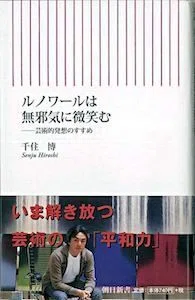
Hiroshi Senju's recollection that he was "completely knocked out in one second by the charm of natural mineral pigments in Japanese painting" changed the way I view Japanese art. Also, Renoir's paintings are apparently 'smiles for the sake of smiles'. Renoir's idea that the absence of a message is the message itself may have been a pioneer of contemporary art.
■10th Place / "World History of Ballet: 600 Years of Dance Pursuing Beauty" / Satoshi Unno

"The charm of ballet is rooted in the fact that living, breathing dancers are expressing themselves right here and now, without words, using only their bodies... it has a mysterious power not found in other dances." I thought that the fact that ballet is more frivolous compared to Kabuki, such as ballerinas becoming prostitutes as seen in paintings by Degas and others, might be a difference in national character and culture.
■11th Place / "The Louvre: A Story of Beauty and Power" / Hideki Kojima

I was able to understand that the Louvre Museum is built upon various histories. I was surprised that the annual "pocket money" of Louis XV, known as the Spendthrift King, was 2.7 million livres (several billion yen) and that he spent every week and every day just playing around.
■12th Place / "Seiji Ozawa: The Japanese and Western Music" / Koichi Endo

Western music is WesternBecause this idea is so strong, it seems that when Japanese people conduct, that issue is always present. Also, I learned that Mr. Ozawa was skilled at being able to objectively analyze an orchestra.
■ 13th Place / "Beautiful People: Faces That Left a Mark on History" / Kyoko Nakano

Ms. Nakano's stance is that "for paintings that have original meanings or stories, appreciating them after knowing those meanings and stories is a form of respect for the work and the artist" For non-religious Japanese people, that is a high hurdle, so I prefer contemporary art, which provides multifaceted suggestions.
■ 14th Place / "Polka Dot Resume" / Yayoi Kusama

If you want to know about Yayoi Kusama, you should read "Infinity Net: The Autobiography of Yayoi Kusama" It was good to be able to clearly understand that her polka dots and soft sculptures are not just 'kawaii,' but stem from her paranoid awe and as an antithesis to misogyny.
▶︎ Summary

What did you think? Even though they are 'art-related,' the selection was wide-ranging, from management to theater and ballet. When I go to exhibitions, I go without researching anything. That is because I want to cherish the excitement of facing the works for the first time. However, I think it is also important to raise the level of my knowledge of art in a broad sense through reading and the like. I intend to continue this virtuous cycle in the future.
いいなと思ったら応援しよう!
 Thank you for your support!