
Azabudai Hills Report: A Violence of Style! The Tallest Observation Deck in Japan is a Must

[Approx. 3,200 characters, approx. 25 photos]
November 2023I visited "Azabudai Hills" which opened in I will write my impressions (plus thoughts on Mori Building) from the perspective of the observation deck and art.
To start with the conclusion, I thought it was a complex that you should visit at least once. This is because 1) the observation deck, which is the tallest in Japan for a building, has a great view and is free!, 2) the building and interior design are violently too stylish, and 3) there are multiple public art installations and permanent exhibitions (which are expensive). It is recommended for both tourists and Tokyo residents.
*The public opening of the observation deck has been changed to April 17th😨 (March 27th release)
Location: Azabudai Hills
Recommended rating: ★★★★☆
Stroller: -
Closed: None
Address: 1-3-1 Azabudai, Minato-ku, Tokyo
Access: Approx. 5-minute walk from Kamiyacho Station, etc.
Admission (General): -
Advance reservation: Not required
Time required: 1 hour to all day
URL: https://www.azabudai-hills.com/index.html
▶︎Access

Azabudai Hills is directly connected to Kamiyacho Station. Also, it can be reached in about a 4-minute walk from Roppongi-itchome Station. Since it can be accessed from the Namboku Line, Hibiya Line, Oedo Line, Mita Line, etc., you should take the line that is convenient from your address.
Address: 1-3-1 Azabudai, Minato-ku, Tokyo
▶︎Reason for visiting

On the day, Azabudai Hills was not the primary objective; I stopped by on my way back from visiting the Kikuchi Tomo Museum. In addition to it being near the Kikuchi Tomo Museum, I wanted to visit once to see what kind of facility it was because 1) there is a lot of public art, and 2) I had heard from the media and people around me that it was too crowded to get near.
▶︎What is Azabudai Hills

Azabudai Hills is a complex facility that opened on Mori Building Co., Ltd. on November 24, 2023. The total project cost is approximately 579.2 billion yen. It seems that moves to acquire this vast land began in 1989. Being a developer is a tough job.

"Azabudai Hills" is divided into Azabudai Hills Mori JP Tower, Azabudai Hills Residence A/B, and Azabudai Hills Garden Plaza A/B/C/D. Inside, it includes housing, offices, medical facilities, commercial facilities, schools, and more. These contain about 1,400 residential units.


The rental price for the Azabudai Hills Garden Plaza Residence is said to be 500,000 to 700,000 yen per month. The apartment prices have not been made public, and it is said that one unit costs 2 billion to 30 billion yen (reference). I wonder what kind of professions the people who live there have...

The architecture of the podium and the public spaces were designed by Heatherwick Studio. It is characterized by a design that looks like a squiggly living creature. In particular, I thought the roof of the Azabudai Hills Arena was interesting, with a futuristic design that looks like it could be in a MARVEL movie. I felt that they aimed for a space that was as stylish and fashionable as possible, sparing no expense. It was like a violence of style!
▼ "Heatherwick Studio: Building Soulfulness"
▶︎ Azabudai Hills Observation Deck Sky Lobby

There is an observation deck in the Mori JP Tower at Azabudai Hills. The height is a staggering 325m! It has surpassed "Abeno Harukas" (300m high), which was previously the tallest in Japan, to become the tallest skyscraper in the country. And you can enter it for free!


The Sky Lobby was not so crowded that you couldn't see the view. The observation floor does not allow for a full 360-degree view; the visible range is about 180 degrees.


However, you can see Tokyo Tower right in front of you! Since Tokyo Tower is 333m tall, it is almost the same height as the Azabudai Hills observation deck. I think it is a must-visit spot for Tokyo sightseeing. And it is free! (Second time mentioning this).


Unfortunately, the general public access to the observation deck has ended as of April 17th (March 27th release). It seems that only office tenants and Hills House Azabudai users will be able to use it 😨
▶︎ Public art you can see at Azabudai Hills

There are a total of four public art pieces installed at Azabudai Hills. Initially, my goal was to go see these. However, I ended up being overwhelmed by the greatness of Azabudai Hills as a whole, including the observation deck and the shopping area.



▶︎ Exhibitions you can see at Azabudai Hills
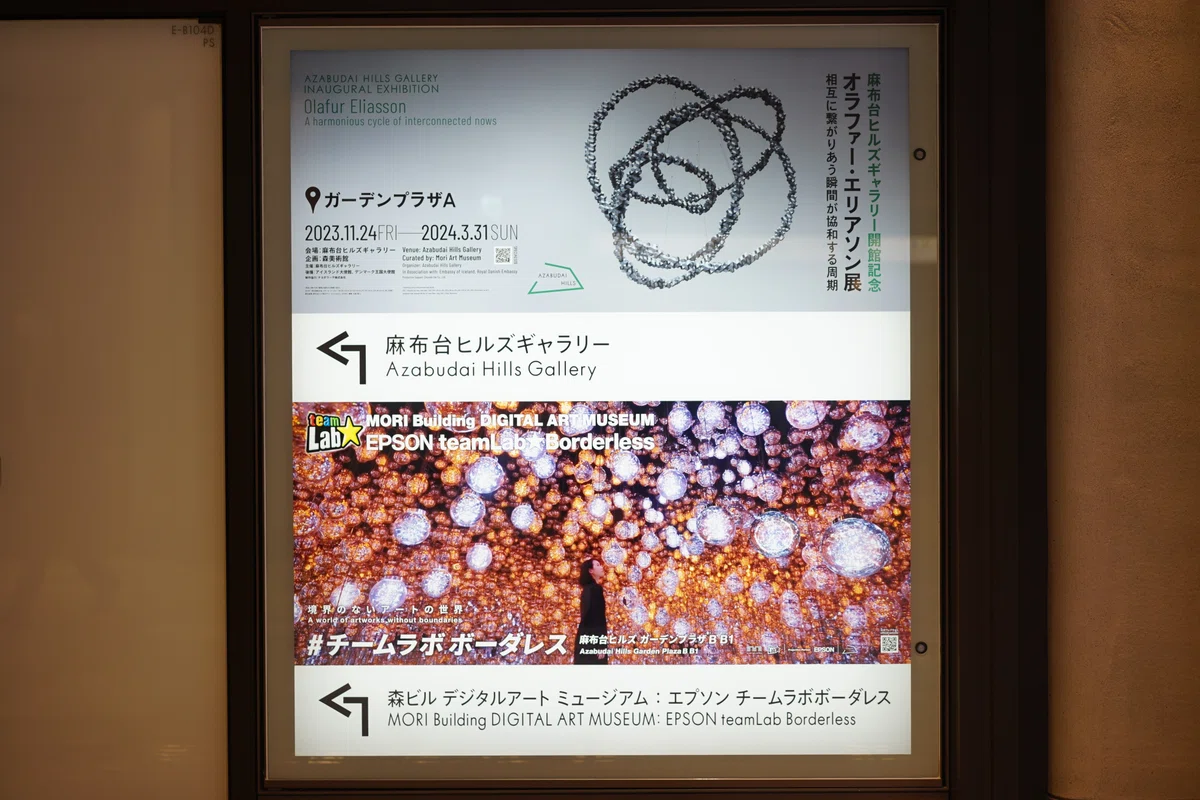
There are also five main permanent galleries at Azabudai Hills. I think it's a place that foreign tourists can fully enjoy (though I personally won't visit ❶ and ❷ unless I'm invited, as they are quite expensive).
❶ Mori Building Digital Art Museum: Epson teamLab Borderless (3,800 yen)
❷ Azabudai Hills Gallery (1,800 yen)
❸ Shueisha Manga Art Heritage (Free)
❹ Gallery & Restaurant Butaiura (Free)
❺ PACE Gallery (Opened in July 2024)

▶︎ Summary
What did you think? Regardless of whether you are interested in art or not, it was a place where you can enjoy yourself all day long. In particular, I am happy that you can go to the observation deck of the tallest building in Japan for free (until April 17th). The building design is also unique and interesting, and including the public art and permanent exhibitions, it is so stylish that it is overwhelming. In addition to being a must-visit for Tokyo sightseeing, it is a place worth visiting at least once even for Tokyo residents.
▶︎ Bonus (About Mori Building)
Since it's a good opportunity, I did a little research on Mori Building. Mori Building is a real estate developer specializing in Minato Ward. Its strength lies in a strategy that focuses large-scale development in the center of Tokyo and specializes in office building development. Although there are some commercial and residential properties, everything is a business to complement the office building business.
The following is a ranking of major developers. Mori Building is the smallest in scale. However, it is amazing that it has broken into the "top 6 companies" despite specializing in Minato Ward.

The operating profit margin for the fiscal year ending March 2023 was 22.0%, which is a high level of profitability. Since Mori Building's projects are basically only in Tokyo, the fact that there are (probably) no transfers might be a positive point. Since the salary is also reasonably high, it seems to be a target for those aiming for the real estate industry.
Note that Mori Building is a privately held company. Nevertheless, there is an "IR Information" section on their website, and they disclose "investor briefing materials" every half year. They also submit securities reports to the Kanto Local Finance Bureau.
The reason Mori Building insists on being private is that redevelopment requires coordinating with many landowners, and in the case of huge projects, it takes more than 20 years to complete. It seems that Mori Building has a commitment to having employees do it themselves without using land sharks, and that point may also be linked to being private.
What I don't understand is why they disclose "investor briefing materials" and "securities reports" despite being private. Are they looking ahead to a future listing? The content of the "investor briefing materials" is very thorough, and I cannot understand the purpose of creating "securities reports" where rules are strictly defined. Considering business partners and recruitment, is financial transparency important even if it is private? I'm curious about what kind of motivation the accounting department at Mori Building has when creating these materials...
いいなと思ったら応援しよう!
 Thank you for your support!