
Famous Sights of Edo Flowers: Ro, Second Group (Chojuro Sawamura)


If you fix the teeth of this wheel, it becomes 'shinba' (new teeth).
It is a market that was newly established after the fish market.
Because it is 'Shinba' (New Market),
it is named after the place, and its liveliness is such that
even the fish seem to come alive.
'Shinba' was a new fish market established in Honzaimoku-cho in the second year of Enpo (1674) following the development of the Nihonbashi fish market. 'If you fix the teeth, it becomes shinba' is a pun on the teeth of a wheel (gear) being fixed to create 'new teeth' (shinba) and 'new market' (shinba).
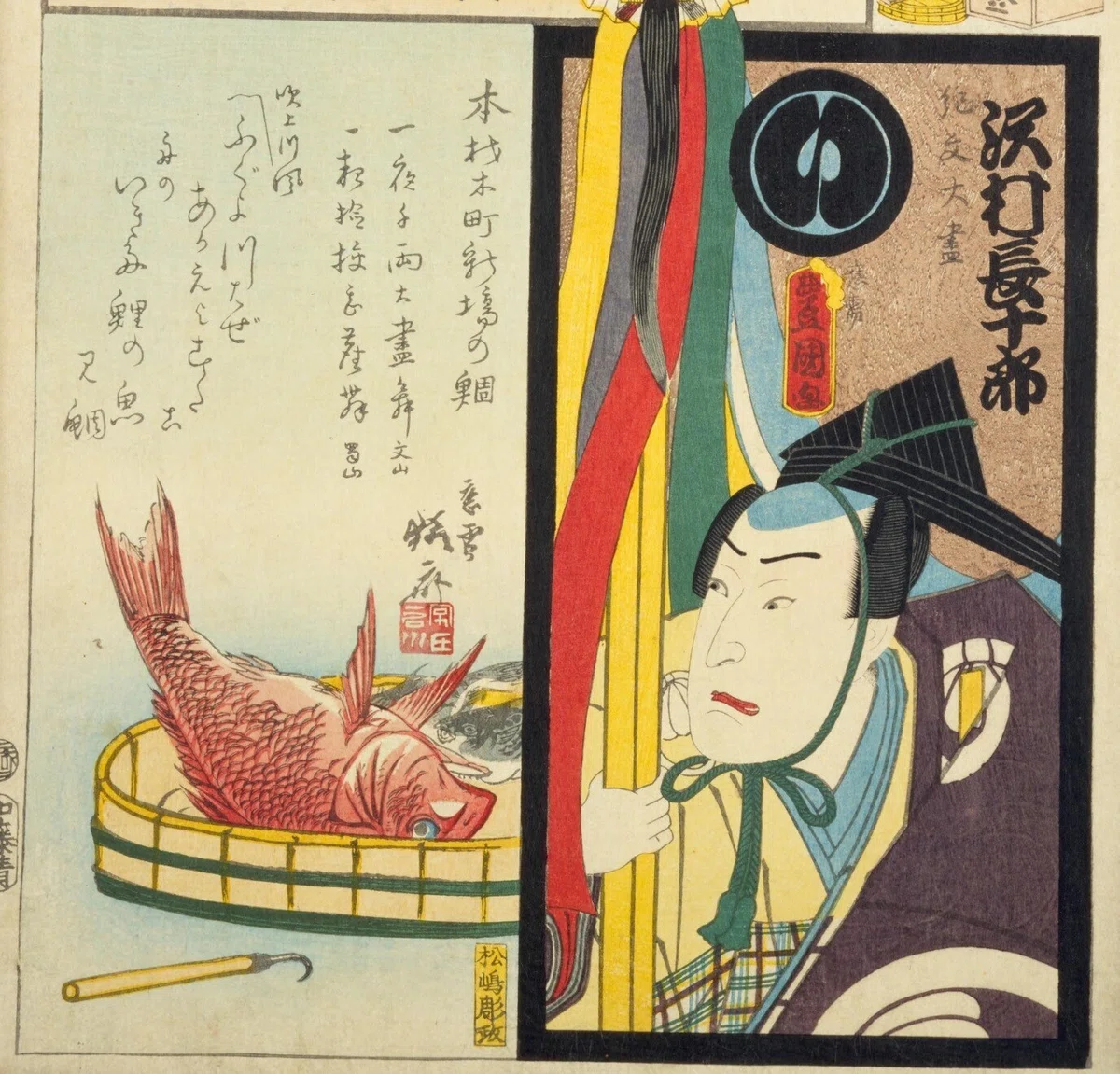
Sea Bream of the Honzaimoku-cho New Market
One-night thousand-ryo wealthy dance Bunzan
10... Shokusan
Fukiage river breeze
Pufferfish, river goby, red stingray, common octopus
Boats coming and going, carp, one-shaku sea bream

'Daijin-mai' (Wealthy Dance) is a type of hayashi-mai (musical dance) performed in the Shin-Yoshiwara pleasure district of Edo. It is a chant consisting of twenty-five sections themed around the origins of the pleasure quarters and the 'daijin' (wealthy patrons who spent lavishly in Yoshiwara), such as Bunzaemon Kinokuniya.
'Fuguyo' is a pun on the river breeze 'blowing' (fuku) and 'pufferfish' (fugu).
'Shakudai' (one-shaku sea bream), if read literally, is 'mitai' (want to see), but I have read it as 'shakudai' to match the illustration. I believe it is a pun between 'want to see' and 'one-shaku sea bream'.
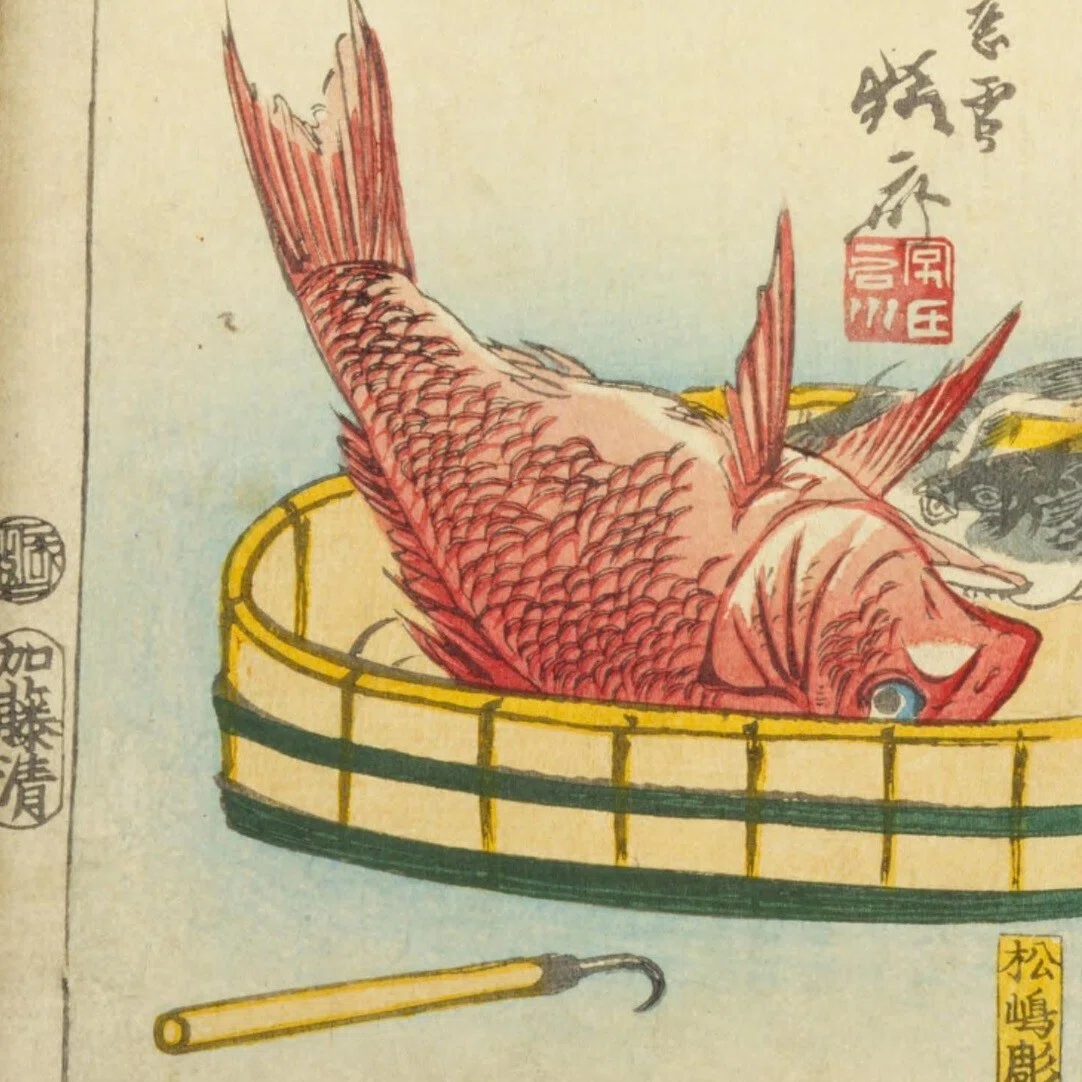
Depicted inside the bucket are a pufferfish and a one-shaku sea bream.
A 'shakudai' is a sea bream that is one shaku (approx. 30cm) in size. Its eyes, which seem to glare at you, and the way its fins are flapping are full of vitality.

Regarding the names 'Teiyo (Clogs?)', 'Kikunomi-oyu', and 'Mokukokyoga' depicted in the Famous Sights of Edo Flowers, unfortunately, there are no clues... I would like to add more information if I find anything.
◇

Photo by mominaina
* Reference: National Diet Library Digital Collections, "Spring Birds: Illustrated Collection of Kouta Songs (1917)", "Illustrated Collection of Dodoitsu Songs", "New Edition of Dodoitsu Songs (1918)", "Complete Collection of Ha-uta Songs (1927)"
Author's Note: ○ indicates characters that could not be deciphered.
I will update this as needed when new characters are deciphered or when I notice typos or misreadings. For details, please read the "About Me / Disclaimer" section. 📖