
Travel Heart. <Shizuoka> Rainy Shuzenji

It was about a week before I set off on my trip, when I stopped by my parents' house.
"I want to go to a hot spring."
I don't remember if my mother said it or if I did, but since we are a family that loves hot springs, someone is usually muttering the same thing regardless of the season.
I didn't have enough time off for a long trip, and while I was idly looking at my smartphone for somewhere good nearby, Shuzenji came to mind.
I myself had never been to Shuzenji, but I remembered that my parents had stayed at an inn there before and said they liked it.
My father happened to have a trip planned with friends, so it was a rare trip with just my mother and me.
It just so happened that an inn had a vacancy for the weekend, so I booked it immediately.
And just like that, a one-night hot spring trip was decided in the blink of an eye a week later.
Since it was the rainy season, I was prepared for it, but the weather for both Saturday and Sunday was rainy.
The fortunate thing was that it wasn't a midsummer day.
Saturday, in particular, had a very comfortable temperature.
This time, in addition to the usual abundance of photos, I've put in some effort to include explanations (though I just pulled them from reference sites). You can just skim through the photos, or if you're interested, you can check the Shuzenji website.
From Tokyo Station to Shuzenji
If you go by train, you will either use the Shinkansen or the Limited Express Odoriko train.
This time, I chose the Limited Express Odoriko, which can go to Shuzenji without a transfer.
It's a direct line from Tokyo Station to Shuzenji Station, and from Shuzenji Station, it takes about 10 minutes by bus to Shuzenji Onsen Station.
Well, as we walked along from the Shuzenji Onsen bus stop, there was a shop selling shiitake mushrooms (donko), and my mother was immediately drawn in and made a purchase.
And near there, we discovered Hie Shrine.
Hie Shrine
Hie Shrine
A shrine with a quiet atmosphere located to the east of Shuzenji Temple. When you pass through the torii gate, magnificent old trees of Japanese nutmeg, zelkova, and cedar stand in a row, covering the approach. At the base of the giant zelkova tree, a sign for the Shinkoin ruins and a stone Koshin tower quietly evoke the traces of the tragedy of Minamoto no Noriyori.
In the precincts, there is a giant Japanese evergreen oak designated as a prefectural natural monument, and the "Child-bearing Cedar," an 800-year-old tree that is said to grant children if you pass between its two trunks.


There was also a couple cedar in the precincts, but it is a shrine that gives an overall cozy impression.


It was Saturday, but there weren't many people.
It was lunchtime, so while we were looking for somewhere to eat, we saw Shuzenji Temple, so we made a detour.
Shuzenji Temple
Shuzenji Temple
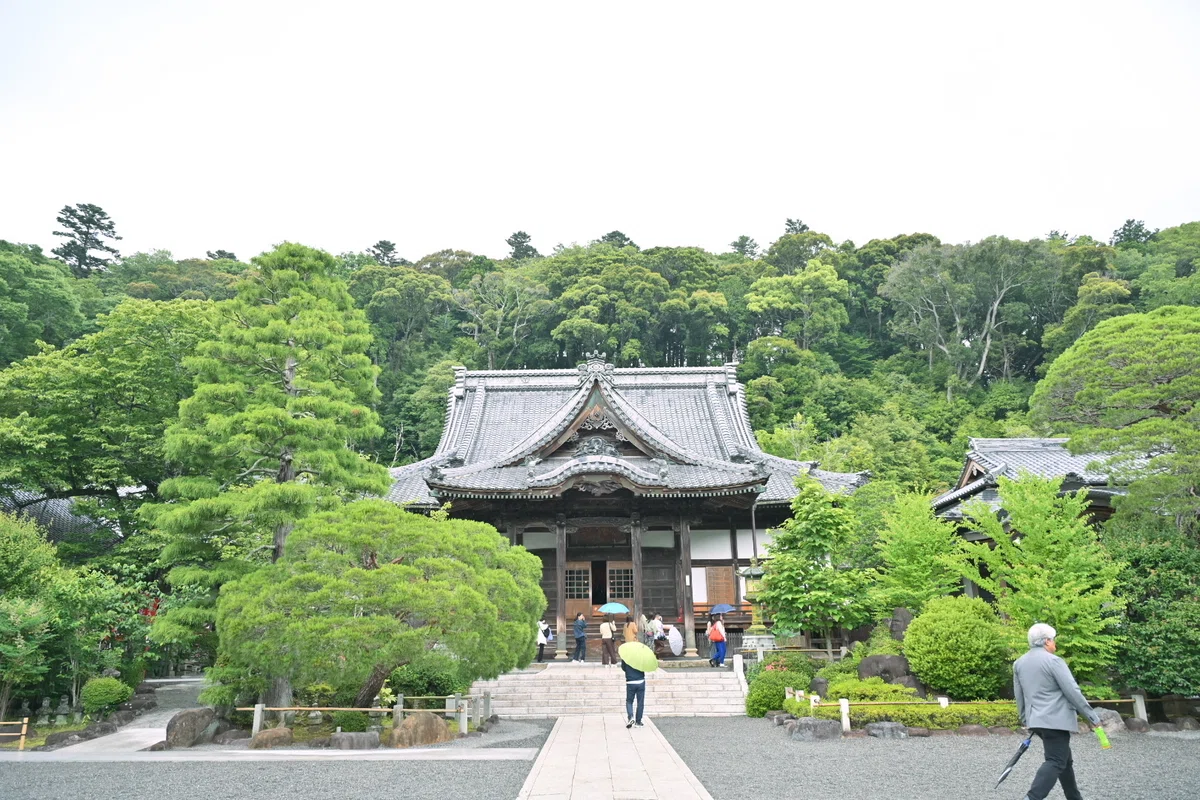
An ancient temple said to have been founded by Kobo Daishi Kukai in 807. It is famous for the ancient masks associated with Minamoto no Yoriie, who was imprisoned and met a tragic end, and which became famous through Okamoto Kido's play "Shuzenji Monogatari," as well as the Hoko Hannya Haramitsukyo sutra donated by Hojo Masako, which are housed in the Treasure House.
[Changes in Shuzenji Temple]
In the early Kamakura period, around the Kencho era (around 1250), Rankei Doryu (a Zen monk from the Song Dynasty who founded Kencho-ji Temple in Kamakura of the Rinzai sect) lived here, and because the scenery of Katsura Valley resembled Mount Lu in China, it was called Shoroshan at the time. In 1361, during the Northern and Southern Courts period, it suffered the ravages of war between Hatakeyama Kunikiyo and Ashikaga Motouji, and in 1402, it was destroyed by fire. In 1489, Hojo Soun, the lord of Nirayama Castle, became its patron and restored it, and his uncle Ryukei Hanjo (of Enshu Sekiun-in Temple) lived there, converting it to the Soto sect and changing the mountain name to Fukuchizan, which continues to this day.
The Treasure House (Zuibozan) displays ancient masks associated with the Shuzenji Monogatari.
The water basin has hot spring water flowing from a dragon's mouth.


It's warm!


|Tokko-no-yu
Tokko-no-yu (No bathing allowed)
This is the spring where Shuzenji Onsen originated. It is said that Kobo Daishi, while traveling through the provinces, was moved by the sight of a boy washing his sick father in the Katsura River. He struck a rock in the river with his tokko (a Buddhist ritual implement), causing a miraculous hot spring to gush forth, and taught the father and son the therapy of hot spring bathing.
*Tokko-no-yu is not a bathhouse compliant with the law, so bathing is not permitted.
*It cannot be used as a footbath either.


It looks like he is holding a tokko in his hand
Hand-made 100% Buckwheat Soba | Koko
There were several soba restaurants, and I found Koko while wandering around looking for one. It looked like I could get in, so I waited for a while.
There was another soba restaurant diagonally across from this one, and there was a line for that one.

The soba eaten with salt was very delicious

Bamboo Grove Path
Once I was full, I resumed my stroll.
There is a path leading to the bamboo grove just to the right of the photo of this shop, so I continued on that way.
I'm grateful that there are signs posted in various places so I didn't get lost.
I didn't know this, but it seems Shuzenji is also famous for its bamboo grove, and there were quite a few people here. Though, it wasn't as crowded as Kyoto or Kamakura.
Bamboo Grove Path
A promenade along the Katsura River that flows through the center of the hot spring town. As you walk along the path that continues from Tokko-no-yu, you can enjoy the sight of teahouses and old-fashioned fire lookout towers. In the center of the bamboo grove, you can feel the breeze while sitting on a large circular bamboo bench. After sunset, it is lit up, allowing you to enjoy a night stroll as well.
(Winner of the 1997 Urban Landscape Excellence Award)


Seeing this, my mother said, "Oh, it's wearing clothes, isn't it?"
Wearing clothes isn't it!?
That's a first for me (lol).
|Kaede-bashi (Maple Bridge)
I learned this for the first time while researching for this note, but it seems the bridges in Shuzenji have blessings related to love.
Love Bridge Tour
The five bridges crossing the Katsura River in Shuzenji Onsen are each said to have blessings related to love. Please cross the bridges while making a wish to have your love fulfilled.


The red of the bridge stands out beautifully.
By the way, there is a gallery called the Shuzenji Corridor along the bamboo forest path.
When I went, there were photos on display documenting the history of Tokko-no-yu.
There were photos so old I couldn't tell when they were from, and they weren't proper ones like the one I posted above; they were photos of people bathing in the middle of the river with only a makeshift wooden board for cover.
I don't know if mixed bathing was common back then, but from today's perspective, it's unbelievable. It was a rather surprising sight.
Looking into it, it seems the photos on display change depending on the season.
Shuzenji Corridor
A Japanese-style gallery located along the bamboo forest path. Throughout the year, exhibitions related to Shuzenji, such as photo exhibitions of Shuzenji's seasonal traditions, are held. Please stop by when you are out for a stroll.
|Shigetsuden
Check-in at the ryokan is at 15:00.
Since I still had time, I decided to visit the places written on the map. One of them was this Shigetsuden.
I thought it was read "Shizukiden," but it was "Shigetsuden."
Shigetsuden
Located at the foot of Mt. Shika, facing Shuzenji Temple, Shigetsuden was built by Hojo Masako as a memorial temple to pray for the repose of her son Yoriie's soul. It is said that she donated thousands of volumes of sutras to mourn him, but most have been lost, and only eight volumes remain today. The 23rd volume of these is kept at the Shuzenji Treasure Museum as a Shizuoka Prefecture designated cultural property. This building is said to be the oldest wooden structure in Izu, and the principal image of Shakyamuni Buddha is characterized by a rare Zen-style form where the Buddha, who should not have any handheld items, holds a lotus flower in his right hand.
I'm not good with history, but my mother is knowledgeable, so I take photos while letting her explanations wash over me.


In the precincts of this Shigetsuden, there are the graves of Minamoto no Yoriie and the thirteen retainers.
Maybe the reason I didn't feel like taking photos was that both were such sad stories.
Grave of Minamoto no Yoriie
Yoriie's grave is in the precincts of Shigetsuden. Yoriie, who succeeded his father Yoritomo and became the second shogun of the Kamakura Shogunate at the age of 18, was eventually caught up in political strife and confined to Shuzenji. Later, at the young age of 23, he was assassinated by Hojo Tokimasa at Hakoyu, which was located by the Kokei Bridge in front of the Shuzenji gate at the time.
Grave of the Thirteen
Beside the grave of Minamoto no Yoriie lies the grave of the Thirteen. It is said that thirteen of Yoriie's retainers plotted a rebellion six days after Yoriie was killed, hoping for a comeback, but they were discovered and killed before they could raise an army. It is said that the spirits of these retainers are enshrined here.
Come to think of it, there was a stone called the "Oukagai-ishi" (Inquiry Stone) placed near Minamoto no Yoriie's grave, and it said to lift it while focusing on your wish.
It is said that if it feels light, your wish will be conveyed, and if it feels heavy, you should pray again at Shigetsuden to have your wish granted.
I steeled myself and lifted it—it was very heavy (lol).
Too bad.


Habitable Ruin Gunjo
Well, I decided to head back toward Shuzenji from Shigetsuden, taking a different path down than the one I came up. Then, I found a place that looked like I could pass through, and since it looked interesting, I went inside.

There wasn't a single person around, but I really liked the atmosphere.


They are apparently called Perapera-yomena (Erigeron karvinskianus).
What a cute name.
I learned later after looking it up that this place is called "Habitable Ruin Gunjo." It seems an abandoned inn was reborn as a room-only lodging.


Just to the right of where I was taking pictures, there was a coffee shop where you could experience roasting beans.

I really like this photo I took looking up from a little further down the slope.

It seems it was Tokko-no-yu Park.
There were many spiraling ladies' tresses blooming, so I ended up taking many pictures.
Just as the name suggests, they are twisted and cute flowers.

I still have a little time before check-in, so I'll look for souvenirs.
My inn for this trip: Arai Ryokan
Arai Ryokan, where my parents once stayed a long time ago.
I was looking forward to it, especially because the Tenpyo Bath is famous. It had the atmosphere of a traditional inn, was very magnificent, and was also very comfortable.
The hot springs and the garden are both very lovely.


It's open to the elements, so it might be tough in midsummer or midwinter
Well, they say Izu is warm, so it might actually be fine


You can feed the koi from this spot where I took this photo (there's some for sale nearby for 100 yen)


There are 6 baths in total.
One of them is a private bath that requires a fee.
They rotate between men and women at set times, so I immediately went hopping between the baths available before dinner.
However, I missed one because the timing didn't work out.

Even though there should have been many guests, it was very quiet


If it had been clear, I would have liked to go to the bamboo forest light-up or the Firefly Evening held at the nearby Aka-gaeru Park, but as night fell, the rain became quite heavy, and it wasn't an atmosphere where I could go out, so I gave up.
The room I stayed in this time had a view of the river and the bamboo forest, so I enjoyed it from a distance.
The next day
I didn't notice, but it seems the sound of the rain was quite loud during the night.
(Basically, I'm the type of person who doesn't wake up to just any sound once I fall asleep)
The forecast said it would clear up in the afternoon, but unfortunately, I was planning to leave on a train around noon, so I couldn't expect to see any clear skies.

It's become a muddy torrent
I went for a morning bath and lounged around the inn until just before check-out.
When I stay at a nice inn, I take more time to spend at the inn rather than being active. It feels like a luxurious time.
I checked out at 11:00 and took a short walk while buying souvenirs that don't last long.

The muddy stream is quite something.
I didn't go in this time, but there is a day-trip hot spring nearby called Hakoyu.
It's a place I'd like to visit when I come back.
Hakoyu
Shuzenji Onsen has flourished as the oldest hot spring resort in Izu.
In the past, there were seven public baths along the river, each bustling with bathers, but by the 1950s, only 'Tokko-no-yu' remained, leaving only memories of those days.
This Hakoyu was built with an attached 12-meter-high Gyokuro (lookout tower) so that visitors could once again enjoy hopping between public baths in Shuzenji Onsen.
Please fully enjoy the Shuzenji Onsen public bath, 'Hakoyu'.
'Hakoyu' is a legendary hot spring where Minamoto no Yoriie, the second shogun of the Kamakura Shogunate, is said to have bathed long ago.
It only has an indoor bath and is extremely simple, but the cypress bathtub is filled with overflowing hot spring water and the scent of cypress...
On sunny days, a shower of light sparkles down through the skylight.
Please enjoy the hot spring atmosphere in a relaxed and leisurely way.
I also climbed the adjacent Gyokuro tower.
I didn't take any photos because the ground was wet from the previous day's rain, but I think I would have seen an even more beautiful view of Shuzenji if it had been sunny.
This Gyokuro tower is named after a Chinese poem by the great writer Natsume Soseki, who loved Shuzenji; that poem is also inscribed on the Natsume Soseki literary monument in Shuzenji Nature Park.
End of the trip
A two-day, one-night trip goes by in a flash and ends before you know it.
It's a shame, but it also makes me want to come back again.
I don't know if it was just a coincidence that there were few people despite it being the weekend, or if it's because people are being drawn to Atami (the number of people getting off at Atami was staggering), but personally, I'm grateful for this kind of relaxed pace.


Since the train departed around noon, I ate lunch on board.
There is a shop called 'Takeshi no Aji-zushi' near Shuzenji Station (just to the right of the train in the photo), and that horse mackerel sushi was truly delicious.
This has become one of the meals I want to eat again.
Since I was writing this while doing research, it turned into a travel photo log with commentary, but it ended up being extremely long, so I'll think about that next time (lol).
This was my first time visiting Shuzenji, and I think it's a place suited for people who want to enjoy the hot springs at a slow pace.
Rather than wanting to move around actively or experience many things, it's more comfortable to spend time loosely and relax at the inn. They say autumn is popular in Shuzenji, so I'm curious about that season too.
So, if there is anyone who has read this far, thank you very much.
My first hot spring trip in a long time was a slow, relaxing, and healing journey.
Where should I go next?
いいなと思ったら応援しよう!
 よろしければ応援お願いします。 いただいたチップは写真を撮るときの活動費に使わせていただきます!