[Internal Interview] The Design Skills Required for Municipal Customer Success and the Future We at MEME Aim For

At MEME Inc., the developer and provider of the digital school payment service "SukuPay", we are currently recruiting new members for our Municipal Customer Success (Municipal CS) team.
Until now, SukuPay has primarily been introduced at the individual school level, but we are seeing an increasing number of cases where it is being adopted at the Board of Education level. We have established the new position of Municipal Customer Success to serve as a role that supports not only schools but also Boards of Education, assisting them from the initial implementation phase through to ensuring the service becomes a standard part of their operations.
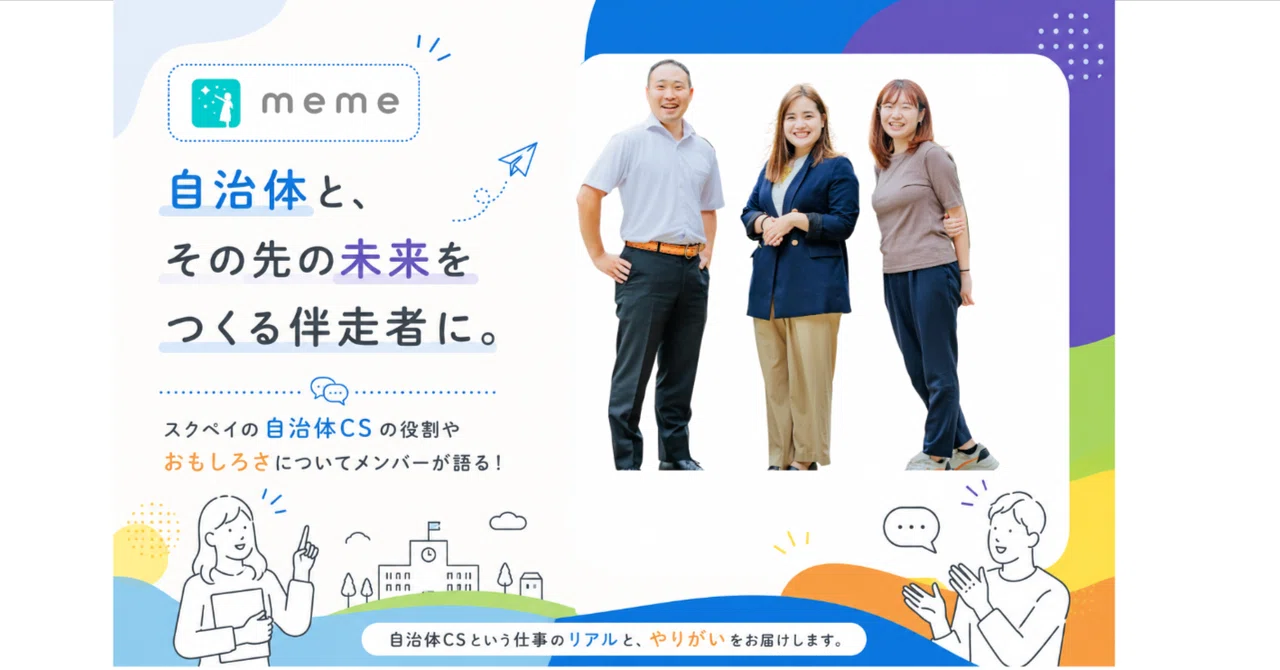
In this interview, our CEO Saito, Head of Customer Success Takahashi, and President's Office member Sugimoto reflect candidly on their experiences while concurrently handling municipal CS duties during the startup phase, and discuss their future outlook and expectations for new team members.

— Could you tell us the background behind hiring for the Municipal CS position at this particular time?
Saito: SukuPay involves many stakeholders, and it can sometimes be difficult to see whose problems we are solving and what those problems are. This is because the perspective differs. From a school's point of view, it is a "service that reduces collection tasks for teachers," but this varies depending on whether you are a school administrator, a homeroom teacher, or an administrative staff member. And from the perspective of a Board of Education representative, it is a "service that changes how teachers work and reduces the financial risks for schools."
Up until now, our mission was to onboard schools so they could use SukuPay effectively and achieve success, but I believe it is also necessary to guide them toward success in the context of what the Board of Education aims to achieve.
— How does MEME define the role of Customer Success?
Takahashi: First, I think we should start by defining what CS (Customer Success) actually is. To the question of "what is success?", I think it means that "the more they use SukuPay, the more they realize their goals, making them want to use it even more. They want to use it because they have the expectation that mastering this tool will help them become even better."
Success, for us, is walking alongside our customers—in this case, the Board of Education and school teachers—to help them reach the state they aspire to be in.
That is why we must properly define what that ideal state is. If things are off-track, we need to ask if that is okay and steer them back in the right direction. That is the fun and interesting part of Municipal CS, but if you don't understand the structure and dynamics of the municipality, you probably can't work together to answer the fuzzy question of "what is the ideal state?" Once you have defined that together, other dynamics will inevitably come into play, and I feel like our role is to act as a guide on how to overcome those frictions.

Sugimoto: On that note, I have a personal understanding of the word "success" that I find quite convincing. The etymology of the English word "success" is Latin, and it originally meant "to follow" or "to come after," rather than "to succeed." Since it implies continuation or moving from the bottom up, I believe that even in the context of success, you cannot reach your ideal state without continuity.
When using the katakana term, the superficial meaning tends to take on a life of its own, but when I think about the work of Customer Success, I focus on how to ensure adoption, repetition, and continuity.
— What does the Municipal CS team actually do?
Saito: We do a lot of things! (laughs) First, we handle onboarding at the start of implementation and perform periodic analysis of usage status.
Takahashi: If I had to sum up what Municipal CS does in one word, it's "everything related to customer support." I think that covers it completely.
Sugimoto: Indeed, rather than just picking out a few tasks, it feels like it encompasses the very core of our operations.
Takahashi: If you dig deeper, it includes gathering internal cooperation and information to provide customer support. We expect Municipal CS members to design and take ownership of this process, and we really need them to do so.
Saito: Also, municipalities want to eliminate the inconsistencies between schools. While SukuPay aims for the standardization of school collection tasks on a large scale, I hope our team can think about what "standardization" means for the specific municipality they are assigned to.
Takahashi: On top of that, it's about acting as an evangelist to articulate what the municipality wants to achieve and then standardizing that internally. Just as Saito-san said, we need to properly break down the fact that the definition of "standard" differs by municipality and build it together.
Saito: That's right. It starts with creating a language that allows us to communicate with the municipality.
Takahashi: Exactly. I call that 'creating a common language'.
Earlier, there was a mention that the etymology of 'success' is 'to continue.' I think that implies that for something to go well, it must be sustained. In short, ensuring reproducibility is crucial, and that depends on whether you can document and analyze what went well. But that's necessary for everyone, not just CS (laughs).
Sugimoto: Speaking of which, having experienced municipal CS, I feel that when design skills are required, it's scary if the design concept is wrong. Therefore, I place great importance on reviewing whether the axis and direction of the design we are drawing are aligned.
Saito: Exactly, that's PM (Project Management) skill.

— What are the interesting moments in this job?
Takahashi: If I talk about the fun of working at MEME rather than just municipal CS, there's nowhere else where you can meet the parents who use your service at an exhibition (laughs). It's like a miracle. Even though it's a BtoB service, being able to meet the end users is the fun part of BtoBtoC.
Saito: That's really true. When we exhibited at an event in Kyoto the other day, visitors from Sendai and Tokyo went out of their way to come to us and say, 'My child's school uses Scupay! It's very convenient and helpful!' Even when I talk to partners, boards of education, or bank staff, they sometimes say, 'Actually, I'm a Scupay user too (laughs),' and they say it with a smile. Those are moments that make us truly happy.
Takahashi: From the perspective of municipal CS, the fun part is that I think it's the government offices and assembly members who create regional infrastructure and its rules. However, through Scupay, we are involved in changing regional rules. A single player at a single company can experience changing infrastructure.
If you can experience that in a region you know, you can be proud of it for the rest of your life, and if you can tell your children, 'Dad helped build this system,' it's something they can be proud of too. How about you, Saito-san?
Saito: I take pride in the fact that we are able to raise the cashless literacy of parents in the region. I think some people find registering bank accounts online difficult. But in reality, there are regions where nearly 100% of parents have been able to register their accounts. I don't think it's very common for almost all parents in a region to have registered their bank accounts online.

Takahashi: MEME originally created this product to improve financial literacy, so it's interesting that we are realizing and experiencing that at such an early stage.
Saito: Also, this might be a strange analogy, but I think the best outcome is for the municipality to eventually become not just a client, but a partner in overcoming projects together. What we, and the board of education, want to achieve is for school teachers and parents to find it convenient and easier to use Scupay. There are bound to be obstacles to overcome in the process, but I want to aim for a relationship where we can say, 'We made it this far together' after we've finished it.
— Are there any unique features of MEME's municipal CS?
Takahashi: The fact that the number of stakeholders tends to increase inevitably is one thing that I feel is clearly different from other companies.
It's not just schools, parents, textbook sellers, and boards of education; it's also the municipality's finance department, digital department, and so on. Other companies' CS teams don't usually go out to build customer touchpoints to that extent.
So, in terms of business skills, I think it's an environment where it's easier to improve compared to CS at other companies. Also, in the context of vertical SaaS, the importance of CS is on a different level. If you consider that there are about 1,700 municipalities, and you think about how many of them will allocate a budget to use it, the impact of a single churn is huge. The importance of CS in the business is extremely high, so it would be good if people could perceive that as a rewarding experience.
Saito: Scupay has a track record of 'Phoenixes,' doesn't it? (*We call contract renewals after a lost deal 'Phoenixes,' comparing them to the immortal bird.)

— Please tell us about your commitment and approach to Scupay as a product.
Saito: It's generally called a SaaS product, but I don't think of it as SaaS. I think we are creating a worldview. For SaaS CS, the goal isn't just to have it introduced and then upsell... it's about being someone who creates a world together by having people use it. To put it simply, is Disneyland fun just because it has Splash Mountain? No, it's the other attractions and characters that create that worldview, and I want to express that through our product.
When we have people as CS who can do that and have that kind of imagination, it’s not just about the mindset of 'I have to generate sales' or 'I have to upsell.' Instead, we can face the question of 'Why do we need to upsell?' That’s what makes it exciting.
I value whether something is exciting. Hundreds of thousands of parents are already using our service, and when I imagine that in the future, whenever they make any kind of payment, it will be through SukuPay, I get really excited. When I think about that, it’s not just about the goal of upselling; I hope we can think together about what kind of world we want to create and what path we should take to get there.
Takahashi:Creating a worldview is important, isn't it? People who are only here because SaaS is a trend or because they like SaaS might find a bit of a gap.
Sugimoto:Speaking of trends, when I met an acquaintance the other day and talked about SukuPay, they asked me about the impact of 'SaaS is dead' on SukuPay, since it's an education payment SaaS. What I realized then is that SukuPay is something that cannot be entirely replaced by AI. I think this is exactly where design skills are required.
While it is a solution, there is a wide range of approaches to the issues we want to solve and the future we aim for, so we have to think about what to do and how to do it.
Saito:I think the essential meaning of 'SaaS is dead' is different. The idea of expanding sales as software is already over. Why? Because there are too many players. You have to provide some kind of added value there.
Takahashi:In the sales world, there was talk about selling things versus selling experiences, right? SaaS is selling things, which is why it's 'dead.' But I believe what we provide at SukuPay is selling experiences and selling moments. To borrow a phrase, we are selling a worldview, and how to realize that worldview in the places we are selling to is exactly what we do in CS.
Saito:I recently learned that Oriental Land promotes 'children's happiness,' and I thought that was really good. If we aim for the happiness of schools and boards of education, I think that will lead to the happiness of children and parents beyond that.
Takahashi:That's good. Let's sell happiness, not SaaS.
(Sugimoto starts singing 'Run, run,' and is stopped by Takahashi)
Takahashi:So, if we increase the resolution of that happiness—if we can explain what kind of happiness it is and why it leads to happiness—then sales can be handled in any way.
Sugimoto:I want the entire organization to have a common understanding of that. Let's do it.

— Finally, what kind of people would you like to work with at MEME?
Takahashi:I want to work with people who have ambition. I think any ambition is ultimately fine, but I'd be happy if that ambition matches MEME's. To increase the resolution of 'people who have ambition'... it means people who are truly living their own lives. I want to work with people like that. If they are that kind of person, even if their initial experience is shallow, I believe they can grow quite quickly.
Saito:Something close to the expression 'ambition' is 'aspiration,' which I value. My own motto is, 'Those without aspiration are fools' (laughs).
Sugimoto:I have always said that I want people who are 'Givers,' which is a core value of MEME, but that has become a given. Now, I want people who can take the current state and move it in a positive direction. Rather than people who create pluses, I want people who can turn minuses into pluses.
This might apply to DX as a whole, but for entertainment services, the direction is usually to make daily life more fun or happier. However, the area we are working in starts from a negative state. It's a state where complex issues with no clear starting point are piled up, or where there are voices of opposition. In such times, I think people who can tackle things with an indomitable spirit—a 'let's do this' spirit—are a good fit.
Takahashi:By the way, does 'enjoying chaos' fit into that image?
Sugimoto:In that sense, it might not be near-equal for me. Rather than 'enjoying chaos,' it's more about being able to 'face' chaos. For example, when there is a complaint from a customer or an incident occurs, I think people usually have negative feelings. However, it might be inappropriate to say this, but I actually get fired up in those situations.
When you are in a startup company, it's normal for things to be chaotic. A negative state is the default. After all, everyone is aiming to become a unicorn company from there.
Saito:Exactly. Since a minus and a minus make a plus, it ends up being a plus after all.
Takahashi:Wait, isn't that a bit off? (laughs)
Saito, Takahashi, Sugimoto:Thank you very much!
At MEME, we are hiring for multiple positions, including Local Government CS.
To implement new standards for the next generation's daily life, we aim to be an organization that can create value with a small, elite team.
We look forward to speaking with you, our future colleague, who will be on the side of changing the world.
