
[Art Exhibition 2024#52] Shiro Kuramata's Design: A Microcosm in Memory at The National Museum of Modern Art, Kyoto

Exhibition Period: June 11 (Tue) – August 18 (Sun), 2024
Shiro Kuramata (1934–1991) first gained attention for his interior design of the San-ai Dream Center, a landmark in Ginza, and established the Kuramata Design Office in 1965. Working against the backdrop of a city constantly changing during the era of rapid economic growth, he collaborated with contemporary artists to propose new spatial concepts.
Meanwhile, he also presented furniture he created independently, without the premise of commercialization. By developing materials that matched his vision and creating designs liberated from standardized convenience, he brought playfulness and essential questions into everyday life.
In the 1980s, he participated in the Italian design movement 'Memphis,' expanding his field of activity to the world. The furniture pieces, which Kuramata intended to 'express in form what cannot be said in words,' remain as eloquent and captivating as ever.
This exhibition traces Kuramata's own words and, alongside materials such as image sketches and dream diaries that can be called the sources of his creativity, listens to the messages his designs convey.
This is his first retrospective in Kyoto in 25 years. Having traveled through Tokyo and Toyama, this exhibition concludes its run at the Kyoto venue.
I went to Kyoto to see Takashi Murakami.
At The National Museum of Modern Art, Kyoto, which is located right across the street from the Kyoto City Kyocera Museum of Art where that exhibition was held, the Shiro Kuramata exhibition was taking place.
It was a traveling exhibition of the one I saw at the Setagaya Art Museum this past January, but I went to see if there were any differences in the way it was displayed or the works exhibited.
The designer for the Kyoto exhibition's main visual is Atsuki Kikuchi.
While the Tokyo exhibition featured 'Miss Blanche' as the main visual, the Kyoto exhibition brought 'Glass Chair' to the forefront.


Personally, I prefer the Kyoto exhibition design as it seems to cite the 80s aesthetic more effectively.
Outside the venue, 'Apple Honey' and 'Sing Sing Sing' were placed, and visitors could sit on both chairs.
Since both are reissued versions from Gallery Tamura Joe, they were likely provided by them.
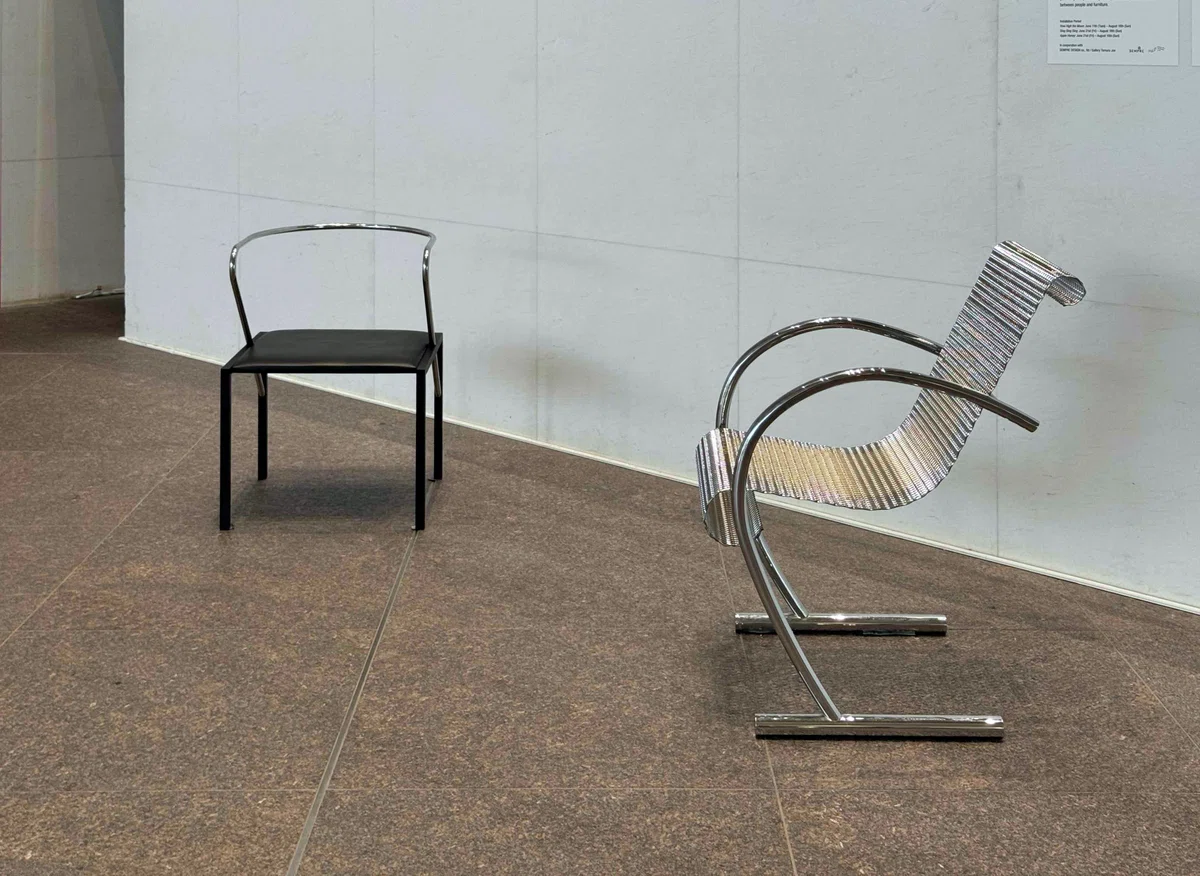
Apple Honey: 330,000 yen
Sing Sing Sing: 687,500 yen
You can also sit on 'How High the Moon,' which was available for sitting at the Tokyo exhibition.
This model is also a reissue from Gallery Tamura Joe, so you can still buy it if you want (though it's expensive).

How High the Moon: 2,062,500 yen
When it comes to 'How High the Moon,' the Artizon Museum is the place to go.
It is a wonderful museum where the elusive 'How High the Moon 2-Seater Model' sits, and they generously allow visitors to sit on it freely.
If you are ever near Tokyo Station, please check it out. ↓
At the Kyoto exhibition, photography is only allowed in the first room immediately after entering the venue.
I was able to photograph 'Glass Chair' and 'Miss Blanche,' which could not be photographed at the Tokyo exhibition.


Both are conceptual masterpiece chairs that represent Shiro Kuramata.
However, I feel like I've been seeing "Miss Blanche" in many places this year.
1[Art Exhibition 2024#01] Shiro Kuramata's Design: A Microcosm in Memory at Setagaya Art Museum
2[Art Exhibition 2024#23] Absolute Chairs at The Museum of Modern Art, Saitama
3[Art Exhibition 2024#45] TRIO: Paris, Tokyo, Osaka - Modern Art Collections at The National Museum of Modern Art, Tokyo
Well, in the first place, I love Shiro Kuramata, so I am going to see them myself.

A print version of this drawing is being sold at "Toki no Wasuremono," but when I inquired, it was quite a price.
I was told that the signature on the front is printed, and the back features an authentic signature by Mr. Kuramata's wife, Mieko Kuramata, but if the signature on the front had been Shiro Kuramata's own, I might have clicked the buy button.
The Kyoto exhibition venue had black walls and dimmed lighting, using spotlights on the works to make them stand out.
Basically, the exhibited works were almost the same as the Tokyo exhibition, but because the presentation was different, the works looked different as well, which was refreshing.
Kuramata's works don't fit the atmosphere of my home at all, so I probably won't ever bring one into my house, but I love the works of Kuramata themselves.
In the collection exhibition, there was a display of prints.

・Katsuro Yoshida
I had a sense of déjà vu because I had just seen them the other day at theThe Museum of Modern Art, Kamakura & Hayama.

・Lee Ufan
Woodblock print.


・Tadanori Yokoo
Personally, I prefer Tadanori Yokoo's vibrant, colorful posters over his oil paintings.


My goshuincho (temple seal book) is also by Tadanori Yokoo.
This was the reason I went to visit Kawaguchi seven or eight years ago.


[Art Exhibition 2024] Summary Magazine ↓
いいなと思ったら応援しよう!
 ありがとうございます。励みになります。