
The Exam War of the Showa Era: An Era When Studying Was Everything

From 1979 to 1980, I was in my third year of junior high school. At the time, we were in the midst of an "exam war." This era is symbolized by terms like "deviation score education," "dropouts," and "school violence." Many people believed that "a child's entire life is decided by their high school entrance exam," and teachers, parents, and we students were all swept up in that trend.
The label of "dropout"

In such an environment, children who were good at studying came to be seen as "good kids." On the other hand, there were also children who struggled with their studies. These children came to be called "dropouts." It is not that they were intentionally lowering their grades. In fact, they wanted to improve their grades, but they did not know how to study, and as a result, they could not keep up with the lessons.
Furthermore, the home environment also became a major issue. If parents could find the time to teach their children, the children could reinforce what they learned at school at home. However, there were many cases where parents could not secure the time to teach due to financial reasons or busy work schedules. As a result, children could not ask their parents about things they did not understand, and they were left behind in class without understanding the material. This problem did not lie with the children, but was rooted in broader social issues.
Despite this situation, adults at the time called children who struggled with their studies "dropouts." Because of this label, quiet children lost their confidence, while strong-willed children sometimes became rebellious, and in some cases, this rebellion escalated, leading to misconduct.
Developing into "school violence"

Even though children who struggled with their studies had done nothing wrong, because of the atmosphere created by teachers that "you are the ones at fault," the strong-willed ones rebelled even more, standing up and saying, "Don't mess with me!" This rebellion sometimes developed into "school violence."
In a sense, I think this was inevitable. Think about it. If we were walking down the street and someone repeatedly insulted us, saying, "You're bad, you're stupid," how would we feel? We might endure it at first, but if the insults continued, we would eventually reach our limit, and our anger might explode. It is the same thing. If we could escape from that situation, we might be able to suppress our anger. However, if escape is impossible, eventually we will not be able to endure it.
Thinking about it this way, in the "exam war" of that time, children could not escape from that situation. As a result, quiet children lost their confidence and sometimes fell into self-isolation. On the other hand, strong-willed children expressed their anger and became rebellious, which sometimes became the cause of "school violence." Of course, there were also children who managed to avoid both patterns.
Adults trapped by stereotypes
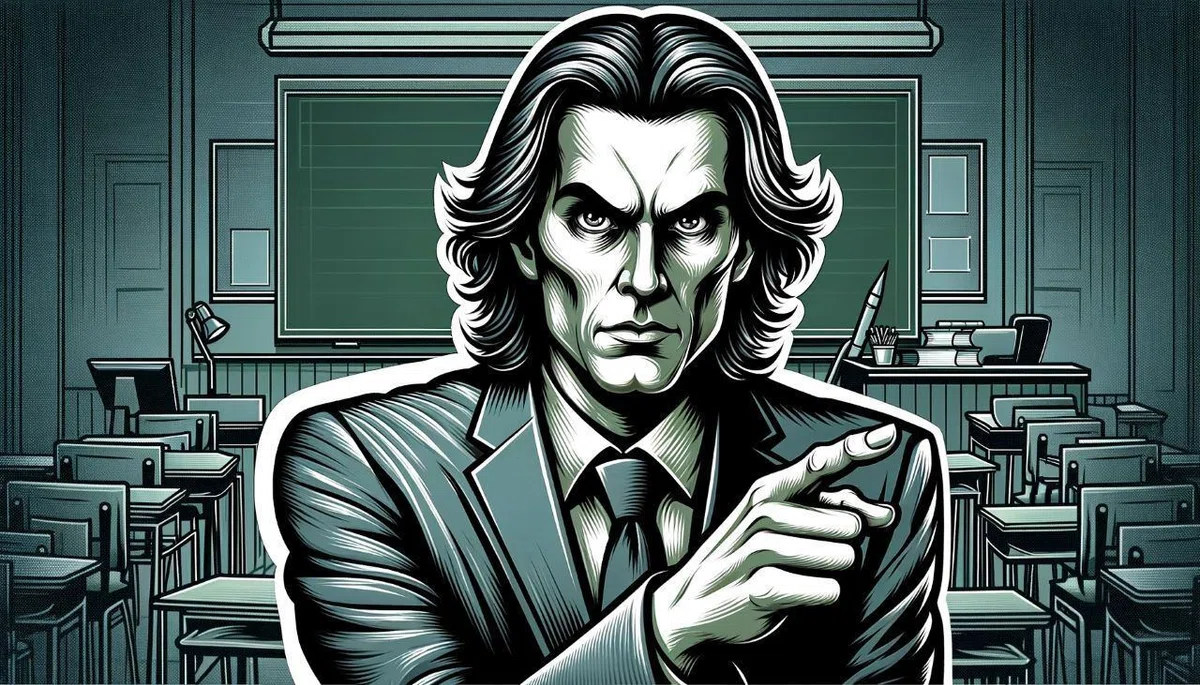
At the time, many adults were trapped by stereotypes. There were not a few teachers who would scold students, saying, "If you can't study, you're no good."
It happened when I was in my third year of junior high school. During a math class, Mr. K tried to make a quiet male student named S solve a specific problem. When S could not answer immediately and looked down for a few seconds, Mr. K shouted loudly, "Too slow!!" As a result, S began to sob. Witnessing this, I felt as if Mr. K was bullying someone weak. Even now, when I remember it, I feel that this kind of approach can never be called education.
Memories of "3-nen B-gumi Kinpachi-sensei"

From the autumn of 1979 to the spring of 1980, the TV drama "3-nen B-gumi Kinpachi-sensei" was broadcast, and it had a major impact on our generation. Although my memory is hazy, there are still two scenes that remain in my heart.
1. Kinpachi-sensei's words questioning entrance exams
This was in the New Year's broadcast. While making mochi, Kinpachi-sensei said something like, "Why do we have to take entrance exams? Making mochi is more fun." The teacher himself also had doubts about the "exam war" of that time.
2. A scene showing genuine concern for a student's future
This was in the broadcast in late February, when the high school entrance exam season was in full swing. There was a quick-tempered student in Kinpachi-sensei's class, and his school uniform was torn during a fight with students from another school at the high school entrance exam venue. The next day, he had another important high school entrance exam. It was an important exam, likely his first-choice school, but he could not leave his school uniform torn. Since there was an interview, his appearance could also be subject to evaluation. "I have to fix it somehow," Kinpachi-sensei said, visiting a nearby tailor late at night, pounding on the door and pleading, "This child's future depends on it. Please, fix it."
This scene shows that the "exam war" of that time also placed great pressure on the teachers. In reality, entrance exams do not determine everything, but the people of that era were at the mercy of them.
I was really tormented by entrance exams back then...

Entrance exams at that time were a huge pressure for us. I remember how my friends and I would often encourage each other on the way home from cram school, saying, 'Yeah, let's do our best.' Thanks to that, it developed into a passionate friendship, though.
This time, I looked back on my experience of the 'exam war.' Some people went on to live happy lives because of this 'exam war,' while others ended up on a distorted path. It is also a fact that even in lives that appear happy at first glance, there are people who carry deep emotional scars. This 'exam war' placed an intense pressure upon us that is impossible to put into words.
👇 I am publishing on Kindle 👇
いいなと思ったら応援しよう!
 よろしければ応援お願いします! いただいたチップはクリエイターとしての活動費に使わせていただきます!