
December 2022 Employment Statistics and ISM Services Sector Surprise

On Friday, January 6, 2023, two important economic indicators were released.
(1)Hourly wage growth, the most closely watched part of the employment statistics, is slowing down
US December Employment Statistics: Non-farm payrolls increased by 223,000 | Toyo Keizai Online
US Employment Statistics: Unemployment rate fell to 3.5% in December, employment increased by 223,000: Nihon Keizai Shimbun
(2)ISM Services (Non-Manufacturing) Business Activity Index: Significant deterioration, falling below 50
US ISM Services Business Activity also signals 'recession' in December, first time in 2 years and 7 months: Nihon Keizai Shimbun
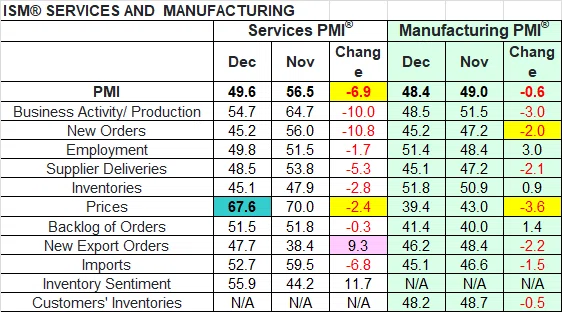
The Fed's goal is to curb inflation. Prices of goods are slowing down, and the focus is on the decline (suppression) of service prices. Therefore, the aim is demand suppression (in short, economic deterioration) leading to wage suppression, which leads to price suppression. This time, the employment statistics showed a slowdown in wage growth (though this may be temporary, so caution is needed), and the ISM services sector showed economic deterioration (there may be some reactionary increase in the future, but this trend is likely certain).
Depending on the CPI to be released on January 12, it is certain that the Fed will raise interest rates by 0.25% on February 1, but after that, they may stop raising rates to observe the effects of the cumulative rate hikes so far. Of course, the main scenario is to raise rates by another 0.25% on March 22, set the target range for the FF rate at 4.75-5.0%, and then wait and see. (As of now, the Fed has signaled further 0.25% hikes.)
The market seems to expect that, given this ISM services business activity data, the economy will enter a rate-cutting cycle in the second half of this year against the backdrop of a recession. The 10-year Treasury yield is currently at 3.56%. If the FF rate is raised to 5% (upper limit) next February, there will be an inverted yield of about 1.3%.
Following today's data, interest rates have fallen (even the 2-year note yield has fallen to 4.25%, showing how much the market expects rate cuts from the second half of this year), and because interest rates have fallen, the P/E ratio has been pushed up (P/E is inversely proportional to interest rates), causing stock prices to rise and the dollar to fall.
From here on, it is difficult. Short-term interest rates will continue to rise. Further declines in long-term interest rates may be difficult. Economic deterioration will continue. Corporate earnings will deteriorate. Expectations for rate cuts from the second half of this year suggest a future economic recovery. Will the market really price in that far ahead? There is no way there won't be turmoil. Although stock prices rose today, the mainstream view on stock prices seems to be that they will fall in the first half of this year due to the recession, but then turn upward.
Hourly wage growth is slowing

Hourly wage growth is slowing, but when viewed on a 3-month comparison basis, it is still high. Whether it will continue to decline remains to be seen.

US ISM Services Business Activity has fallen significantly
Even if there is a temporary rebound, the downward trend is unlikely to change due to the effects of the interest rate hikes so far. There is a possibility that it could fall to levels seen during the IT bubble burst in the early 2000s or the 2008 Lehman Shock.

What is concerning is that even though the ISM Services (Non-Manufacturing) Business Activity Index has fallen this much, the price index remains high. In the CPI to be released next week, attention will be focused on core service prices (excluding energy services), which Chairman Powell mentioned he was watching during the press conference after the last FOMC.

いいなと思ったら応援しよう!
 よろしければ応援お願いします! いただいたチップはクリエイターとしての活動費に使わせていただきます!