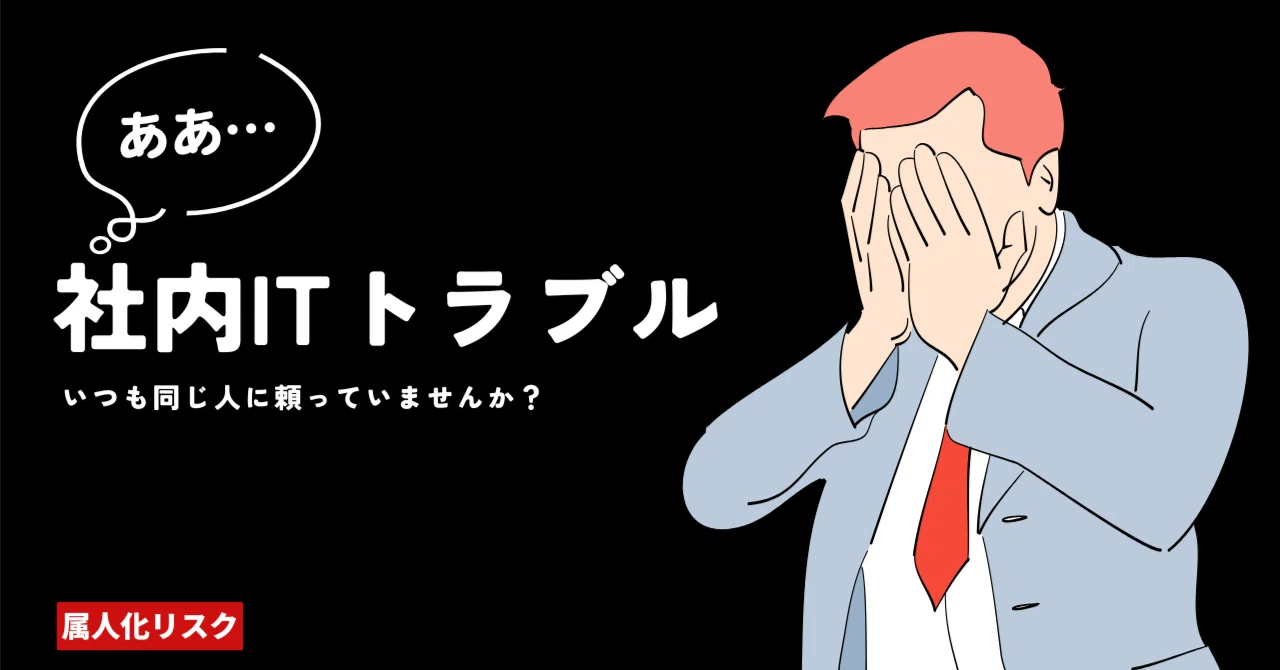
Are you always relying on the same person for internal IT issues? That might be a 'silent risk' for your company.

"My computer isn't working..."
"I can't send emails..."
Every time such complaints arise, the same person's face inevitably comes to mind within the company.
This is a very common scene in small and medium-sized enterprises.
In companies without a dedicated IT person,
"the person who seems knowledgeable,"
"the person who set it up a long time ago,"
or "the young person who might understand" naturally becomes the go-to for questions.
In fact, this is a structure that arises precisely because the person is trying their best.
While they are helping out of goodwill, a situation where "only that person knows" is created before anyone realizes it.
However, from the perspective of the company as a whole, this state carries risks that cannot be overlooked.
Why do IT issues concentrate on the same person?
The reason is very simple.
No official IT person has been designated,
there are no manuals or rules,
and a culture of "just ask the person who seems to know" has been established.
When these three factors overlap, troubleshooting naturally gathers around a specific individual.
As a result, situations arise where they have to interrupt their actual work to respond, the details of the response remain only in that person's head, and no one else can handle it if that person is away. The person who was initially a "helpful presence" ends up burdened with an "inescapable role" before they know it.
The misconception that "it's fine because there's a knowledgeable person"
I often hear business owners say, "We're managing somehow because we have one knowledgeable person." In the short term, it certainly works. However, in the long term, the risks increase.
What happens if that person resigns, goes on transfer or long-term leave, or becomes too busy to respond? When reliance on specific individuals becomes too extreme, even outside experts cannot intervene, and in many cases, it ends up costing more in terms of time and money.
The difference in IT troubleshooting comes down to "whether there is a system in place" rather than "whether there is someone who understands."
Examples of "IT reliance on individuals" common in small and medium-sized enterprises
In reality, the following states are often seen: only the person who performed the initial PC setup understands the contents, no one understands the structure of shared folders, only specific people know the passwords, there is no history of troubleshooting, and the same questions are repeated over and over.
These are all caused by the "lack of a system."
Realistic measures you can take right now, even without an IT person
You might be thinking, "So, do I have to hire a dedicated IT person?" but there is no need to go that far right away.
To start, the following three things are sufficient.
The first is to decide on a "point of contact" for IT issues.
It does not need to be a perfect person in charge.
Just by centralizing the entry point to "consult here first" and "consult outside if you can't judge," confusion will be greatly reduced.
The second is to simply record common issues.
You don't need a fancy manual. Just by keeping a memo of "how you handled it" when emails can't be sent, when a PC is slow, or when a password is forgotten, the burden the next time the same issue occurs will be surprisingly reduced.
The third is to decide on an external resource you can rely on.
If you try to solve everything internally, it will inevitably lead to reliance on specific individuals. It is important to draw a line between what you can do yourselves and what you should leave to outsiders.
IT issues can be reduced through 'systems,' not 'people'.
In companies where IT issues are concentrated on the same person, it is not that person's fault. When there are no rules, no records, and no designated point of contact, reliance on specific individuals happens naturally.
Conversely, by simply organizing your systems a little, you can reliably reduce both the burden and the risk. This can be achieved without major investments or implementing complex systems.
A word from IT Work Lab
With the concept of 'Providing an IT specialist for your company,' IT Work Lab supports small and medium-sized enterprises in building realistic and sustainable IT environments.
We provide comprehensive support for tasks that an IT specialist should handle, such as organizing IT issues, establishing internal rules, managing accounts and permissions, building backup environments, and serving as a daily IT consultation desk.
'Internal IT issues are always concentrated on the same person.'
'I don't know who to ask.'
If any of this sounds familiar, it might be time to pause and get things organized. Even just talking about your situation is a good first step. Please feel free to consult with us.
👉 Click here for the IT Work Lab official website
いいなと思ったら応援しよう!
 いつも読んでいただき、ありがとうございます。
役に立った!と感じていただけたら、チップで応援していただけるとうれしいです。今後の記事づくりに活用させていただきます。
いつも読んでいただき、ありがとうございます。
役に立った!と感じていただけたら、チップで応援していただけるとうれしいです。今後の記事づくりに活用させていただきます。