
Which type are you? The 4 styles of 'leadership'

Yesterday, I celebrated a cute junior colleague of mine being promoted to a leadership position.
We were all talking about what kind of leader they want to become.
In that discussion,
I think there are many forms of leadership.
Of course, it differs depending on the personality and type of the person becoming the leader,
and I also think it varies depending on the characteristics and goals of the group.
I believe there is a suitable leadership style depending on what kind of group it is.
While it would be ideal to be able to change shape freely without deciding on a specific type for yourself, that is quite difficult, isn't it?
Also, leadership theory has likely been exhausted, and there are many documents on it.
I, too, have learned various things about it in the past.
PM style, autocratic style, etc......
A bit difficult? (laughs)
Also, depending on how you put it, there are various ways to perceive the styles, such as six or three.
Please note in advance that today's explanation is something I have personally classified on my own.
I have classified them into the following four types.
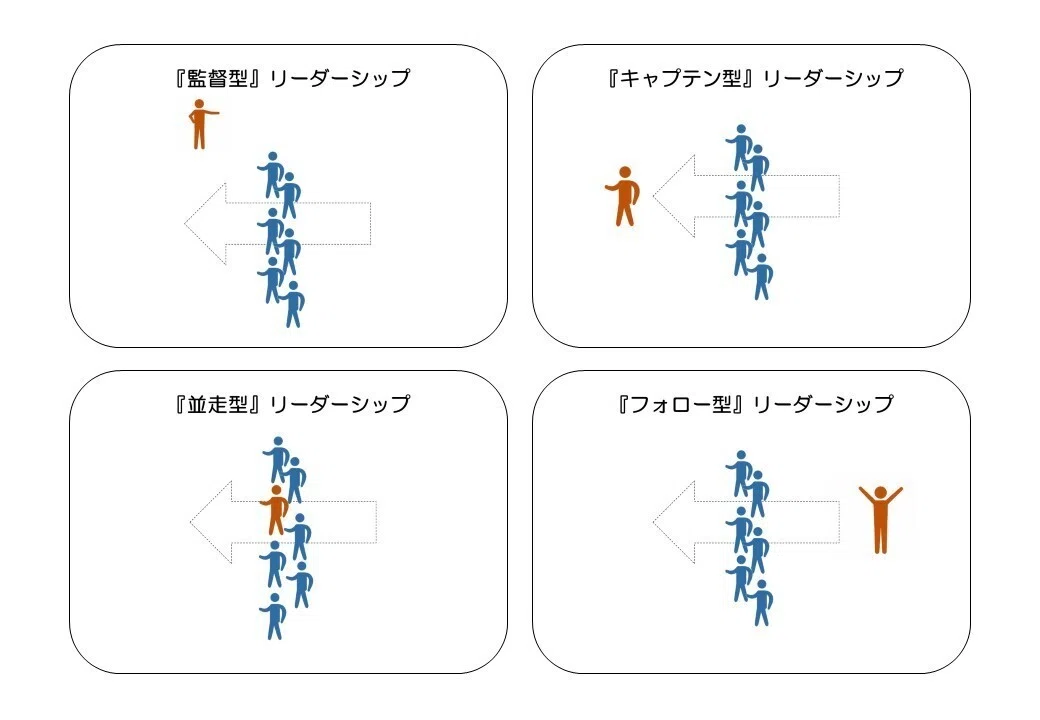
The blue people represent the members who make up the group, and the orange color represents the leader.
This is a classification of how leadership is taken in the direction the group is heading.
Yeah, I'm glad I was able to make it into a picture!!
I would like to explain the characteristics of each type of leadership, including a note of self-admonition.
1. 'Director-style' leadership

This is a form of leadership deeply rooted in Japanese society.
It is where there is a director, and the group moves based on their instructions and orders.
In companies as well, I think there are many cases where presidents and superiors fall into this category.
For this, strong authority and leadership are essential.
A relationship of trust where people think, 'It will be fine if we just do as that person says!' is necessary.
If there is a strong charisma, you can lead many groups.
On the other hand, members might be doing things 'reluctantly,' or
they might just be following along, which tends to lead to a lack of initiative.
If you assume you are a strong leader and there is a gap in awareness between you and your members, the group's performance will drop immediately, so you need to be careful.
(2) 'Captain-style' leadership

This is also easy to understand!
There is a captain running in front, saying, 'Follow me!'
They are a very reliable presence, and we follow along behind them.
Compared to the director style, they are running with you, so it is easier to build a relationship of trust.
A captain needs appropriate ability and enthusiasm.
Energy and physical strength are necessary.
If the captain's momentum wanes, there is a possibility that the group will also decline.
Also, a slight concern is that the person running at the back of the group might become invisible,
or when you look back, you might find that a huge gap has opened up between you and everyone else.
The captain themselves may also feel doubts or anxiety, wondering if this is okay, if everyone is convinced, or if the direction they are heading is correct.
Worries and anxieties are prone to arise.
(3) 'Side-by-side' leadership

Therefore, a version where the captain matches their pace more with everyone is the 'side-by-side' style.
It is the so-called 'Let's go with our arms linked!' type.
Because conformity is high, the feeling of moving forward together becomes stronger.
The relationship of trust will also likely deepen.
Dialogue with members, create empathy, align emotions, and let's run together!
If you are worried about your captaincy in terms of ability or physical strength, this side-by-side style might be good.
On the other hand, because everyone is lined up side-by-side, I think there is also the drawback that it becomes unclear who the leader is.
Also, because you are matching everyone's speed, the problem of not making much progress forward also arises.
(4) 'Follower-style' leadership

Finally, there is the follower style.
This is the most difficult pattern of leadership.
It is what you might call the 'I'm supporting you from behind' feeling.
It's like saying, 'I'm watching over you, so do your best!'
You push them forward and support their individual growth and efforts.
(1) The director style requires people to be told what to do.
(2) The captain style requires you to lead from the front.
(3) The side-by-side style involves the struggle of moving forward together.
Compared to these, the greatest merit of the follower style is that each person can move forward proactively.
They might even start heading off in all directions.
However, the speed and distance each person travels will likely be greater when compared on an individual basis.
You could perhaps call this 'management' that watches over them.
If this leader lacks 'foresight,' there is a possibility that things will go significantly off track.
Also, it might require a great deal of magnanimity.
Even though you are supposed to have delegated, you might find yourself meddling here and there.
It requires the generosity to say, 'Do as you like! I'll take responsibility!'
I think it also requires having the surplus resources in terms of time, budget, and personnel.
Summary

So, we have looked at the four styles of leadership.
Which type are you?
Also, what type of leader is present in the group you belong to?
I don't think you can be completely classified as just one, and it is likely that you fit into multiple categories.
Looking back on myself personally, when I was young, I was only (1) and (2).
At that time, I was overflowing with self-confidence and had the energy to say, 'Follow me!'
But when I met the current members of my NPO, I despaired at my own lack of ability.
They were an amazing group of members.
Because of that, I naturally acquired facilitation skills and aimed to be a (3) type leader.
As the organization grew and collaboration with others increased, I realized the fun of 'cooperation' and began to think about (4). Having each person act proactively. I began to feel the expansion of this potential.
I think my leadership is shallow, and although I am just talk and lack the actual ability to back it up,
I believe I can embody any of the (1), (2), (3), or (4) leadership styles, and that is the ideal.
In other words, I think it is best if you can take any position depending on the situation.
Sometimes running in front to pull everyone along, looking back here and there, and keeping pace with everyone. Sometimes stepping back a pace to encourage everyone.
It might be difficult to do everything at once, but if you keep this image in the back of your mind and stay conscious of it, I think the nature of leadership will start to become a little clearer.
Perhaps this applies not only to leadership, but to various human relationships as well.
Thank you for watching again today.
With the transfers and promotions this spring, I imagine many new leaders will be born.
I'm rooting for you!
Let's do our best together!!
(Instead of 'Good luck!', saying 'Let's do our best!' is also a tip for leadership styles 2, 3, and 4.)
<Article from 'today' one year ago★>
Today is Thank You Day.
In the middle of the flowing seasons.
This is an article I wrote thinking about that famous song. I was so happy to see it quoted on Twitter and elsewhere.
Today is also my eldest son's graduation ceremony.
いいなと思ったら応援しよう!
 いただいたサポートは、NPO法人好きっちゃ北九州の活動費に、大切に活用させていただきます!!