I am publishing a book titled 'Marketing "Connecting" Thinking Techniques' aimed at eradicating the 'This isn't what I expected!' sentiment by eliminating medical-style malpractice in marketing!! (→ Full introduction released)

(Updated November 22, 2024)
The content of this article has been turned into a NewsPicks video!
(End of update)
Working every day, I encounter various "Why is this happening?!" moments.
For example,
Why do so many people think there is a customer acquisition method somewhere in this world that is more efficient (lower CPA) than listing ads? (There is no such magic in this world!)
Why do so many people expect the CPA of video marketing to be lower than that of listing ads? (That is not the true strength of video marketing!)
Why do so many people misunderstand content marketing as something that "works immediately" or is "more efficient than advertising"? (There are many uncontrollable factors, and it doesn't work immediately!)
Why do so many people think that if something goes viral, the product will sell like crazy? (Only certain product categories sell well through virality!)
Why do so many people think that they can "sell products immediately" or "increase store visitors immediately" with an official SNS account? (People looking at SNS are "people who have no business with you"!)
Why do so many people think that if an influencer posts, "diffusion will occur"? (Diffusion and sharing are different!)
Why do so many people think that strategic PR will increase media exposure for their products? (Strategic PR is not product publicity!)
Why do so many people get so caught up in immediate CPA that they end up raising their medium-term CPA? (If you don't increase the number of branded searches, it will only get harder!)
Why do so many people have excessive expectations that fan marketing will improve LTV and acquire new customers? (I feel sorry for the fans!)
Why do so many people think, "It's not selling because of the ads!" when they run ads and the product doesn't sell? (Advertising effectiveness and marketing effectiveness are different things (advertising effectiveness is only a small part of marketing effectiveness)!)
And so on (there are many more, but I'll stop here).
I may sound arrogant, but I am still in training myself, so I don't think my way is the only correct one. Even so, I have always had a strong sense of the problem: "Isn't there some way to reduce the unhappiness caused by these misunderstandings?"
With that in mind, I published "The Map of Sales" (Nikkei BP) in June 2022, but this book showed the causal structure of total sales, and its effect on reducing misunderstandings and discrepancies at the field (individual measure or method) level was limited.
On the other hand, the following note I wrote in November 2022 is still being read by many people (even now, a year after its publication, it still gets over 1,000 PV per month).
I thought, "I see, the information that everyone in the 'field' wants is 'here', isn't it?" So, I decided to take on the challenge of writing a book that eliminates the "field-level misunderstandings and discrepancies" that I have felt were an issue for many years, based on the aforementioned note.
I wrote about these thoughts in the "Introduction" of this book. I am releasing the full text, so please read it if you'd like!
Introduction
I want to eliminate "medical malpractice" in marketing.
This is the purpose of writing this book. In the field of marketing, such unhappiness and disappointment are being created somewhere every day, as follows:
We ran a TV commercial, but sales didn't increase much. TV commercials are a dead end!
We increased the budget for listing ads to expand our customer base, but the CPA is rising. What is the agency we entrusted with the operation doing?
We worked on video marketing, but I was disappointed because the CPA was high. It's a hot topic, so we tried it, but it was a huge letdown.
We are working on content marketing, but the number of customers hasn't increased at all. Isn't "having customers find you without us selling to them" a pack of lies?
It went viral, but sales didn't budge. That's meaningless!
We are operating an official SNS account, but I don't think it's leading to "sales." Is there any point in doing this?
We worked on influencer marketing, but the posts didn't spread, and I was disappointed. Sales didn't increase much, and I wish I hadn't done it.
We worked on strategic PR, but our company's products weren't exposed, and it was a letdown. What kind of strategic PR is that?
We worked on fan marketing, but I don't think sales are increasing. If it was going to be like this, I should have just run ads for new customer acquisition as usual.
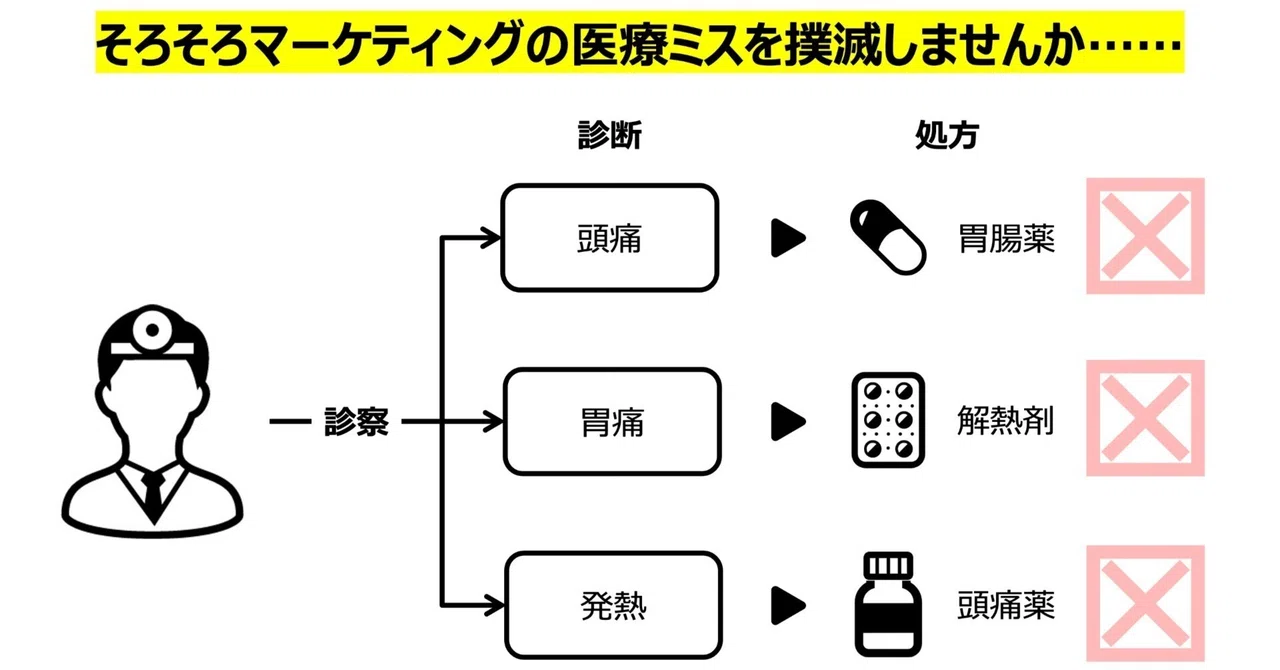
Most of these were not caused by the measures themselves being bad, but by medical malpractice. In other words, they were "initiatives where failure (not achieving the expected results) was guaranteed before even starting" due to mistakes in either diagnosis, prescription, or both.
Since the purpose of marketing is to "have customers buy," it can be said that a marketer's job is to correctly examine and diagnose the reasons why customers do not buy their company's products (= illness) and prescribe the medicine that will most effectively treat that illness.
Nevertheless, in many workplaces, stomach medicine is prescribed to people with headaches, and headache medicine is prescribed to people with stomachaches. And then, trouble ensues with people saying, "What is this medicine! It doesn't work at all!" Also, the patient side wants "trendy medicine," saying, "Doctor, I've been feeling unwell lately. Can I have that 'medicine' everyone is talking about?" and takes a new drug unrelated to their own illness, only to be disappointed, saying, "It doesn't work at all!"
The problem with these is not the medicine (measure) taken, but the fact that they are not taking medicine that suits their own illness.
Just as there is no "panacea that can cure any illness" in this world, there is no "all-purpose measure that can solve every marketing problem in one go." Also, just as there is no "health medicine to become healthy," there is no "sales improvement measure to increase sales." What exists are "awareness improvement measures," "interest-arousing measures," "understanding promotion measures," "trust acquisition measures," etc., to increase sales, and there is no such thing as a "measure to increase sales."
Just as headache medicine only works for headaches, specific methods and measures only work for specific problems. A "healthy body (= sales)" is obtained as a result of "multiple medicines (= measures) taken according to each symptom" working structurally. To achieve this, there is no other way than to correctly diagnose your own illness and provide the correct prescription.
Then why do so many medical malpractice cases occur so frequently in the field of marketing? It is because the various knowledge (points) that many marketers have are not connected to the flow of marketing (lines) or the overall picture of the strategy (planes). If you liken marketing to "climbing a mountain with the summit being having customers buy and continue to buy," the route to the summit is not necessarily just one. The main route (line) is the flow of marketing, specific measures (points) are the concrete steps to overcome various obstacles existing on each route, and the design of multiple routes to the summit represents the overall picture of the marketing strategy (plane).

The biggest factor in losing sight of the overall picture and the route is the obstacles lurking on each route. By focusing too much on overcoming the obstacles right in front of you (points), the act of overcoming the obstacles itself becomes the goal, and you lose sight of your position, wondering, "Wait, what am I doing this for?" That obstacle is "one passing point that must be overcome" existing on the route (line) to the summit, and you must never forget that "there is always something beyond that (the goal is always reaching the summit)."
When you can see the full picture of the strategy to reach the summit, and understand the positioning of each route, the typical obstacles, and the background and meaning of the tactics to overcome them, marketing becomes significantly more accurate and interesting. The fact that the <points ⇄ lines ⇄ planes> of marketing are not connected not only causes medical-style errors but also leads to the "boredom" and "ennui" of the marketers working in the field. As a result of the hyper-specialization of work and organizations due to the digitalization of marketing, young marketers in particular have lost the opportunity to engage in anything other than localized (point-based) tasks, such as "acquiring a target number of customers at a CPA of X yen or less."
As a result, all KPIs (Key Performance Indicators) have become fragmented, and the field has become flooded with "achieving KPIs for the sake of achieving KPIs." For example, one of the KGIs (Key Goal Indicators) for websites at automobile or housing manufacturers is "visit reservations." Web managers aim to achieve their own KPIs, and if the numbers are insufficient, they try to increase the number of visit reservations through gift campaigns or advertising. However, even if you increase the number of reservation customers who are only after the gift, there may be many last-minute cancellations, or even if they do visit, they may not become hot leads and will only take up the sales team's time, potentially worsening overall sales efficiency.
The ultimate goal of marketing is to increase the number of closed deals, and the number of visit reservations and visitors are merely means to that end. Yet, excessive specialization and the pressure to achieve individual KPIs are creating a massive amount of sub-optimized work that does not necessarily lead to the achievement of the objective.
Marketers in the field are studying hard to escape from the barren land described above (that's you, the person holding this book!). However, learning marketing, which is broad and deep in every aspect, is not straightforward. Everyone harbors concerns such as the following.
I don't know what to learn or in what order.
I am anxious because I don't know if my way of learning is correct.
I don't understand the overall picture of marketing (I don't know where I am or what I am learning right now).
I cannot apply what I have learned to practice.
I don't have a mentor-like figure in marketing, so I can't get feedback.
I am isolated because I cannot create a common language within the company.
The digitalization of marketing has created a massive amount of "point-based work." And every young marketer inevitably starts their career with some kind of "point-based work." However, as mentioned earlier, a point (individual measure) is one solution to overcome an individual obstacle on a line (the route to the summit), and the goal is ultimately to advance along the route and reach the summit. If you cannot see the summit, do not know the full picture of the route you are on, and only face the obstacles right in front of you, it will be difficult to achieve high-quality problem solving. Above all, that work is not very interesting, is it?
Of course, points are important. Because there are points, you can create lines, and because you advance along lines, planes are established. However, there is a world of difference in the precision, creativity, and fulfillment of work between looking only at points and engaging with them, versus seeing the lines within the plane and engaging with the points right in front of you while knowing the type and order of the points on that line.
If you meet a friend on a Sunday morning, they say "Let's go," and you are made to walk for about an hour, anyone would feel anxious, right? "Where are we heading?" "How far is the destination? (How many hours will we walk?)" "What is the route?" "Will we take breaks along the way?" and above all, "Why are we going there? (What good things will happen if I reach the destination after all this trouble?)" — you should have a mountain of questions.
Engaging in point-based work without understanding the planes and lines is not healthy, both from a strategic perspective and from the mental perspective of marketers working in the field. The expansion of "forced work" undertaken without knowing this background information weakens the "ability to think for oneself and repeat creative ingenuity in the field" and is one of the factors that induces medical-style errors.
To solve these issues, there is no choice but to work while strongly being conscious of "what kind of obstacle on which route (line) of the overall strategy (plane) is the work I am currently engaged in meant to overcome (point)?" That is by no means easy, but this book should be able to help with that.
Target readership for this book
This book is primarily intended for those belonging to business divisions, advertising, PR, and marketing departments of large companies (manufacturers, retail chains, service industries, and the food service industry) that mainly handle B-to-C products, as well as those working at advertising agencies, PR firms, consulting firms, and various other support vendors that assist these people. In all cases, it is aimed at young to mid-level staff in their 20s and 30s whose knowledge and experience are still scattered as "points" and are not connected as "lines" or "planes." Therefore, it should also fit business people with no industry experience who are thinking of changing jobs to the above industries, as well as students who are thinking of finding employment in those industries.
It's late, but let me introduce myself.
My area of expertise is marketing. Over the past 25 years, I have been involved in supporting the advertising, PR, and marketing of over 300 major companies. In the first half of my career, I experienced marketing research, concept development, product development such as naming and package design, wide-area distribution measures for manufacturers, and shelf-space productivity analysis. In the second half of my career, I founded the current Tribal Media House in 2007 and have been engaged in supporting corporate marketing from the perspective of social media and digital utilization.
Because I learned traditional marketing in the first half of my career and gained practical experience in the social media and digital domains in the second half (I am not someone who has pursued only one area deeply), I believed I could objectively and neutrally overlook the various variables that affect sales, and in June 2022, I published 'The Map of Sales' (Nikkei BP).
There are many high-quality specialized books in the world. However, most of them explain specific theories or methods in depth, and there has been a problem where understanding the 'overall picture' and the 'positional relationship of each method,' as well as the 'relative understanding of points and lines on a plane' that helps with 'selection' and 'combination' for daily practice, and the 'connection between abstract concepts' that links points to points and lines to lines, has depended on the experience and effort of each reader.
When designing marketing communication to 'increase sales (to get customers to buy),' this book aims to connect 'individual measures ⇄ main routes ⇄ strategy' as 'points ⇄ lines ⇄ planes,' and by relatively comparing what 'can be done' and 'cannot be done' with each major measure, it aims to increase the resolution of the positional relationship and meaning of the work you are currently in charge of. If the 'points ⇄ lines ⇄ planes' of many marketers are connected, the medical-style errors occurring in large numbers in the marketing field should definitely decrease.
After finishing this book, you will surely be itching and excited to try it out in practice. I hope this book will become a guidebook for readers' marketing practice and that medical-style errors will disappear from the marketing field.
A lucky day in January 2024
Noriyuki Ikeda
Table of Contents
Introduction: What is Marketing?
Part 1: Why are 'medical errors' occurring frequently in the marketing field now?
Chapter 1: There is no panacea that cures all marketing problems at once
Chapter 2: Frequent medical errors and their causes
Part 2: Connecting the 'points, lines, and planes' of marketing
Chapter 3: The many reasons why you should understand the 'points, lines, and planes' of marketing
Chapter 4: Drawing the overall picture of marketing strategy = 'plane'
Chapter 5: Nine principles of marketing strategy
Chapter 6: Connecting 'planes and lines' through the four main routes to purchase
Part 3: Understanding 'points'
Chapter 7: What 'can be done' and 'cannot be done' with major measures
Chapter 8: Correctly measuring the effectiveness of measures
Publication is Wednesday, January 17, 2024!!

So, we are holding an Amazon pre-order campaign!
Exclusively for those who pre-order this book on Amazon, we will give away PPT data (over 50 slides) of the illustrations included in the book for free. Please feel free to use them in various business scenes (e.g., creating strategy design documents or proposals).

↓ Sample of gift illustrations ↓


▶ How to apply
Purchase 'Marketing "Connecting" Thinking Skills' on Amazon and keep the 'order number' listed in your purchase history or order confirmation email
Please enter the required information in the application form below to apply
The deadline for entering the form is 23:59 on Sunday, December 31, 2023
(Postscript)
The Amazon pre-order campaign has ended. Thank you for your many applications!
(End of postscript)
==
At our company (Tribal Media House), we provide an online free learning service called 'MARPS' (fully committed to by Ikeda) to support marketers' 'knowing → understanding → being able to do' and to realize marketers' growth and career advancement. Just by registering as a member, you can use all content from Ikeda and gorgeous guests for free. It is packed with learning programs that help solve problems that marketing personnel often face in the field! Please check the link below to see what kind of learning programs we offer. We are waiting for those who want to learn marketing 'systematically'!
==
I also post various things on X (formerly Twitter) (please follow me ♡)