
Five Years Since the 'First Year of Legal Tech'—The Unique Barriers and Limitations of Japanese Contract Practice Revealed

Five years have already passed since 2020, the year that was called the 'First Year of Legal Tech'.
In these five years, the landscape of legal and contract work surrounding us seems to have changed completely.
AI-powered contract review, the introduction of CLM (Contract Lifecycle Management), and the expansion of electronic contract platforms—these solutions have been introduced one after another in Japan, following the lead of other countries.
However, now, I would like to dare to ask,
'Has Japanese contract practice really changed in these five years?'
My answer is,NO.
Superficial changes and the persistence of essential 'hassle'
Of course, I am not saying there have been no changes. Paper contracts are now managed in the cloud, and AI reviews can sometimes be completed in seconds. There are certainly situations where the speed until contract execution is evaluated as having increased.
However—
Has there been any change in the entire contract workflow?
What about the quality and speed of decision-making as an organization?
How about the way trust is built?
Rather, aren't many practitioners and legal staff feeling that,
'It has become somewhat more convenient. But essentially, it remains a hassle.'?
The 'three gaps' highlighted in these five years
What I personally have felt most strongly over these five years is the existence of several essential 'gaps' that have arisen between Japanese contract practice and technology.
Broadly speaking, they can be summarized into the following three points.
1. Importing the US-style legal tech philosophy as-is
By ignoring Japan's unique business customs and decision-making processes and relying too much on Western pioneering models,'technology-driven, superficial convenience' has taken precedence, and we have failed to approach the fundamental issues. That is the first major gap.
2. The mismatch between a contract culture 'governed by atmosphere' and technology
Technology introduction based on 'rationality' and 'explicit knowledge' in contract practice did not mesh with theatmosphere, human relationships, business customs, and contract cultureunique to Japanese companies. There was a lack of consideration for Japanese contract practice there.
3. Lack of strategy for the 'largest volume zone' of contract practice
Even among contracts, there is a current reality where the most voluminous group—contracts of intermediate difficulty—which are not simple enough to be processed with templates, yet not important enough for experts to be constantly attached to, are the most cumbersome and time-consuming to process, yet are not being handled appropriately.
I would like to look at the details in order.
US-style legal tech philosophy—A world that seeks to 'correctly manage' the 'correct contract'
US-style legal tech has developed based on a very clear philosophy.
A contract is a 'complete record of agreement,' and an ideal format exists
Contract work can be optimized through templating, risk detection, and lifecycle management
Rationality, reproducibility, and transparency are emphasized, and a structure that allows for quantitative evaluation is designed
Based on this way of thinking, contracts have been treated as 'objects of generation and management' that are highly compatible with AI and databases.
Then, why didn't it fit in Japan?
The reason is clear.
Japanese contract culture emphasizes 'agreements nurtured within relationships' rather than a 'correct contract'.
Characteristics of Japanese contract practice:
Consensus building is effectively completed through internal approval processes, verbal discussions, and emails.
A contract is not the end point of negotiations, but rather a ritual or procedure for confirming trust.
Unwritten 'between the lines' nuances and 'exceptions' often dictate decision-making.
More than the document itself, the people, the organization, and the history determine the meaning of the contract.
In such a context, the context, accumulation of judgments, and traces of trust are sometimes more important than the contract clauses themselves.

The mismatch between a contract culture governed by 'atmosphere' and AI
To reiterate, a large part of Japanese contract work is driven by an 'atmosphere' consisting of tacit understanding, organization-specific decision-making, and empirical rules.
However, at least until now, AI has been unable to read this 'atmosphere.'
While US-style CLM excels at managing explicit knowledge, the background and flow of judgments, such as 'why it turned out that way' remained a black box, making it difficult to utilize in practice.
The swamp of the 'middle zone' in Japanese practice
Furthermore, in order to significantly advance contract DX initiatives, we must address the 'middle zone' of contracts, which exists as the largest volume zone for many companies.
This is a category of contracts that exists between terms of service or standard agreements—which can be concluded almost entirely using templates with only minor field-level modifications—and highly specialized contracts where individual characteristics are significant and risk management is critical.
Characteristics of this middle zone:
Subtle customization is required for each company.
The risk is not high, but the procedural aspect cannot be ignored.
Modification, addition, or deletion of certain clauses is necessary.
It can never be handled by automation alone.
This area is a gray zone that is suitable for neither full automation nor full manual processing by AI and has become the biggest bottleneck hindering the efficiency of DX.
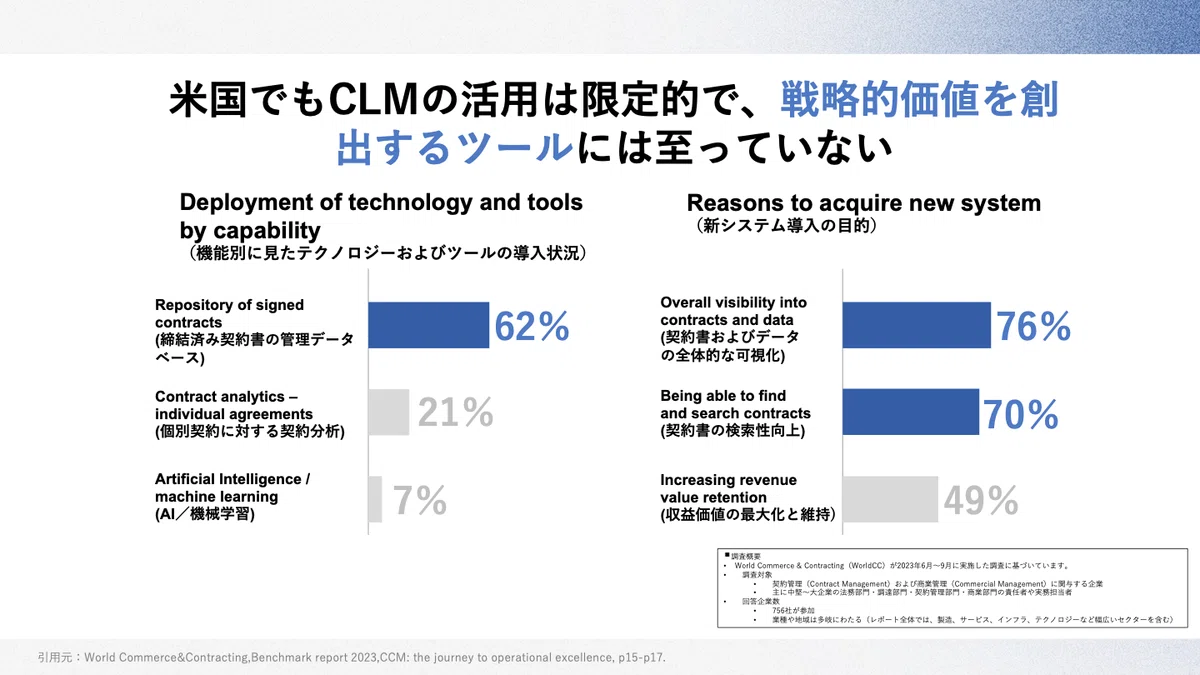
Reference: Even in the US, full-scale utilization of CLM is still in progress
A 2023 survey by WorldCC of 756 companies worldwide revealed that in many cases, CLM remains at the level of contract storage and search, and has not led to AI utilization or strategic analysis.
Even in the US, where IT literacy is high, advanced utilization of CLM is difficult.
Should we not reconsider the correctness of positioning it as a solution to the challenges of Japan's 'middle zone'?
The 'overwhelming customer understanding' we believe in
What Hubble has consistently valued is 'overwhelming customer understanding'.
To be deeply rooted in the reality of the field and to fundamentally face the way Japanese contract practice works.
That is why we have maintained the perspective of 'viewing contracts as a flow of communication,' and while feeling a sense of discomfort with US-style ideologies, we have walked our own path.
Our Choice—Not 'Eliminating the Atmosphere,' but 'Treating it as a Structure'
In fact, we have always viewed contract work not as a problem of document management, but as the internal and external agreement process itself.
And, as an approach different from US-style CLM, we have viewed it as a
'Contract Communication System'. (At the stage where the name CLM became recognized as a certain category, we call it CLM in the sense that it possesses those functions.)
Not just the creation and review of contracts, but internal and external exchanges
The basis for judgment, the flow of internal approval, and the history of decision-making
This is a mechanism to record, visualize, and accumulate all of these as 'part of the contract.' I am now convinced of how essential this approach was.
And, 2025—The Birth of the Contract Flow Agent (CFA)
End of 2024.
We began considering an 'AI Agent concept' as a redefinition of an essential solution for Japanese contract practice.
And in July 2025, we will finally announce the 'Contract Flow Agent (CFA)'.
Not just the contract itself, but
reading and interpreting internal approvals, past negotiation history, and the flow of decision-making,
understanding the context of the agreement process,
and advancing the contract work itself,
implementing into AI a structure that 'simplifies procedures while reading the atmosphere' in line with Japanese contract culture.
That is the mission of CFA.

What is Contract Flow Agent?
Contract Flow Agent (CFA) is an AI that understands the 'flow' and 'background' of a contract and makes judgments and provides advice based on context.
Capable of reading and interpreting contract negotiations and revision history, and making proposals based on the context
Can explain not only the wording of clauses but also 'why it turned out this way'
Learns past judgment patterns and automatically converts tacit knowledge into explicit knowledge

Why Hubble?
As mentioned above, we have consistently aimed to visualize the contract process and agreement process, and have designed our product accordingly. I believe this is not just a difference in simple functions, but a difference in product philosophy and philosophy.
As a result, Hubble is able to visualize the decision-making process within a company, who in the organization made what decision with what background, and the circumstances leading up to the contract conclusion.
This foundation for holding context data is exactly the data infrastructure needed for the coming AI era.

AI rooted in Japanese contract culture that will change the next five years
We view contracts not merely as the exchange of documents, but as the institutionalization of trust.
We have chosen to structure and train AI on the 'atmosphere' and 'background' surrounding contracts. This accelerates contract operations.
Japanese companies today are plagued by complex and inefficient internal decision-making and contracting processes, and these delays are hindering business growth. Especially now, as we face the harsh reality of a shrinking labor force, traditional methods will increasingly leave us behind in terms of competitiveness.
By first smoothing out internal contract processes and establishing a foundation for rapid decision-making, we will dramatically improve the speed of the entire organization. Moving forward, it is necessary to facilitate smoother inter-company negotiations and decision-making processes, thereby strengthening the decision-making power of Japanese business as a whole. I believe it is possible to realize a society that can win in international competition using speed as a weapon, even as the workforce declines. The approach of reforming contract processes holds potential that many have yet to realize, but it is a challenge that will impact a large market and bring transformation to the entire industry.
Contract Flow Agent—the arrival of AI used in Japanese contract practice will change the next five years.
いいなと思ったら応援しよう!
この記事は noteマネー にピックアップされました
