
Preventing Managers from Becoming a 'Lid': 5 Strategies to Avoid Stifling Organizational Growth

When a manager's limited skills or knowledge hinder the growth of their subordinates—acting as a so-called 'lid'—it is a significant loss for the organization. Managers should be individuals who never stop growing themselves and who maximize the potential of their subordinates. To achieve this, it is important to be mindful of the following elements and translate them into concrete actions.
1. Continuous Self-Growth
Managers must constantly acquire new knowledge and skills and continue their own self-growth. In today's rapidly changing world, standing still means falling behind. For example, by attending seminars on the latest technology or reading books on leadership, you can acquire the ability to adapt to the changes of the times.
Specifically, taking online courses on cutting-edge technologies like AI and data analysis, or participating in cross-industry networking events to gain a broader perspective, is also effective. It is also important to regularly read papers and books in your field of expertise to keep your knowledge updated.
Furthermore, seeking mentorship or coaching to evaluate yourself from an objective perspective and aim for further growth is also effective. A mentor not only shares their own experience and knowledge but also provides advice on career paths and emotional support.
2. Prioritizing Coaching
It is important to value dialogue with subordinates and deeply understand their goals and challenges. Rather than one-way instructions or orders, it is crucial to boost subordinates' motivation and encourage proactive behavior through conversation.
For example, conducting regular 1-on-1 meetings to discuss subordinates' career plans and skill development can boost their motivation and support their growth. In 1-on-1 meetings, it is important to listen carefully to the subordinate, show empathy, and provide concrete advice and feedback.
Also, by utilizing coaching frameworks such as the 'GROW model,' you can foster the ability for subordinates to tackle problem-solving on their own. The GROW model consists of four steps: Goal, Reality, Options, and Will, supporting the process where subordinates set goals, grasp the current situation, consider multiple options, and create an execution plan.
3. Practicing Empowerment
By delegating authority to subordinates and respecting their autonomy, you can encourage their growth. It is important to avoid micromanagement, trust your subordinates, and give them responsibility and discretion.
For example, by entrusting them as a project leader, you can foster a sense of responsibility and leadership. By checking the project's progress regularly and providing necessary support while leaving the final decisions to the subordinate, you can promote their growth.
Also, by creating an environment where it is easy to propose new ideas, you can stimulate their creativity and lead to the revitalization of the entire organization. Holding brainstorming sessions where ideas can be freely exchanged or launching experimental projects to try out new technologies and methods is also effective.
4. Ensuring Psychological Safety
Creating an environment where subordinates can speak with peace of mind is essential for the growth of the entire organization. An organization where diverse opinions fly and active discussions take place becomes a breeding ground for innovation.
For example, by regularly conducting team reflections and providing opportunities to learn not only from successes but also from failures, you can enhance psychological safety. By constructively discussing what was learned from a failure and how to apply it next time, rather than blaming, you can increase the team's overall desire to learn.
Also, by respecting diverse opinions and encouraging constructive discussion, you can foster an atmosphere where new ideas are easily born. By bringing together members with different backgrounds and values, you can view things from multiple perspectives and find better solutions.
5. Utilizing Feedback
Regular feedback is extremely important in promoting the growth of subordinates. By providing feedback based on concrete actions and results rather than abstract evaluations, subordinates can objectively grasp their own strengths and weaknesses and find areas for improvement.
For example, by providing feedback on specific actions and results rather than just evaluating goal achievement, subordinates can objectively grasp their own strengths and weaknesses and find areas for improvement. It is important for feedback to point out not only positive aspects but also specific areas for improvement and to provide future action guidelines.
Also, it is possible to perform self-evaluation from multiple perspectives and connect it to further growth. By receiving feedback not only from your manager but also from colleagues and subordinates, you can deepen your self-awareness.
By practicing these elements in a balanced manner, managers can maximize the potential of their subordinates and contribute to the growth of the entire organization. This will also lead to the manager's own career advancement and become a driving force for producing even greater results.
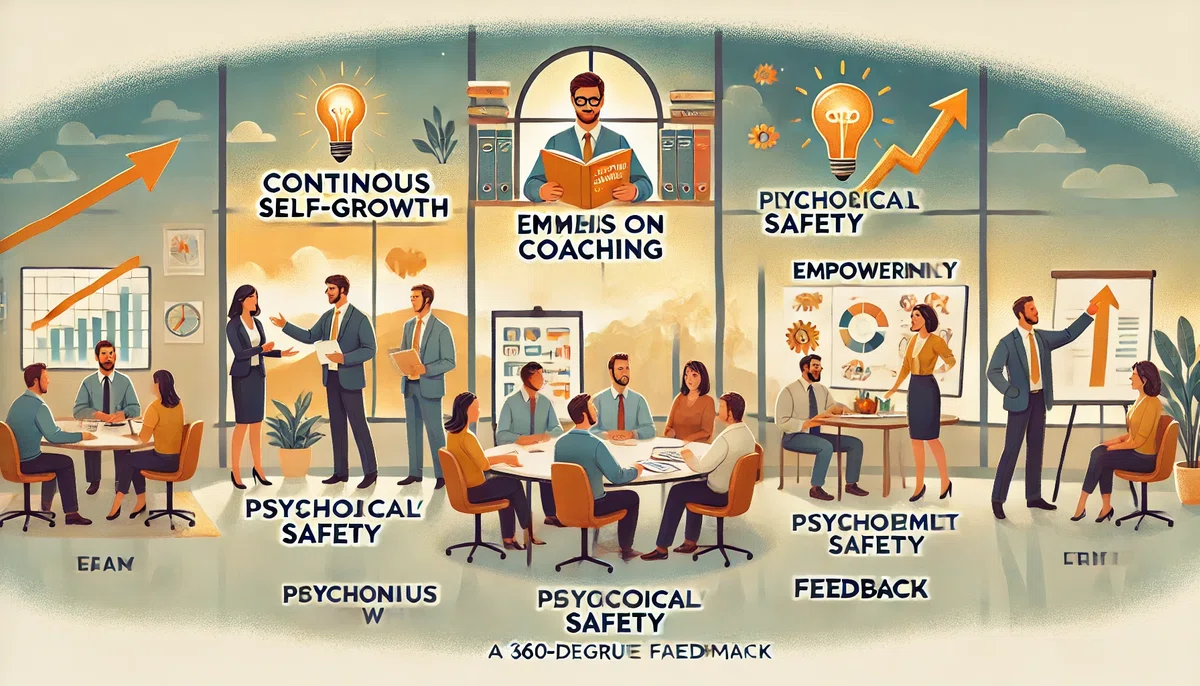
Five key elements for managers to support the growth of their subordinates are visualized. Each section depicts a manager reading a leadership book for self-growth, a manager conducting a 1-on-1 meeting using the GROW model, a manager delegating tasks with trust, a team sharing opinions with peace of mind in a brainstorming session, and a manager providing concrete feedback using multi-faceted feedback. Overall, a warm and harmonious atmosphere can be felt.