
What You Can Collaborate on with ChatGPT (For School Vice Principals)

AI is entering our lives more than we ever imagined.
Just as mobile phones evolved from feature phones to smartphones, it will be difficult to turn back the clock now.
How can we utilize AI and connect it to what we can do and what we want to achieve? If we don't look at it from that perspective, there is a fear that we will be left behind in the blink of an eye.
In this article, I will write about how I interact with ChatGPT.
This article also serves as a presentation script for the 4th term of the "GIGA School Concept Implementation Seminar" which is an online staff room I belong to.
1. What is ChatGPT?
It is a text-based AI tool developed by OpenAI.
It excels at answering questions and generating text.
It is based on a large-scale data learning model called GPT, and it has learned a vast amount of text information. Therefore, it can answer questions about a wide variety of topics.
In fact, it is used for a wide range of purposes, including education, translation, and code suggestions.However, ChatGPT is not perfect. It does not always provide accurate answers, and it may not be compatible with the latest information.
2. GPT-kun is great at summarizing
Having ChatGPT summarize long texts might be the most common way I use it.
I often ask him to do this task as well.
For example, at the end of the first semester, we conducted a school interim evaluation survey.
We have students, parents, and teachers answer it.
In addition to a 5-point scale, there are also written responses.
I have GPT-kun summarize these written parts.
The written sections are filled with various perspectives, content, and volumes, but I have GPT-kun read them all and summarize them for me.
He does a great job while considering commonalities, points of emphasis, and importance.
What used to take me a long time to do myself can now be done in just a few minutes, and I have realized the efficiency of my work.
Outsourcing my thinking felt a bit guilty at first.
But I started to think that I should focus on thinking about how to improve the organized issues instead, and now I leave all these summary tasks to GPT-kun.
3. Leave research to him too
If you wanted to look something up in the past, I think you would have asked Google, but from now on, it is better to ask ChatGPT.

If you turn on "Web access," GPT-kun will access the internet himself and do the research for you. He seems to look at several sites and even lets you know the sources.
He checks multiple sites and then summarizes and writes out the information based on what was written on those sites.
With the settings above, it means he will research three sites via Google search.
For example,
I would like to research the revision of the Student Guidance Compendium. Please access the MEXT website and sites summarized by general users, and write a summary. Could you summarize it in about 400 characters with headings?
If you ask something like that,
GPT will access several websites and write it out for you.
With this,
・The effort of searching and selecting sites
・The effort of reading those sites
・The effort of extracting keywords and summarizing them
GPT will take on these tasks for you.
Well, sometimes it researches things different from what you wanted, but for that, you need toacquire the skill of how to talk to GPTas well.
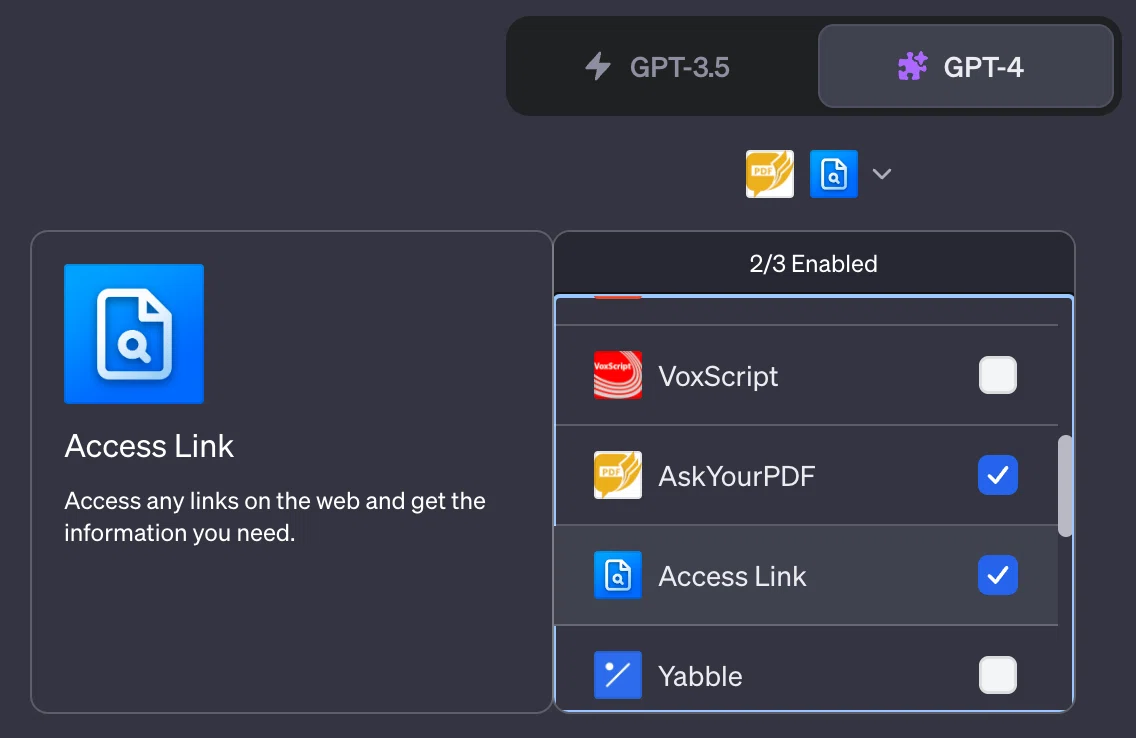
Also, if you enable the plugin function and use plugins like Access Link and Ask YourPDF,
you can have GPT read articles or PDFs from sites you have specified in advance.
For example, in the previous case,
I would like to research the revision of the Student Guidance Compendium. Could you read the following reference articles, add headings, and summarize them in about 400 characters?
***Reference Articles
https://www.mext.go.jp/content/20230220-mxt_jidou01-000024699-201-1.pdf
https://www.nits.go.jp/materials/intramural/files/129_001.pdf
https://kyoiku.sho.jp/214626/
If you do it this way, GPT will read the relevant sites and PDFs, organize that information, and write a summary for you.
4. How to talk to GPT
To ask GPT to do various things, you need certain tips.
1. Make questions specific and concise.
If your question is vague, the answer will likely be rough as well.
GPT is good at returning plausible-sounding answers, so if you want to get an accurate answer, you also need to improve the precision of your questions.
2. Assign a role. Have it act the part.
“You are a 6th-grade homeroom teacher at an elementary school.”
“You are a writer who writes blog posts.”
If you assign a role like this and have it answer in that role, it is easier to get the expected response.
3. Specify the character count and writing style (e.g., table format, with headings)
By making your request specific, it will return an appropriate volume.
“Summarize in under 200 characters”
“Write it out in table format”
“Write it clearly with headings”
and so on, be sure to specify these.
4. If the answer is not what you expected, provide additional instructions.
That said, it is not guaranteed that the expected answer will be output on the first try.
"Please provide specific examples and explain in more detail."
"Please highlight the important parts and try again."
"Please also refer to this site and add any missing perspectives."
And so on; by providing additional instructions on what is missing, the accuracy will continue to improve.
5. Conversely, have it ask you questions. Have it tell you what it needs.
You can also have GPT ask you questions, and together you can create a better answer.
"If there is anything you would like to ask me additionally to make this answer more detailed, please ask me."
By answering the questions it asks, the accuracy will likely improve.
Summary | Things I want to try using it for
In this article, I have written about how I collaborate with ChatGPT from the position of a junior high school vice principal.
ChatGPT can help you efficiently carry out necessary work by asking questions and giving instructions appropriately.
I wanted to study AI during summer vacation, so I took the plunge and paid for GPT-4, and I can't go back now.
And ChatGPT will increasingly enter the educational field in the future, and children will likely start using it as well.
In fact, many people are already putting ChatGPT into practice.
For example,
・During class reflection time, if you send questions or thoughts to GPT, you can instantly get answers to your questions, as well as advice and encouragement.
・Ask GPT about moral issues that came up in a moral education class. Deepen your own thinking while repeating the dialogue.
・Have GPT think of a script for a play.
・Have it think of grading criteria for Japanese language descriptive questions.
・Have it schedule individual parent-teacher conferences based on requests from parents.
・Have it organize events related to student guidance cases in chronological order based on interviews with students.
・Convey the purpose, number of people, budget, etc., and have it plan an itinerary for a field trip or school excursion.
・Convey the school type and scale, and have it create a draft for school administrative duties.
・Have it create a timetable.
・Have it create 4-choice quiz questions, including thinking of the incorrect options.
・Have it think of new learning games.
Just by looking into it a little, this much comes up (I also asked GPT and had it teach me this), so it should really be usable for many things in the educational field. It has considerable potential.
The times cannot be turned back now.
What can it be used for? What kind of effects can be obtained from that?
I would like to think about it carefully.
End
Thank you for reading to the end.
I am writing various other things with the theme of Education x XX.
I would be happy if you read them.
If you are new here, please start from here.
I would be very happy if you could give me a "Like" or "Follow".
The article that has been read the most this week is here.