
Takehiko Fukunaga, Shinichiro Nakamura, Saiichi Maruya, 'Definitive Edition: Midnight Stroll - The Pleasure of Mystery', Kodansha, Published June 1978


Takehiko Fukunaga (1918.3.19-1979.8.13)
Shinichiro Nakamura (1918.3.5-1997.12.25)
Saiichi Maruya (1925.8.27-2012.10.13)
'Definitive Edition: Midnight Stroll - The Pleasure of Mystery'
Binding and Illustrations by Makoto Wada, Kodansha, Published June 1978
Second printing, July 12, 1978
Date of purchase and used bookstore unknown, 350 yen

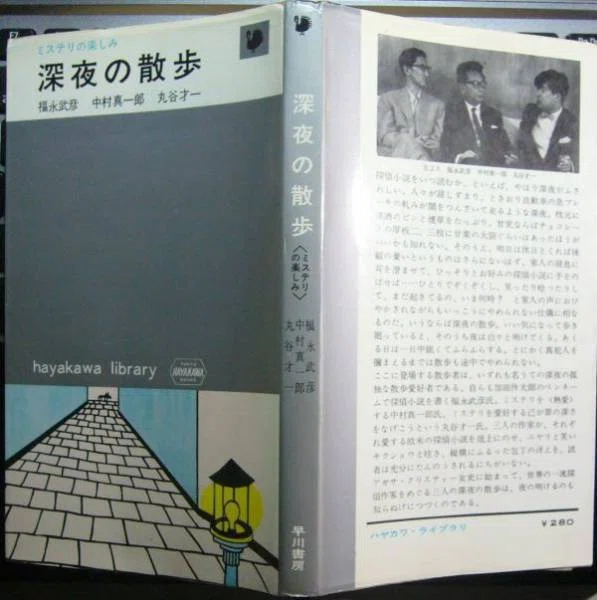
First edition, Hayakawa Publishing, Published August 1963
The first book by Saiichi Maruya I ever read was
this first edition (the photo on the back cover, where he is still in his thirties, is so young!),
which I borrowed from the Tokyo Metropolitan Tachikawa Library when I was a high school student (1970-73).


Kodansha Bunko, Published June 1981, not yet seen
https://www.amazon.co.jp/dp/B000J7XTS4
Hayakawa Bunko, Published November 1997, not yet seen
https://www.amazon.co.jp/dp/4150305919
'Midnight Stroll' by Takehiko Fukunaga
'Back Seat' by Shinichiro Nakamura
'My Sin' by Saiichi Maruya
I set out on a 'midnight stroll' with a mystery novel in hand. Thanks to that, I'm in trouble the next morning from lack of sleep. But I can't give up this 'bad habit.' Three of the leading literary figures of our time, who admit to being mystery addicts themselves and are recognized as such by others, talk wittily and freely about the pleasure of reading mysteries, backed by their extensive knowledge. Discussing numerous masterpieces of modern mystery with high critical insight and foresight, this book had a decisive influence on later generations.
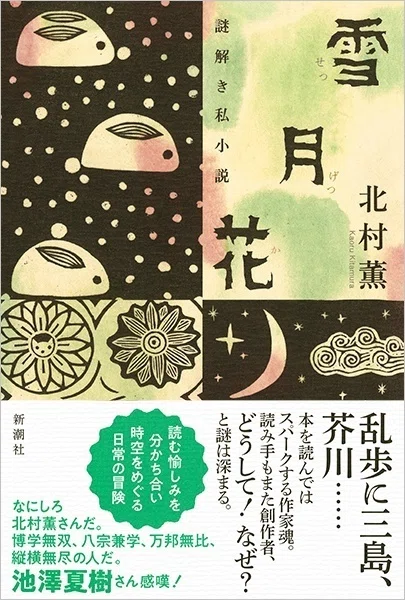
Kaoru Kitamura, 'Setsugekka: Mystery-Solving Private Novel', Shinchosha, Published August 2020
Finished reading October 11, 2020https://www.facebook.com/tetsujiro.yamamoto/posts/4536071999800737
'Personally, the trio of 'Midnight Stroll' fits in between the Dassen Trio [Toru Yuri, Toshio Minami, Mutoshi Hachinami, 1956-61] and
the Tenpuku Trio [Shinsuke Minami, Mutsuo Totsuka, Shiro Ito, 1961-73].
In high school, a friend told me about it, and I went to a used bookstore in Urawa, the prefectural capital. 'Ellery Queen's Mystery Magazine' was stacked there for thirty yen a copy. I bought them in bulk and read them. Among them was the essay 'Midnight Stroll.' It taught me about mysteries with a brilliant narrative style. This was the first time I learned the names Takehiko Fukunaga, Shinichiro Nakamura, and Saiichi Maruya.' p.206 'Hana'
'Midnight Stroll', Hayakawa Publishing, 1963.8
(It was not reprinted, according to the 'Definitive Edition Afterword')
'Ellery Queen's Mystery Magazine'
Serialized from the July 1958 issue to the June 1963 issue.
Takehiko Fukunaga passed away in 1979,
and Shinichiro Nakamura in 1997,
so there may be many people who don't know them anymore, but they were prominent writers at the time of the serialization.
Since Saiichi Maruya (1925-2012) had not yet won the Akutagawa Prize, I think he was seen more as an assistant professor at Kokugakuin University, an English and American literature scholar, and a translator, rather than a novelist.
This book is a collection of essays that three writers who love detective novels serialized in a magazine specializing in detective novels.
My Sin - Saiichi Maruya
On Christmas Stories
For the Jaded Reader
On Long, Long Stories
Sagan's Cousin
On Adventure Novels
Letters
Books to Read in a Double Bed
On Crime Novels
A Man Named Philip Marlowe
Not Being a Beauty
On Cain, Camus, and Women
On Men's Reading Material
In the Margins of a Preface
On Taboos
Disliking New Words
'When Marlowe is asked by a woman, 'How can a man as tough as you be so gentle?', he answers like this:
'If I wasn't tough, I wouldn't be alive. If I couldn't be gentle, I wouldn't deserve to be alive.'' p.240
Saiichi Maruya, 'A Man Named Philip Marlowe', EQMM, August 1962 issue
Regarding the fact that this line was altered and used in the promotion of the 1978 Kadokawa film 'Proof of the Wild',
Saiichi Maruya, 'Playtime 2', Yamato Shobo, Published February 1980
https://www.amazon.co.jp/dp/B000J8A2H4

Chuko Bunko, Published July 1983
https://www.amazon.co.jp/dp/4122010403
is included in,

'Mystery as Pleasure (Chikuma Bunko)', Chikuma Shobo, Published November 2012
https://www.amazon.co.jp/dp/4480429999
and reprinted in,

'The Strange Relationship Between Kadokawa Films and Chandler'
'Weekly Asahi', October 20, 1978 issue
please take a look.
'The story goes back nearly twenty years, but at the time, I was discussing one newly translated detective novel in every issue of a magazine called 'Ellery Queen's Mystery Magazine' (abbreviated as EQMM), which was published by Hayakawa Publishing.
In that writing, at one point, I took up Chandler's 'Playback' (translated by Shunji Shimizu) at the recommendation of EQMM editor-in-chief Taro Koizumi, and wrote this about the private detective Marlowe.
'[Omitted] When Marlowe is asked by a woman, 'How can a man as tough as you be so gentle?', he answers: 'If I wasn't tough, I wouldn't be alive. If I couldn't be gentle, I wouldn't deserve to be alive.'''
Through this writing of mine, this line by Marlowe instantly established its fame. First, Taro Koizumi, editor-in-chief of 'EQMM', was completely taken by this phrase, and as a result (though there is a bit of a leap here), he quit Hayakawa Publishing to become Jiro Ikushima, a hard-boiled detective novelist, and every time he discussed the difficult question of what hard-boiled is, he quoted this again and again.
Furthermore, his wife at the time, the female detective novelist Kimiko Koizumi, also (I don't know if it was husband-led wife-following or wife-led husband-following) loved this quote dearly, and whenever she discussed detective novel theory, men's theory, women's theory, love theory, or life theory, she brought up this line by Marlowe.
On one side, a handsome man who is the representative of hard-boiled in our country; on the other, one of the most beautiful and talented women among female detective novelists. The influence of these two was immense. 'Indeed, that's cool,' people thought, and many others quoted it.
"If I wasn't hard, I wouldn't be alive. If I couldn't ever be gentle, I wouldn't deserve to be alive."
If you translate it in the Kadokawa movie style as 'If you aren't gentle,' the most important thing—the shift from 'hard' to 'gentle' depending on the situation—is lost.
Here, it is surely correct to translate it in the style of Shunji Shimizu: 'If you cannot be gentle, you have no right to be alive.'
Saiichi Maruya, 'The Strange Relationship Between Kadokawa Movies and Chandler'
'Mystery as Pleasure (Chikuma Bunko)' p.185-188
It was this piece by Saiichi Maruya, who passed away ten years ago in October 2012, that taught me, then a high school student, about the existence of the Los Angeles private investigator, Philip Marlowe.
Excel file "Chronological List of Saiichi Maruya's Works.xls" currently 2990 rows
Currently organizing the table of contents, first publication dates, and books reviewed, along with over 80 books, sorted by publication date.
Bookmeter: Saiichi Maruya's Bookshelf (173 books registered, sorted by publication date)
https://bookmeter.com/users/32140/bookcases/11091201

Mystery Bookshelf (334 books registered, sorted by author name in Japanese alphabetical order)
https://bookmeter.com/users/32140/bookcases/11091193
