
Takeshi Yanagisawa (1960.3.25- ) "Shukan Bunshun in 2016" Kobunsha, Published December 2020, 528 pages. In Memoriam: Masahiko Katsuya [1960.12.6-2018.11.18] The 'Terrifying Newcomer' Bunshun Era, A Premature Death at 57. Bunshun Online 2018/12/30. Masahiko Katsuya "Ike-Men!" Shinchosha, Published April 2006, 192 pages.


Takeshi Yanagisawa (1960.3.25- )
"Shukan Bunshun in 2016"
Kobunsha, Published December 2020
528 pages
https://www.amazon.co.jp/dp/4334952143
"The story of the most feared magazine in Japan today and the honest men behind it.
Kazuyoshi Hanada and Manabu Shintani.
A thrilling, unparalleled non-fiction work that depicts the weekly magazines and
the scenes of scoops in the Showa, Heisei, and Reiwa eras, centered on these two legendary editors-in-chief."
Table of Contents
Prologue: Disciplinary Action Against the Editor-in-Chief
Chapter 1: The Man Who Energizes You When You Meet Him
Chapter 2: Weekly Magazine Reporter
Chapter 3: The Suspect Bullet
Chapter 4: The Hanada Weekly
Chapter 5: The Marco Polo Incident
Chapter 6: The Murder Squad
Chapter 7: "Shukan Bunshun" in 2016
Final Chapter: Bunshun Online
Afterword: "Shukan Bunshun" in 2020
Takeshi Yanagisawa
Born in Tokyo in 1960. Non-fiction writer.
After graduating from the Faculty of Law at Keio University, he worked for an air conditioning manufacturer before
joining Bungeishunju Ltd. He worked in the editorial departments of
"Shukan Bunshun" under Editor-in-Chief Kazuyoshi Hanada and
"Sports Graphic Number" under Editor-in-Chief Atsuo Shitara, among others,
and became independent in 2003.
His debut work published in 2007,
"Antonio Inoki in 1976," was highly acclaimed. His major books include
"Crush Gals in 1985",
"The Story of Japanese Wrestling",
"Giant Baba in 1964",
"UWF in 1984",
"Summer Christmas in 1974:
The Era of Yoshio Hayashi and Pack-In-Music"
."
Finished reading on February 11, 2021
Fukuoka City Public Library, 7th in reservation queue
"Shosetsu Hoseki"
January 2018 issue - May 2020 issue
Serialized, revised, and expanded
"I came up with the idea of making the two editors-in-chief [of 'Shukan Bunshun'] the protagonists,
or perhaps the narrators.
They are Kazuyoshi Hanada [born September 13, 1942] and
Manabu Shintani [born September 1, 1964]."
With these two, who are more than 20 years apart in age, as the protagonists,
I provide an overview of the 100-year history of "Bungeishunju" and
the 60-year history of "Shukan Bunshun."
I depict the rise and fall of this rare publishing company, which has been closely involved with this country and has created numerous social phenomena, while simultaneously moving the characters and the historical background.
For readers who know nothing about the job of a magazine editor,
I introduce it, including some occasionally humorous episodes.
I [Takeshi Yanagisawa, born March 25, 1960] am
a former Bunshun employee, and I have the experience of working in the same editorial department as both Hanada-san and Shintani.
I also have many acquaintances within the company.
If things go well, it might become an interesting read."
p.519 "Afterword: 'Shukan Bunshun' in 2020"
"Masahiko Katsuya [born December 6, 1960 - died November 28, 2018]
died of liver failure. He was 57 years old."
Just before 6:00 PM, I received a call from
Kotaro Kashihara, who is one year junior to Katsuya and serves as the Web Business Division Manager at Bungeishunju.
He asked me to write a memorial piece for 'Bunshun Online'.
When I accepted, shortly after,
I received an email from Naohiro Takeda, the editor-in-chief of 'Bunshun Online',
formally requesting the manuscript.
This was my first time writing a manuscript for a website.
I spent about an hour and a half writing the following manuscript
['In Memoriam: Masahiko Katsuya
The 'Terrifying Newcomer' Bunshun Era, A Premature Death at 57
I first met him in the spring of 1985,
the place was the 'Emma' editorial department just before its launch.
Masahiko Katsuya was from the Waseda University Otome-chick Club.
When he heard that I had been involved with the manga magazine 'Pafu' during my university days [Keio University Faculty of Law],
he showed me his membership card for the Keiko Takemiya Fan Club 'Sunroom,' membership number No. 1.
I was wide-eyed with surprise, but I was probably the only one in the Bunshun office at the time who would have reacted that way.']
https://bunshun.jp/articles/-/10115I wrote that."
p.483 "Final Chapter: Bunshun Online"

"Submitted at 19:31.
20:44, 20:56
Preview page
(something like a proof galley with the manuscript and photos laid out) received.
20:56, corrected manuscript submitted.
3 minutes later, confirmation email:
'Two corrections. Uploading within 10 minutes.'"
"Within 90 minutes of submission, all work was completed.
For someone raised on magazines,
it was a mind-blowing speed."
p.485 "Final Chapter: Bunshun Online"
https://ja.wikipedia.org/wiki/勝谷誠彦
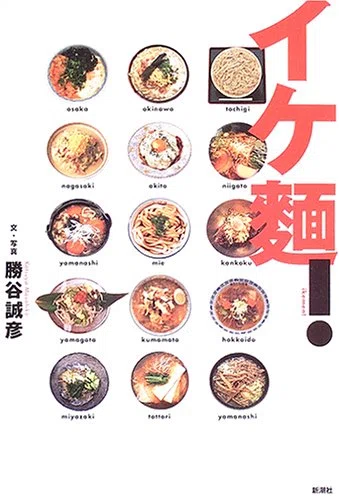
Masahiko Katsuya
"Ike-Men!"
Shinchosha, Published April 2006
192 pages
https://www.amazon.co.jp/dp/4104462047
"In search of the 'Ike-Men' (cool noodles) waiting for me somewhere in Japan—
A nationwide noodle-eating journey by columnist Masahiko Katsuya,
who is active in magazines, television, and more!
The 'local noodles' born and passed down in this country are the true 'Ike-Men'.
From 'major noodles' like Yokote and Ota yakisoba, and Nagasaki champon,
to unknown 'Ike-Men' like Kumamoto's Taipien and Nagasaki's Shimon noodles,
he has eaten about 100 varieties.
Traveling the length and breadth of the country in search of 'Ike-Men' with a firm, chewy texture and a smooth throat-feel.
Exploring the heart of Japan, the 'Land of Noodles.' Includes many color photos."
Finished reading on September 17, 2010.
Fukuoka City Public Library collection.
Contains 15 out of the 26 installments of 'Katsuya's Noodle Travels' and
'Local Noodle's Walker' published in 'Tabi' magazine from July 2003 to September 2005.
From Jingisukan ramen in Ashibetsu, Hokkaido in the north,
to Fuchiba soba in Urasoe, Okinawa in the south, and even
Mak-guksu in Chuncheon, South Korea,
the color photos and text are all mouth-watering.
According to the editor's 'report' at the end of the book,
Kurume ramen from Fukuoka also appeared in the magazine series.
It is a pity it was not included in this book.
"He suddenly scatters potatoes onto the iron plate.
Yes. These potatoes are the hallmark of Tochigi yakisoba.
'I boil them at home in a pressure cooker from the morning and bring them here.'
He adds cabbage and puts the noodles on top.
Then, he ladles something from a can on the side.
'This? It's dashi (broth).
I make it from stir-fried minced meat and green onions.'
Whether it's the potatoes or the minced meat, it's truly simple, or rather, humble.
Honestly, I am not a fan of potatoes.
Seeing them lumped in there makes me want to ask about their compatibility with the noodles.
I pick up my chopsticks with skepticism.
I put the potato and noodles into my mouth together... Delicious!
Wow, I was surprised.
Despite being potatoes, they have a real affinity with the noodles.
Of course, that is solely because they were pre-boiled until soft,
and if they had been stir-fried while hard, they would have felt more awkward in the mouth.
The sauce has soaked gently into the softness that collapses on the tongue.
Yet, when you chew, there is that slight, unique bitterness of the potato,
which saves the whole dish from becoming too childish.
Even without much meat, the fact that the flavor has soaked thoroughly into the noodles is likely due to the effectiveness of the minced meat and green onion broth."
p.124
Tochigi City 'Omamyuda Shoten's' famous potato yakisoba for 300 yen.
A tasty line connecting town revitalization and local noodles.
Bookmeter
Ken Yanagisawa's Bookshelf
https://bookmeter.com/users/32140/bookcases/11091212
