
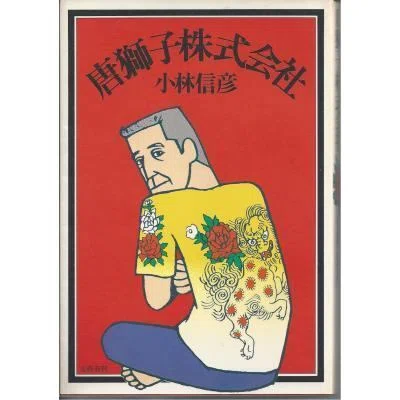
Nobuhiko Kobayashi 'Karajishi Kabushiki Gaisha: Nobuhiko Kobayashi Collection' Freestyle, Published December 2016. 'Karajishi Kabushiki Gaisha' Bungeishunju, Published April 1978. 'Karajishi Wakusei Senso (Star Wars)' Bungeishunju, Published November 1978. 'Karajishi Chojin Densetsu (Superman)' Bungeishunju, Published June 1979. 'Karajishi Genji Monogatari' Shinchosha, Published December 1982.


Nobuhiko Kobayashi 'Karajishi Kabushiki Gaisha: Nobuhiko Kobayashi Collection'
Cover Illustration/Commentary: Hisashi Eguchi
Freestyle, Published December 2016
https://www.amazon.co.jp/dp/4939138836
From 'Star Wars' to 'The Tale of Genji'—a grand feast of gags, nonsense, and parody! The launch of an internal company newsletter, broadcasting stations, film production, music festivals... Driven by the whims of the big boss, a new chivalrous path begins today. The first complete collection, including 'Karajishi Genji Monogatari'!
The second installment of the Nobuhiko Kobayashi Collection.
A 570-page, vertically long format similar to foreign paperbacks or Hayakawa Shobo's Pocket Mystery series.
The first installment was
'Kyokuto Serenade: Nobuhiko Kobayashi Collection', published March 2016https://www.amazon.co.jp/dp/4939138798
.
Seventeen stories from the 'Karajishi Kabushiki Gaisha' series published in 'Bessatsu Bungeishunju' issues 139-148 (March 1977 - June 1979),
'Weekly Sankei' Jan 3/10 combined issue, Jan 17 issue, Aug 5 issue, and Aug 12 issue of 1982,
and 'Shosetsu Shincho' May 1981 - August 1982 issues.
'Karajishi Kabushiki Gaisha', 'Bessatsu Bungeishunju' No. 139, Spring 1977 issue
'Karajishi Hoso Kyokai', 'Bessatsu Bungeishunju' No. 140, Summer 1977 issue
'Karajishi Seikatsu Kakumei', 'Bessatsu Bungeishunju' No. 141, Autumn 1977 issue
'Karajishi Ishiki Kakumei', 'Bessatsu Bungeishunju' No. 142, Winter 1977 issue
'Karajishi Eiga Sangyo', 'Bessatsu Bungeishunju' No. 143, Spring 1978 issue
'Karajishi Wakusei Senso (Star Wars)', 'Bessatsu Bungeishunju' No. 144, Summer 1978 issue
'Karajishi Tantei Gunzo', 'Bessatsu Bungeishunju' No. 145, Autumn 1978 issue
'Karajishi Ansatsu Shirei', 'Bessatsu Bungeishunju' No. 146, Winter 1978 issue
'Karajishi Dasshutsu Sakusen', 'Bessatsu Bungeishunju' No. 147, Spring 1979 issue
'Karajishi Chojin Densetsu (Superman)', 'Bessatsu Bungeishunju' No. 148, Summer 1979 issue
'Karajishi Senshu Sodatsu (Stove League)', 'Weekly Sankei' Jan 3/10 combined issue, Jan 17 issue
'Karajishi Shibumi Toso', 'Shosetsu Shincho' May 1981 issue
'Karajishi Ijin Taisaku', 'Shosetsu Shincho' November 1981 issue
'Karajishi Dengekitai-in (Raiders)', 'Shosetsu Shincho' March 1982 issue
'Karajishi Genji Monogatari', 'Shosetsu Shincho' June 1982 issue
'Karajishi Nyuyoku Zokubutsu (New Yorkers)', 'Shosetsu Shincho' August 1982 issue
'Karajishi Ryori Kakumei', 'Weekly Sankei' August 5 and August 12, 1982 issues
When I was a student (1973-78), the surprise I felt when I first read these in 'Bessatsu Bungeishunju', which my father used to buy, was intense—I was rolling on the floor laughing. Nearly fifty years ago, I was going to the movie theater almost every day, and I devoured every issue.
As stated in the 'Afterword' on page 542: 'The first piece was written as an experiment to see how far comedic imagination could be escalated, and since it became a topic of conversation, one could say that the subsequent runaway train began.'
In the afterword of the second book, 'Karajishi Wakusei Senso (Star Wars)', it said:
'The reason I decided to continue, despite intending to stop after the four stories included in 'Karajishi Kabushiki Gaisha', was due to the encouragement of my respected friend Hideo Osabe, and a few lines of criticism that appeared in the magazine 'Gen'eijo' (I learned much later that it was written by Azusa Nakajima using a male first-person perspective). This also means that they were the only two people who acknowledged it.' p. 295
'Born in Tokyo and raised in Nihonbashi, it is unreasonable for me to write in Kansai dialect.
It is strange no matter how you look at it, but the reason I pushed through with it is thanks to my respected friend Akio Inaba [Feb 1, 1934 - Mar 17, 1999 https://ja.wikipedia.org/wiki/稲葉明雄 ], who was born in Osaka. He was born in the Kansai region, and at his funeral, I learned that he had a very unique upbringing. If not for those circumstances, even if I knew that a special PR magazine (?) existed among the people of that region, it would have been impossible to realize it.
It was impossible for me to turn my poor writing into brilliant Kansai dialect. It was a blessing in disguise that he corrected it in detail at coffee shops near his parents' home or at restaurants in Shinjuku hotels.'
p. 543 'Afterword'
Standalone book
'Karajishi Kabushiki Gaisha' Bungeishunju, Published April 1978
Back cover/Recommendation: Morio Kita, Yasutaka Tsutsui
https://www.amazon.co.jp/dp/B000J8QCY6
'Karajishi Kabushiki Gaisha', 'Bessatsu Bungeishunju' No. 139, Spring 1977 issue
'Karajishi Hoso Kyokai', 'Bessatsu Bungeishunju' No. 140, Summer 1977 issue
'Karajishi Seikatsu Kakumei', 'Bessatsu Bungeishunju' No. 141, Autumn 1977 issue
'Karajishi Ishiki Kakumei', 'Bessatsu Bungeishunju' No. 142, Winter 1977 issue
'Kumo o Tsukamu Otoko', 'Shosetsu Sunday Mainichi' April 1971 issue (Reprinted in 'Hayakawa Mystery Magazine' January 1972 issue)
'Kumo o Tsukamu Otoko Futatabi', 'Hayakawa Mystery Magazine' January 1972 issue
'JELLIES', 'Monthly Playboy' January 1976 issue
'The strange translation of the Mother Goose nursery rhyme ('Who Killed Cock Robin?') in the third story ['Karajishi Seikatsu Kakumei'] only had two stanzas when published in the magazine, but for this book, I have included a complete translation (?) of all fourteen stanzas. There are also significant additions in the third story. For an author born in downtown Tokyo, writing all the dialogue in Kansai dialect was not easy, and more than half of my energy was drained by it. The words of the 'I' in the story, Kuroda, are not Osaka dialect, but a mixture of the unique dialects of the yakuza who advanced from Kure to Hiroshima and created the 'Hiroshima Conflict'. The intellectual Harada's speech is relatively close to common language (standard Japanese), and Dark Aramaki's speech is changed little by little, such as his Kawachi dialect becoming more pronounced when he gets excited.'
p. 304 'In Place of an Afterword: Exercises in Comedic Imagination'
The dialects of the characters in the 'Battles Without Honor and Humanity' film series 1973-74
https://www.allcinema.net/cinema/144227
are the ones used here.
'Karajishi Wakusei Senso (Star Wars)' Bungeishunju, Published November 1978
https://www.amazon.co.jp/dp/B000J8L0FC
'Karajishi Eiga Sangyo', 'Bessatsu Bungeishunju' No. 143, Spring 1978 issue
'Karajishi Wakusei Senso (Star Wars)', 'Bessatsu Bungeishunju' No. 144, Summer 1978 issue
'Karajishi Tantei Gunzo', 'Bessatsu Bungeishunju' No. 145, Autumn 1978 issue
'Suiboki', 'Ushio' December 1964 issue
'Chunen Tanteidan', 'Hayakawa Mystery Magazine' September 1969 issue
'Yoko ni Natta Otoko', 'Ryudo' May 1974 issue
'Jinsuke Graffiti', 'All Yomimono' May 1978 issue

'Karajishi Chojin Densetsu (Superman)' Bungeishunju, Published June 1979
https://www.amazon.co.jp/dp/B000J8G9K8
'Karajishi Ansatsu Shirei', 'Bessatsu Bungeishunju' No. 146, Winter 1978 issue
'Karajishi Dasshutsu Sakusen', 'Bessatsu Bungeishunju' No. 147, Spring 1979 issue
'Karajishi Chojin Densetsu (Superman)', 'Bessatsu Bungeishunju' No. 148, Summer 1979 issue
'Waga Moratorium', 'All Yomimono' June 1979 issue
'Oyako Danran-zu', 'non-no' December 20, 1978 issue
'Ie no Naka no Meitantei', 'Mystery Magazine' October 1974 issue
'Tekkai', 'Warau Otoko: Doke no Gendaishi' Shobunsha, Published July 1971
'Otona no Jikan', 'Shosetsu Gendai' March 1966 issue
'Kieta Doki', 'Hoseki' February 1959 issue

'Karajishi Genji Monogatari' Shinchosha, Published December 1982
http://www.amazon.co.jp/dp/B000J7IGHI
'Our Big Boss' empathized intensely with Hikaru Genji.
A hilarious series where gag follows gag.
'Karajishi Senshu Sodatsu (Stove League)', 'Weekly Sankei' Jan 3/10 combined issue, Jan 17 issue
'Karajishi Shibumi Toso', 'Shosetsu Shincho' May 1981 issue
'Karajishi Ijin Taisaku', 'Shosetsu Shincho' November 1981 issue
'Karajishi Dengekitai-in (Raiders)', 'Shosetsu Shincho' March 1982 issue
'Karajishi Genji Monogatari', 'Shosetsu Shincho' June 1982 issue
'Karajishi Nyuyoku Zokubutsu (New Yorkers)', 'Shosetsu Shincho' August 1982 issue
'Karajishi Ryori Kakumei', 'Weekly Sankei' August 5 and August 12, 1982 issues
'Chojin Tantei' Shinchosha [1981.3]
https://www.facebook.com/tetsujiro.yamamoto/posts/907005602707413
http://www.amazon.co.jp/dp/B000J80AO4
http://www.amazon.co.jp/dp/410115807X
Readers who have forgotten should recall that Dark Aramaki was <wearing a baseball uniform and covered in mud> in that fifth story ['A Strange Incident in Osaka', 'Shosetsu Shincho Bessatsu' Winter 1980 issue]. There is no need to explain why that was the case. There are terms like 'Yosano Genji' and 'Tanizaki Genji' in the world, but I would like you to casually call this book 'Kara-Genji'. However, if a careless person mistakes it for a work by Juro Kara [Feb 11, 1940 - ], that is not our responsibility.' p. 269

Nobuhiko Kobayashi (Dec 2, 1932 - )
Bookmeter: Nobuhiko Kobayashi's Bookshelf (134 registered books, in order of publication date)
https://bookmeter.com/users/32140/bookcases/11091202
