
If I hear that you are waiting on the peak of Mount Inaba, where we parted, I will return now. Naoto Yoshikai (1953- ) "Rereading the Hyakunin Isshu 2: Focusing on Wordplay" Shintensha, published September 2020, "Chapter 7: The Freshness of Ariwara no Yukihira's 'Tachibakare' Poem (No. 16)"


Naoto Yoshikai (1953- )
"Rereading the Hyakunin Isshu
2: Focusing on Wordplay
Shintensha Sensho 97"
Shintensha, published September 2020
312 pages
https://www.amazon.co.jp/dp/4787968475
Finished reading on June 18, 2021
Collection of Fukuoka City Public Library
"Chapter 7
The Freshness of Ariwara no Yukihira's
'Tachibakare' Poem (No. 16)" p.87-95
If I hear that you are waiting on the peak of Mount Inaba, where we parted, I will return now.
Kokin Wakashu, Volume 8, Parting Poems, 365 (Perhaps the opening poem)
Ariwara no Yukihira (818-893)
A poet and court noble of the early Heian period.
The second (or third) son of Prince Abo,
Danjō no Kami (Director of the Danjōdai, an honorary position given to royalty),
who was the first prince of Emperor Heizei.
Older brother of Ariwara no Narihira.
First appearance in the Kokinshu (four poems). One poem in the Shin Kokinshu.
Eleven poems included in imperial anthologies.
"There are no poems in the Manyoshu that mention Inaba Province.
It was not a place name that was typically incorporated into poems.
[The 'Tachibakare' poem] is its first appearance in an imperial anthology.
At the time of Yukihira's poem, it had not yet become a 'utamakura' (poetic pillow word/place)."
p.89 '1. Raising the Issue'
"Two kakekotoba (pivot words) are used,
and the nature of 'the pine growing on the peak of Mount Inaba'
and the human affairs of 'parting and leaving' and 'if I hear you are waiting, I will return now'
are beautifully fused, constructing a world that is truly 'Kokinshu'-esque."
p.92 '2. The Pillow-word-like 'Tachibakare'
"The 'Pine of Inaba' is represented by Teika's
Do not tell me you are waiting, hoping I will forget; rather, the autumn wind on the peak of Mount Inaba
Shin Kokin Wakashu, Volume 10, Travel Poems, 968
and is frequently composed in
'Sengohyakuban Uta-awase',
'Saishō Shitennō-in Waka',
and 'Kenpō Meisho Waka'
as poems that use Yukihira's poem as a 'honkadori' (allusive variation).
By this point, it had become so established (popular) that
mentioning 'Inaba' meant 'pine' would follow."
p.93 '3. 'Pine of Inaba' as a Pivot Word
"Yukihira's 'Tachibakare' poem
was an original poem even within the 'Kokinshu'.
The combination of 'Inaba' and 'pine'
had not been composed at all before that,
and because it became a huge hit as an allusive variation in the Shin Kokin era,
it is misunderstood as having been a poetic pillow word since ancient times,
but it was a new image of a poetic pillow word created by the attention given to Yukihira's poem.
Along with that popularity,
it was selected for the Hyakunin Isshu as Yukihira's representative work,
but now that freshness is difficult to understand."
p.94 '4. Summary'
Table of Contents
Introduction
Chapter 1
Deciphering Emperor Tenji's 'Autumn Field' poem (No. 1)
Chapter 2
Is 'Shirotae no' a pillow word? Differences between Empress Jito's poem (No. 2) and Yamabe no Akahito's poem (No. 4)
Chapter 3
Interpretation of 'Will I sleep alone?' in Kakinomoto no Hitomaro's poem (No. 3)
Chapter 4
The uniqueness of 'Long, long' in Kakinomoto no Hitomaro's poem (No. 3)
Chapter 5
Reading Otomo no Yakamochi's 'Magpie' poem (No. 6) as a poem of waiting for love
Chapter 6
Re-examining Abe no Nakamaro's 'Heaven's Plain' poem (No. 7): Starting from the Ueno theory
Chapter 7
The freshness of Ariwara no Yukihira's 'Tachibakare' poem (No. 16)
Chapter 8
The 'Chihayaburu' fantasy in Ariwara no Narihira's poem (No. 17): Concerning voiced and unvoiced sounds
Chapter 9
Reconsidering 'Water-diving' in Ariwara no Narihira's poem (No. 17): Following the Morita theory
Chapter 10
Reconsidering 'The moon of the long month's dawn' in Sosei Hoshi's poem (No. 21)
Chapter 11
A study of 'Dawn' in the 'Hyakunin Isshu': Starting from Mibu no Tadamine's poem (No. 30)
Chapter 12
Is 'Hisakata no' in Ki no Tomonori's poem (No. 33) a pillow word for 'light'?
Chapter 13
Re-examining 'Sue no Matsuyama' in Kiyohara no Motosuke's poem (No. 42): Triggered by the Tohoku tsunami
Chapter 14
Concerning Fujiwara no Kintō's 'Sound of the Waterfall' poem (No. 55): Re-examination from Saigyo's poem
Chapter 15
Reconsidering the pivot word in Koshikibu no Naishi's 'Oeyama' poem (No. 60): Triggered by the Asami theory
Chapter 16
Reconsidering 'Deep in the night' in Sei Shonagon's poem (No. 62): Verification of the Kobayashi theory
Chapter 17
Reconsidering 'The gap in the door' in Shun'e Hoshi's poem (No. 85)
Chapter 18
Pivot-word usage of 'As the night deepens' in Sangi Masatsune's poem (No. 94)
Chapter 19
Focusing on 'Signs of summer' in Jusanmi Ietaka's poem (No. 98)
List of First Publications
Afterword
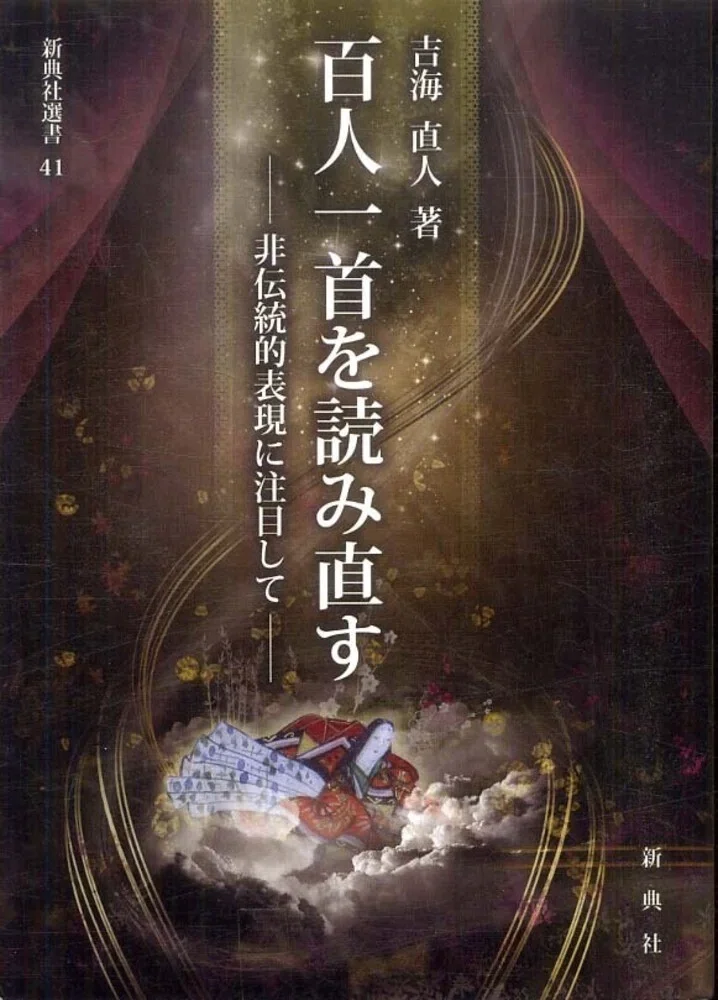
Naoto Yoshikai (1953- )
"Rereading the Hyakunin Isshu"
Shintensha, published May 2011
262 pages
https://www.amazon.co.jp/dp/4787967916
https://www.facebook.com/tetsujiro.yamamoto/posts/796282843779690
四年前に読んだ本。吉海直人 『百人一首を読み直す 非伝統的表現に注目して (新典社選書)』 http://goo.gl/y65g16 #bookmeter 新典社...
Posted by 山本 鉄二郎 on Thursday, March 19, 2015
Naoto Yoshikai
Born in Nagasaki Prefecture in 1953
Specially Appointed Professor, Department of Japanese Language and Literature, Faculty of Representation and Culture, Doshisha Women's College of Liberal Arts
https://www.dwc.doshisha.ac.jp/talk/japanese/detail01/
This is the 7th book by Naoto Yoshikai that I have read.
Dokushometer
Naoto Yoshikai's Bookshelf (7 books registered, in order of publication date)
https://bookmeter.com/users/32140/bookcases/11091377
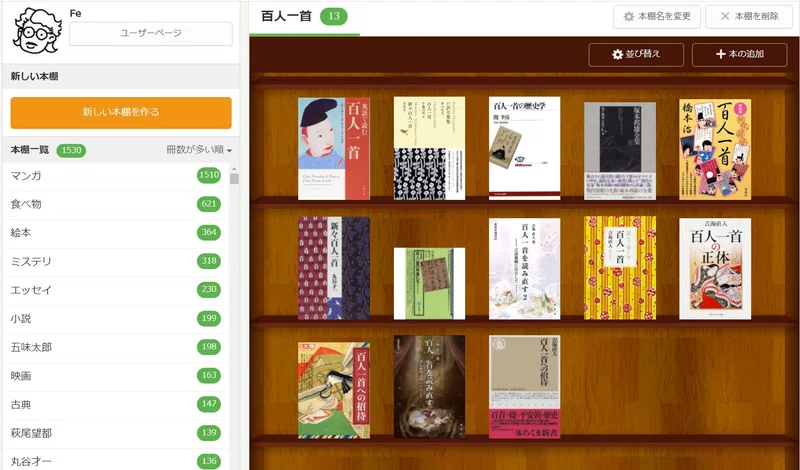
Hyakunin Isshu Bookshelf (13 books registered)
https://bookmeter.com/users/32140/bookcases/11091294
Half of them, 7 books, are by Naoto Yoshikai.

https://note.com/fe1955/n/n586a12682eab
My sleeves are getting wet with dew because the thatch of the hut in the autumn field is thin.
Naoto Yoshikai (1953- )
"Rereading the Hyakunin Isshu
2: Focusing on Wordplay"
Shintensha, published September 2020
"Chapter 1: Deciphering Emperor Tenji's
'Autumn Field' poem (No. 1)" p.15-24
'Japanese Linguistics' June 2017 issue (Vol. 36, No. 6)
https://note.com/fe1955/n/n62266db52edf
Spring has passed, and summer seems to have come; they say they are drying white robes on Mount Kagu in heaven.
When I go out to Tago no Ura and look, snow is falling on the high peak of white Fuji.
Naoto Yoshikai (1953- )
"Rereading the Hyakunin Isshu
2: Focusing on Wordplay"
Shintensha, published September 2020
"Chapter 2: Is 'Shirotae no' a pillow word?
Differences between Empress Jito's poem (No. 2) and Yamabe no Akahito's poem (No. 4)"
https://note.com/fe1955/n/n0ba90ea3e6c6
Like the trailing tail of a mountain pheasant, will I sleep alone through the long, long night?
Naoto Yoshikai (1953- )
"Rereading the Hyakunin Isshu
2: Focusing on Wordplay"
Shintensha, published September 2020
"Chapter 3: Interpretation of
'Will I sleep alone?' in Kakinomoto no Hitomaro's poem (No. 3)"
https://note.com/fe1955/n/n8a17ee829b0e
Like the trailing tail of a mountain pheasant, will I sleep alone through the long, long night?
Naoto Yoshikai (1953- )
"Rereading the Hyakunin Isshu
2: Focusing on Wordplay"
Shintensha, published September 2020
"Chapter 4: The uniqueness of
'Long, long' in Kakinomoto no Hitomaro's poem (No. 3)"
https://note.com/fe1955/n/n4f431d990faa
When I see the whiteness of the frost placed on the bridge that the magpies have crossed, I realize the night has deepened.
Naoto Yoshikai (1953- )
"Rereading the Hyakunin Isshu
2: Focusing on Wordplay"
Shintensha, published September 2020
"Chapter 5: Reading Otomo no Yakamochi's
'Magpie' poem (No. 6) as a poem of waiting for love"
https://note.com/fe1955/n/n33fa91b5395e
When I look far away at the heaven's plain, is it the same moon that appeared on Mount Mikasa in Kasuga?
Naoto Yoshikai (1953- )
"Rereading the Hyakunin Isshu
2: Focusing on Wordplay"
Shintensha, published September 2020
"Chapter 6: Re-examining Abe no Nakamaro's
'Heaven's Plain' poem (No. 7): Starting from the Ueno [Makoto] theory"
https://note.com/fe1955/n/nce8e9a0c3675
Emperor Gotoba (August 6, 1180 - March 28, 1239)
"New Japanese Classical Literature Series 11
Shin Kokin Wakashu"
Annotated by Yutaka Tanaka and Shingo Akase
Iwanami Shoten, January 1992
Saiichi Maruya (August 27, 1925 - October 13, 2012)
"Emperor Gotoba, Second Edition"
Chikuma Shobo, September 2004
"Emperor Gotoba, Second Edition"
Chikuma Gakugei Bunko, March 2013
https://note.com/fe1955/n/n8dfcbf3d6859
Princess Shikishi (1149-1201)
Kumiko Tabuchi (1957- )
"Shin Kokinshu: The Era of Emperor Gotoba and Teika (Kadokawa Sensho)"
Kadokawa Gakugei Shuppan, December 2010
"Heretical Princess and Court Lady Poets: Princess Shikishi and the Shin Kokinshu"
KADOKAWA (Kadokawa Gakugei Shuppan), February 2014
Keiko Hirai (1947- )
"Princess Shikishi (Collection of Japanese Poets 010)"
Kasama Shoin, April 2011
Akiko Baba (January 28, 1928 - )
"Princess Shikishi (Chikuma Gakugei Bunko)"
Chikuma Shobo, August 1992
https://note.com/fe1955/n/n47955a3b0698
Gotobain no Kunaikyo
(Gotobain no Kunaikyo, dates of birth and death unknown)
"New Japanese Classical Literature Series 11
Shin Kokin Wakashu"
Annotated by Yutaka Tanaka and Shingo Akase
Iwanami Shoten, January 1992
https://note.com/fe1955/n/n34d98221cddf
For example, my dear, won't you scoop me up like you scoop up fallen leaves with a rustle?
Kazuhiro Nagata (May 12, 1947 - )
"That chest was as far away as a cape
Youth with Yuko Kono"
Shinchosha, published March 2022
318 pages