
4-1 Probability of Intersection Events: Calculating Conditional Probability & Multiplication Theorem of Probability using Rectangle Area

This Statistics Topic
We will work on problems to find the probability of intersection events using the definition of conditional probability and the multiplication theorem of probability.
We will also solve similar problems for review. A cute shopkeeper will appear!
Preparation of the Official Problem Collection
We will use problems from the "Official Problem Collection." Please have the official problem collection at hand.
Don't worry if you don't have the official problem collection!
Please enjoy learning statistics at your own pace in the "Learn" and "Practice" chapters!
Solving Problems
📘 Official Problem Collection Category
Probability Field
Question 1: Probability of Intersection Events (Taking an Exam Preparation Course)
Exam Date
Statistics Grade 2, November 2019, Question 8 (Answer Number 12)
Problem
Please refer to the official problem collection.
How to Solve
Problem Intent
Under the following conditions, we will find the probability that an examinee will "take the course" and "pass the exam" at the same time.
【Probability of taking the course】
・Probability that an examinee takes the course: 20%
【Probability of passing the exam】
・Probability of passing the exam among those who take the course: 70%
・Probability of passing the exam among those who do not take the course: 30%
Solving with a Diagram
Using a square with a width of 1, a height of 1, and an area of 1, we will find the ratio (probability) of examinees who "take the course" and "pass the exam" at the same time.

① The probability that an examinee "takes the course" is 0.2.
② The probability of "passing the exam" given that they "take the course" is 0.7.
The probability that an examinee "takes the course" and "passes the exam" at the same time is found by multiplying (the product of) the probability from ① (0.2) and the probability from ② (0.7).
The answer is 0.14.
Solving with the Multiplication Theorem of Probability Formula
First, we define the events as follows:
・Event of taking the course: $${A}$$
・Event of passing the exam: $${B}$$
The probability we are looking for is the probability of the intersection event $${P(A \cap B)}$$, where the "event of taking the course $${A}$$" and the "event of passing the exam $${B}$$" occur at the same time among examinees.
From the problem statement, we obtain the following probabilities:
・Probability of "event of taking the course $${A}$$": $${P(A)=0.2}$$
・Conditional probability of "event of passing the exam $${B}$$ occurring" given "event of taking the course $${A}$$": $${P(B \mid A)=0.7}$$
We apply these values to the multiplication theorem of probability to calculate the probability.
【Multiplication Theorem of Probability】
$$
P(A \cap B) = P(A)\ P(B \mid A)
$$
[Calculation Process]
$$
P(A \cap B)=0.2\times0.7=0.14\\
$$
The answer is 0.14.
Answer
1. It is 0.14.
Difficulty: Easy
・Knowledge: Probability of intersection events, conditional probability, multiplication theorem of probability
・Calculation skills: Formula construction (low), calculator (low)
・Estimated time: 1 minute
Learn
Menu
Let's approach the problems from the official workbook!
This time, let's solve a similar problem together!
Events and Probability
📕Official Textbook: 2.1 Events and Probability (from page 55)
Similar Problem
Consider customers who purchase sweets with a lottery ticket.
Usually, there is a 20% chance of winning the lottery.
For customers who are friends with the shopkeeper, there is an 80% chance of winning the lottery.
The probability that a purchaser is friends with the shopkeeper is 30%.
When one person is randomly selected from the purchasers of sweets with lottery tickets, what is the percentage probability that the person is friends with the shopkeeper and wins the lottery?

Events and Probability
Let the event of being friends with the shopkeeper be $${A}$$, and the event of winning the lottery be $${B}$$.
The symbol $${P}$$ is used for probability.
The probability of the event of being friends with the shopkeeper is expressed as $${P(A)}$$, and since the probability is 0.3, it is expressed as $${P(A)=0.3}$$.
Let's visualize this.
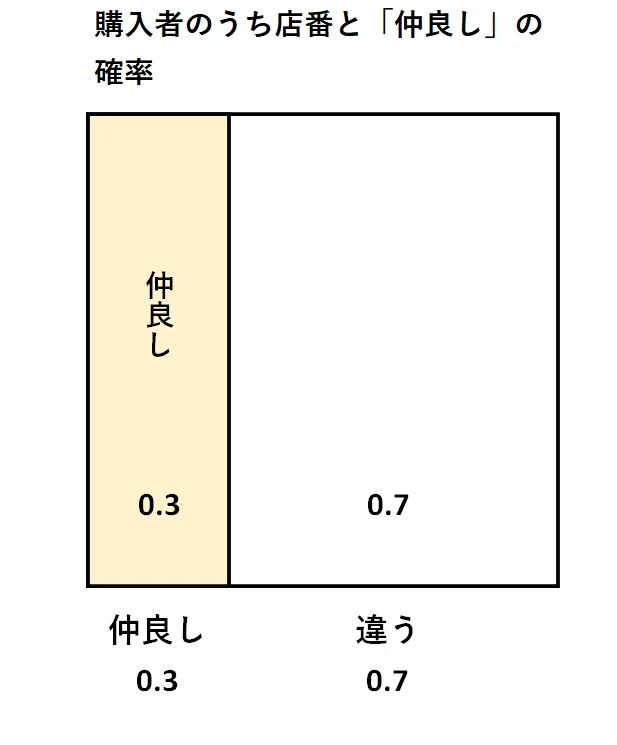
Conditional Probability
The probability of winning the lottery given that one is friends with the shopkeeper is expressed as $${P(B \mid A)}$$.
Since the probability is 0.8, $${P(B \mid A)=0.8}$$.
This means $${P(winning the lottery \mid friends with the shopkeeper)}$$, which is the probability of "winning the lottery" under the condition that the event "friends with the shopkeeper" occurs.
Conditional Probabilityis what it is called.
Let's visualize this.
The probability of "winning" when "friends" is set to 1 is 0.8.

Probability of Intersection Events
The event of being friends with the shopkeeper and winning the lottery is an event where the event $${A}$$, "being friends with the shopkeeper," and the event $${B}$$, "winning the lottery," occur simultaneously.
An event where one event and another event occur simultaneously in this way is anintersection event.
It is expressed as $${A \cap B}$$.
The probability that this intersection event occurs is expressed as $${P(A \cap B)}$$.
The question asks to find the probability of the intersection event $${P(A \cap B)}$$.
Let's visualize this.

Formula for Conditional Probability
This may be sudden, but here is the formula for conditional probability.
All the actors that have appeared so far are gathered here.
$$
P(B \mid A) = \cfrac{P(A \cap B) }{P(A)}
$$
Let's put it into words.
$$
P(Winning the lottery, given being friends with the shopkeeper) \\
\\
=\cfrac{P(Being friends with the shopkeeper and winning the lottery)}{P(Being friends with the shopkeeper)}
$$
Let's visualize it.

Multiplication Theorem of Probability
We derive the multiplication theorem of probability by rearranging the definition of conditional probability.
$$
P(A \cap B)=P(A)\ P(B \mid A)
$$
Let's put it into words.
$$
\begin{align*}
&P(Being friends with the shopkeeper and winning the lottery)\\
&=P(Being friends with the shopkeeper) \times P(Winning the lottery, given being friends with the shopkeeper) \\
&=0.3 \times 0.8 =0.24
\end{align*}
$$
Let's visualize it.
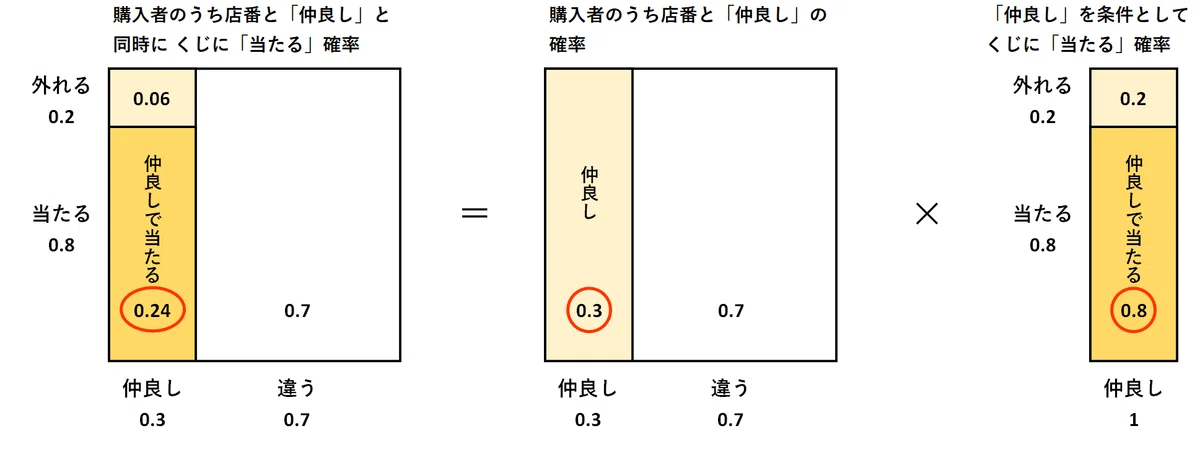
The calculation result is 0.24.
When one person is chosen at random from those who purchased the candy with a lottery ticket, the probability that they are friends with the shopkeeper and have won the lottery is 24%.
(End)

Summary of Formulas
Conditional Probability
$${P(B \mid A) = \cfrac{P(A \cap B) }{P(A)}}$$
Multiplication Theorem of Probability
$${P(A \cap B)=P(A)\ P(B \mid A)}$$
(Reference) Addition Theorem of Probability
$${P(A \cup B)=P(A)+P(B)-P(A \cap B)}$$
Put it into practice
Not this time.
Let's try creating it with a calculator or by hand!
Not this time.
Let's try creating it in EXCEL!
Not this time.
Download EXCEL sample file
There is no file provided this time.
Let's try creating it with Python!
There is no content for this section.
Download Python sample files
There are no files provided this time.
Conclusion
The theme of "Probability" has begun.
This theme features a variety of formulas and calculation methods.
Since these are fundamental formulas, it is recommended to memorize them for exam preparation.
For topics where the behavior of random variables and distributions is interesting, I plan to incorporate ways to experience the movements through Python or Excel so that you can get a better feel for probability and distributions.
Thank you very much for reading until the end.
Articles in the Relaxed Statistics Series
Next article
Previous article
Table of contents
いいなと思ったら応援しよう!
 応援ありがとうございます。これからもがんばって記事を作成します!