
[Reading] An Ecological View of Civilization - Expanded New Edition

Publication Information
Title: An Ecological View of Civilization - Expanded New Edition
Author: Tadao Umesao
Publisher : Chuokoron-Shinsha (2023/10/24)
Paperback : 400 pages
Motivation for reading this book
As usual, Makoto Mogimentioned in one of his books or videos that " Tadao Umesao's 'An Ecological View of Civilization ' is quite interesting," so I decided to give it a read.
My impression after reading it is that this is a book that should be read. I feel that it overwhelmingly deepens one's understanding of what is currently happening in the world. In this book, Eurasia plus the African Mediterranean coast are broadly divided into two regions, with Japan and Western Europe called the First Region, and the other regions called the Second Region (the book does not cover North and South America, or Africa south of the Mediterranean side). The Second Region includes India, Russia, Turkey/Arabia, and China. Hmm? Are the current countries included in the Second Region the core of what are called BRICS and the Global South?? The Second Region is rising, while the First Region is clearly beginning to show signs of decline. And as of January 2024, the places at war are almost entirely in the Second Region (though there are signs that the war situation is expanding toward the Taiwan Strait and the Korean Peninsula, both of which fall into the Second Region in Umesao's classification). Looking at it this way, the world model presented by "An Ecological View of History" strongly gives the impression that it is useful not only for interpreting history but also for interpreting current geopolitical dynamics. I think that just keeping this framework in mind might help clarify many things.
Also, this book is very easy to read. Although it is a thesis... there are no difficult terms, and the concept itself is simple. Also, the traces of the travels that led to this idea are included in the form of essays, as if guiding the reader through the author's thought process. There are easy-to-understand diagrams, making it easy to grasp. The essence of an ecological view of history could probably be described in just a few pages. I suppose that is what useful ideas and capable models are like.
A world history model
re-envisioned as parallel
rather than oppositional
"An Ecological View of History" was proposed in 1957, and it can be said to be an excellent model that continues to provide ideas even now, 66 years later. It is a model that does not fade even after hundreds of years, isn't it? It is not difficult at all, and there is no harm in keeping it in mind.
In this article, I will first explain "An Ecological View of History." Then, I would like to say a little about the influence of this book. As usual, it has become long, so I have posted a table of contents. Please jump to where you wish.
From here on, I will explain the ecological view of history.
An Ecological View of History
Let's get right to explaining the ecological view of history. First, please look at the figure below.
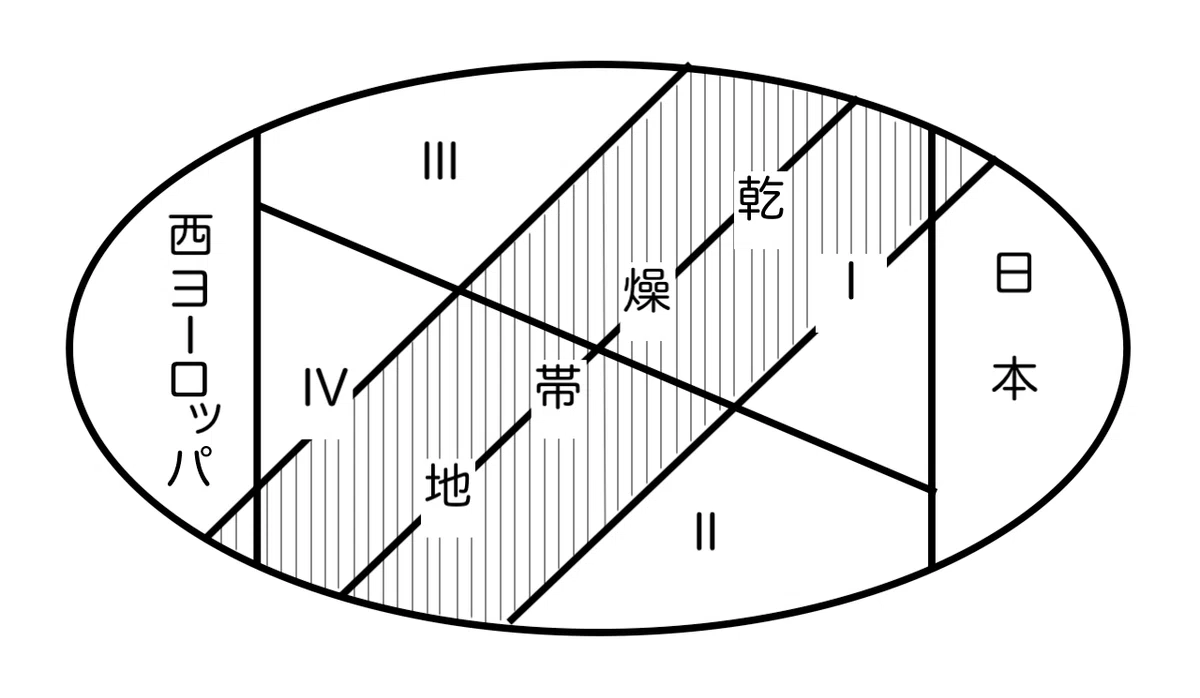
This is a schematic diagram centered on the Eurasian continent, with Japan and the Mediterranean coastal countries of Africa added. This is the so-called Old World (the world known before Columbus discovered the New World). An ecological view of the history of civilizations is a historical and geopolitical model targeting the Old World. The author divides the Old World into two major parts, designating Japan and Western Europe as the first region, and everything else as the second region. The second region's I, II, III, and IV are the Chinese world, the Indian world, the Russian world, and the Mediterranean/Islamic world, respectively (p. 202). And what is noteworthy is the arid zone in the center. From here, violence occurred time and again, and the civilizations of the second region were destroyed each time, forcing other civilizations to emerge. On the other hand, the first region was far removed from the source of violence, escaped destruction, and enjoyed the freedom to grow from within (p. 202). The Japanese civilization and Western civilization of the first region changed in similar ways, and the worlds of the second region—(I) the Chinese world, (II) the Indian world, (III) the Russian world, and (IV) the Mediterranean/Islamic world—also repeated similar changes. This is called civilizational succession (the transition of civilizations) parallel phenomena. This is the core of the ecological view of the history of civilizations.
There are laws to social change and development
Umesao was originally an ecologist based on biology. At the end of the war, he was in Mongolia for research. In the 1950s, stimulated by the theories of the then-famous historian Toynbee, he wrote this book as an answer, or simply put, as a challenge. Also, the Marxist view of history was dominant at the time. Both Toynbee's and Marx's views of history claim that 'culture and civilization evolve in one direction.' On the other hand, while Umesao shares the belief that there are laws to social change and development, he used ecology as a model and argued that change occurs due to changes in the environment and the society itself, and that different developments are possible depending on the region. He also used ecological terminology to call the changes in society, culture, and civilization succession.
Civilization and succession (using ecology as a model)
Let's define the terms briefly here. Umesao perceives that civilization is a lifestyle. And the phenomenon of civilizational succession is,
The phenomenon of succession occurs when the results of the interaction between the subject and the environment accumulate, making it impossible to contain within the previous lifestyle, leading to a transition to the next lifestyle. ... It is the self-movement of the subject-environment system. It is natural that the laws of movement differ where conditions are different.
Since the conditions are different in the first region and the second region, the self-movement of the subject-environment system is naturally different, he says.
Advancement of civilization: Parallel phenomena of succession
As of 1957, only Japan and a few Western countries had achieved highly civilized societies. Even today in 2024, the only developed countries, such as the G7, are Japan and the West (including two North American countries). What is a highly civilized society?
...Characteristics of... highly civilized countries... for example, immense industrial power... vast transportation and communication networks spread across the country. Well-equipped administrative organizations and educational systems. Widespread education, abundant goods, high standards of living. High average age. Low mortality rates. Developed scholarship and arts.
Whether it is a highly civilized society can be judged by economic power, infrastructure, and standards of living and education.
In the Old World, countries other than Japan and the West, "as for the rest, China, Southeast Asia, India, Russia, Islamic countries, and Eastern Europe still have a significant gap." p107.
And not by coincidence, Japan and the West in the First Region became highly civilized countries; this is because Japan and the West had similar conditions (the parallel phenomenon of civilizational transition).
The difference between the First Region and the Second Region is a difference in history
In terms of the patterns of the historical paths they have followed, the difference between the First Region and the Second Region is significant. It causes differences spanning a wide range of social systems, religion, and culture.
Now, let us look at the civilizations and histories of the First and Second Regions in a little more detail.
The emergence and transition of civilization in the First Region
According to Umesao, the civilization of the First Region developed as a peripheral area to the ancient civilizations that emerged in the Second Region, while being influenced by them. The First Region subsequently developed in parallel, through turmoil to the establishment of feudalism, and further through revolution (the Meiji Restoration in Japan) to high capitalism led by capitalists. Along the way, phenomena such as the Reformation, the Renaissance (the rise of Kokugaku in Japan), the formation of guilds, the development of a series of free cities, and overseas trade p116. Although Japan's capitalist development was somewhat delayed because wealth was not sufficiently accumulated due to national isolation (though Japan's rice market was the first in the world to have futures trading), Umesao states that these were not coincidental, and that there were similar transitions in social phenomena in Japan and the West. Without being affected by the violence of arid zones, culture and civilization grew comfortably, and history unfolds through forces from within the community. This is autogenic succession p126.
The emergence and transition of civilization in the Second Region
On the other hand, the Second Region is the birthplace of ancient civilizations and ancient empires. However, as mentioned above, from arid zones, nomads and others generated violence, destroying civilizations and repeatedly causing new ones to emerge. As a result, endogenous growth did not occur sufficiently, and it did not develop the feudalism that would later become the soil for nurturing capitalists. History in the Second Region is often driven by forces from outside the community. This is allogenic succession p126. Parallel phenomena can also be seen in this region. (I) The Chinese world, (II) the Indian world, (III) the Russian world, and (IV) the Mediterranean/Islamic world,
each have a structure of a huge empire surrounded by satellite states. Although the empires have all collapsed today, their unity as a community has not disappeared. Even now, the possibility of the reproduction of this four-block coexistence state is very strong" p202-p203.
Revision adding Southeast Asia and Eastern Europe: Similarity of peripheral countries
The author attempts to develop and revise the ecological view of the history of civilization. Then, parallel transition phenomena can be seen here as well.

First, let's determine the position of Southeast Asia. We will revise Figure A above to create Figure B.
The location of Southeast Asia is... in the humid zone of the eastern part of the Old World. And it borders three worlds: the Indian world, the Chinese world, and the Japanese world. The triangular region protruding from the Chinese world into Southeast Asia can be considered to represent the so-called Lingnan region.
Umesao says that Southeast Asia is definitely a secondary region, as the feudal system that would foster capitalists did not develop there.
So, what kind of region is this Southeast Asian world?
Southeast Asia
The countries in this region are all disparate in terms of ethnicity, culture, language, religion, and lifestyle, and it is difficult to say that they form a single Southeast Asian civilization. The reason for this lies in the historical background where the people living in this area have constantly changed.
In ancient times... it was a land of savagery and barbarism. Later, great civilizations were imported from neighboring regions, creating imitation empires. After that... invasions from other civilizations, or the influence of their chain reactions, led to repeated destruction and rise and fall. Overall, various old and new elements remain in a mosaic pattern.
And in modern times, while many countries became European colonies, they were never united and ruled by any single nation. They were occupied by Japan at the end of the war (though opinions may differ on whether it was liberation or occupation).
Eastern Europe: As a contrast to Southeast Asia
Umesao states that he is not well-versed in Eastern Europe, but he finds similarities compared to Southeast Asia. Parallel phenomena of civilizational transition can also be found here.
Eastern Europe is surrounded by three worlds: the Russian world, the Mediterranean/Islamic world, and the Western European world. There are many countries. Ethnicities and languages are also diverse. There are Slavic, Latin, and Greek groups. The Hungarian language does not belong to the Indo-European language family. Religions also include Catholicism, Greek Orthodoxy, Islam, Judaism, and other minorities. It repeatedly suffered invasions from the Russian world, the Mediterranean/Islamic world, and the Western European world, and in the early modern period, it was mostly a dependency of other countries p217-219. This mosaic nature is indeed very similar to Southeast Asia. And the clincher is the influence of the two world wars. The three great empires of Russia, Austria-Hungary, and Turkey collapsed in World War I. This liberated vast regions from empires. World War I created the countries of Eastern Europe p219. On the other hand, the countries of Southeast Asia were also liberated from their colonial status by World War II.
These two phenomena... when taking into account that the civilizational historical positions of Southeast Asia and Eastern Europe are similar, can indeed be seen as a series of phenomena. ... Eastern Europe and Southeast Asia in the Old World, in terms of the liberation of two intermediate regions, it can be said that the two world wars had similar significance.
I think that with just this insight alone, think tanks around the world should seriously start conducting research based on the 'Ecological View of Civilization History'... and while it cannot be denied that I am a very short-sighted person, I feel it would be a great shame to dismiss it entirely. What do you all think?
The influence of this book
I will list, in my own way, things that I think may have been influenced by this book.
Samuel Huntington's 'The Clash of Civilizations' adopts a similar classification of civilizations
A historical view and theory of civilization that dispels the Marxist view of history
Did it serve as the foundation for the 'Free and Open Indo-Pacific Strategy' proposed by former Prime Minister Abe?
Now, let's look at each one.
Samuel Huntington's 'The Clash of Civilizations' adopts a similar classification of civilizations as this book
The classification of civilizations in this book An Ecological View of History of Civilizations (1957) appears to have been inherited almost entirely as is by Samuel Huntington in his 'The Clash of Civilizations' (1996) as if it were passed down. In addition to the Japanese civilization, Western civilization, Indian civilization, Russian civilization, Turkish-Arab civilization, Chinese civilization which are equivalent to those in Umesao's 'An Ecological View of History of Civilizations', Huntington also lists Latin American civilization, African civilization. 'The Clash of Civilizations' is a book that depicts the conflict structure of the post-Cold War world, and it also mentions potential conflicts and battles; it has received a certain level of recognition as a theory of civilization, for instance, for having predicted the 9/11 terrorist attacks. It is fair to say that it plays a role in discussing the theory of civilization. Whether Huntington was aware of Umesao's paper and whether Umesao's 'An Ecological View of History of Civilizations' is actually cited in 'The Clash of Civilizations' is unknown (the Japanese version only lists some of the cited literature), but considering the approximately 40-year gap between the publication of the two works (this book was partially translated into English and published in 1986 and 1995), and the fact that Huntington himself stated that 'Japanese civilization' constitutes a single civilization within one country and had delved deep enough into Japanese studies to explain the uniqueness of 'Japanese civilization,' it is hard to believe he was completely unaware of it. Alternatively, if the two of them, Umesao and Huntington, arrived at similar conclusions from completely different research paths, wouldn't that in itself be an event that supports the usefulness of that classification method?
A theory of civilization and history that dispels the Marxist view of history
If I were to mention another aspect of this book's usefulness, it would be that it provides an alternative to the Marxist view of history(including the Frankfurt School). This has been mentioned repeatedly by Yasushi Tani, Professor Emeritus at Kyoto University, in the afterword and other parts of this book. You might think, 'The Marxist view of history'? Why are you talking about such an old thing?' Be not surprised; it is no exaggeration to say that every single elementary, middle, and high school textbook in Japan is based on the Marxist view of history. I am convinced that deeply perceiving that there is a historical view other than the Marxist one enriches one's life. (I plan to write a separate article on this).
Did it serve as the foundation for the 'Free and Open Indo-Pacific Strategy' proposed by the late Prime Minister Abe?
'The Sea and Japanese Civilization' (1999), included in this book, is a revised and reconstructed version of a lecture given in a dialogue format. The main point is, 'How about Japan building friendships with the countries along the sea routes of Southeast Asia, India, and Australia? That is also a traditional route that has existed since the 16th century. It is a route our ancestors opened up and then abandoned due to national isolation.' This is a concept that could even be called the foundation for the 'Free and Open Indo-Pacific Strategy' proposed by the late Prime Minister Abe, who fell to a gunman's bullet.
As an answer paper to Toynbee's history books
The author, who was originally a scientist and ecologist, while actually conducting cross-sectional research across the Eurasian continent, submitted Toynbee's view of history (from A Study of History and Civilization on Trial) as if it were an answer paper to An Ecological View of History of CivilizationsAn Ecological View of History of Civilizations. According to the author, the parts of Toynbee's historical view that he could not accept (pp. 95-96) were his treatment of Japanese civilization (viewing it as a derivative of Chinese civilization) and his assertion that only Western civilization remains healthy. It is certainly understandable to be annoyed by such extreme Eurocentrism. However, as expected of the scholar Umesao, while he acknowledged that his own "An Ecological View of History of Civilizations" was a premature work not yet fully developed as a theory, he did not let it go to waste.
...I do not intend to criticize Mr. Toynbee's theory... I took Mr. Toynbee's... theory as a challenge from the Western side in the theory of civilization. ...I felt compelled to at least raise my hand to respond.
Rather than a criticism of Toynbee's theory and historical view, it was "my attempt to draw the first sketch of this world here" (p. 97). In other words, this book is the author's attempt to depict a theory of civilization, which could originally be infinite in number.
Umesao made various prophetic statements. "High economic growth, the collapse of the Soviet Union, an information society, the decrease in full-time housewives... numerous prophecies." It is said that he got them right. "Prophet Tadao Umesao" contains detailed discussions on this. Umesao, a giant of intellect representing the Showa era. It seems he also made predictions about Japan. I would like to read it.
Extra: The person known as Tadao Umesao
I knew nothing about him, so I am truly glad that I had the opportunity to learn even a little bit about Umezao this time. Of course, I knew he was the author of this book and the author of "The Technique of Intellectual Production." I was able to read this book, but unfortunately, I have not yet read "The Technique of Intellectual Production."
His biography is well summarized on Wikipedia. Alternatively, there is also a chronology on the National Museum of Ethnology website. Here, I will pick out the things that stayed in my mind.
Umezao was 25 at the end of the war. He was conducting research on livestock in Mongolia. It is said that "Recollections of Mongolia" goes into detail. He escaped from Inner Mongolia barely with his life!? Perhaps he didn't have a good impression of the military from around this time.
Originally a science student, while he was capable of mathematical research, he also seemed suited for fieldwork. In 1955, he belonged to the anthropology team of the Hindu Kush branch of the Kyoto University Karakoram-Hindu Kush Scientific Expedition, where he conducted research on the Moghol people. Umezao conducted fieldwork many times throughout his life, and his experiences, including those from this time, became the foundation for "An Ecological View of History."
Umezao wascultural anthropology's leading expert in Japan, and the site of the Osaka Expo houses the National Museum of Ethnology, of which Umezao was the first director.
He also played a role in the 1970 Osaka Expo. Since he was a Kyoto University professor and a national public servant at the time, he could not step into the spotlight, so the popular writer Sakyo Komatsu took the lead instead. It was after that when Taro Okamoto, of "Art is an explosion!" fame, became the theme exhibition producer. Umezao held salons for intellectuals, and Komatsu was a regular. It is said that they were full of intellectual stimulation without being stiff.
He was an Esperanto advocate and a long-time proponent of promoting the Romanization of Japanese. Later, when he lost his sight at 64, he struggled with Japanese homonyms and supposedly said, "Just get rid of kanji!" or something to that effect. The number of works he produced after losing his sight is greater than the number of works he produced before. His wife must have had a hard time.
Come to think of it, I feel like there were letters of invitation addressed to my father from Esperanto or Romanization societies!? at our house too. Was that before elementary school? Both my father and mother didn't agree with those kinds of movements at all, saying, "Japanese is easy to read because it has hiragana, kanji, and katakana." Even if someone is a genius, there are achievements that remain and others that don't. It seems the Romanization society in Kyoto disbanded in 2023. Prosperity and decay? Impermanence? I also like Japanese with a mix of kana and kanji, and Umezao's writing is hard to read because he doesn't use kanji in the usual places. But... it's a shame that something someone cherished is disappearing, and it hurts my heart. It can't be helped, though...
Bonus: For those who want to broaden their horizons or deepen their knowledge further
I'll post some things that caught my attention after a quick search.
There are some books I haven't read yet either, but for your reference if they might be of help.
Works by the author [Tadao Umezao] and related materials: Various
I could only find the complete works on Kindle. I suppose they aren't collected in paper books.
Not a book by Umezao, but a book depicting how accurate Umezao's near-future predictions were. It seems to be about Umezao's worldview and his theory of humanity. It's a bit intriguing. Umezao's final prophecy is "Japanese civilization is nearing its end"!?
Books by Makoto Mogi: Those that seem to be particularly influenced by "An Ecological View of History" (I'm just assuming that)
To me, this feels like a kind of answer to "Methodological Notes on Comparative Religion" within "An Ecological View of History."
Samuel Huntington's theory of civilization
Toynbee's history books
"A Study of History" is a very long work. An abridged version has been published.
Books by the science fiction writer Sakyo Komatsu
I received congratulations from note.

One was a post I made earlier in relation to this article. The other is some random thoughts regarding my first shrine visit of the year. Please feel free to read them if you like.
いいなと思ったら応援しよう!
 ありがとうございます❣️よりよい記事を書くために使わせていただきます💫
Thank you for your support! I’ll put this toward creating higher-quality articles.
ありがとうございます❣️よりよい記事を書くために使わせていただきます💫
Thank you for your support! I’ll put this toward creating higher-quality articles.