
The Shape of Your Love and Your Emotional Scars [Attachment Styles & Attachment Disorders]

"Why do I keep distancing myself from people?🥺"
"I want to rely on others, but I just can't...😢"
"I know I worry too much, but I can't break free from my own rules...😩"
Have you ever felt uneasy like this about how you relate to others?
Actually, this might be related to your "attachment style," which was formed from your childhood experiences. "Attachment style" might be involved.
"Wait! What is an attachment style? Is that the same as an attachment disorder?" I'm sure some of you are thinking that. But it's different💡
To you who are worried, "Maybe I have an attachment disorder?"
First, what is an "attachment style" that exists before that?
And how is it different from an attachment disorder?
Let's unravel those differences together✨
"Attachment style?!"
An attachment style is like a "habit of keeping distance" in your heart that everyone has. "habit of keeping distance" like that.
However, when it becomes too skewed, it can lead to difficulties in living—
✅ Getting tired from worrying too much about how others feel
✅ Wanting to get closer, but for some reason keeping your distance
✅ No matter how hard you try, the feeling of being unfulfilled never goes away
💕 Attachment styles have "types" that determine how people build relationships with others.
There is also a theory that divides attachment styles into the following 4 types!
Secure Type (Ideal way of connecting)
Avoidant Type (Tends to be self-reliant without depending on others)
Anxious Type (Sensitive to relationships breaking and tends to accommodate others too much)
Disorganized/Avoidant Type (Wants to get close but is afraid. A mix of both habits)

The most representative ones are the "Avoidant Type" and "Anxious Type"🌿
🔍 What kind of people tend to fit into which type?
✅ Secure Type
People who had a "reasonably" stable relationship with their parents (caregivers) when they were children
Having experienced having your emotions accepted, it is easier to develop a sense of self-esteem
Even as an adult, you can build relationships where you can appropriately rely on others and be relied upon
✅ Avoidant Type
People who often experienced being ignored or treated coldly when expressing emotions as a child
Had to suppress their own needs and force themselves to be 'independent'
Tends to keep distance in romantic and interpersonal relationships. 'I'm fine on my own' is a common phrase
✅ Anxious Type
Cases where caregivers were 'capricious' or 'over-involved'
Grew up thinking 'I have to be a good child' or 'I have to watch the other person's mood' to be loved
Tends to become dependent in relationships and is haunted by a 'fear of abandonment'
✅ Disorganized/Fearful-Avoidant Type
Common in people with complex backgrounds such as trauma or abuse, where they 'want to connect but are afraid'
Harbors the contradiction of wanting to trust people while simultaneously being afraid of them
In some cases, panic or anger may arise as you get closer to someone
🥰 'Attachment Style' Points

Actually, 'attachment style' isn't very well known yet, but knowing it might help you quickly understand your emotional habits and your sense of distance from others.
'What is an Attachment Disorder?'
I think some of you may have heard the term 'attachment disorder'.
The original 'attachment disorder' is positioned as a clinical diagnostic term used in psychiatry and similar fields..
🩺 Attachment disorder is an official diagnostic name
Reactive Attachment Disorder (RAD)
Disinhibited Social Engagement Disorder (DSED)
It seems there are diagnostic names such as these.
These are caused by severe caregiving failures in early childhood (e.g., abuse, neglect, being raised in an institution, etc.), and result in symptoms at a level that interferes with daily life, such as
being unable to have basic trust in people or having an excessive lack of boundaries.
The reality behind the use of these terms is that some people are carrying pain that affects their daily lives.
There is a difference between "attachment styles" and "attachment disorders." ⇩⇩⇩
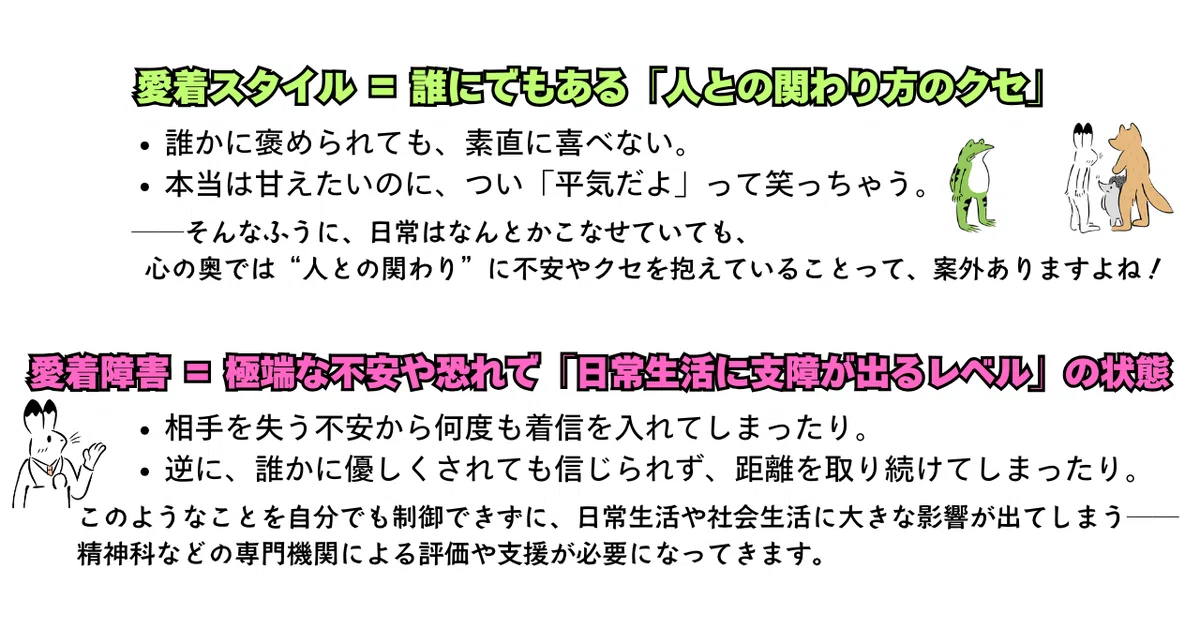
Perhaps, with a shallow understanding of "attachment styles," one might jump to the conclusion that they or someone else "might have an attachment disorder."
However, it is not you or others who determine "whether or not it is an attachment disorder," but rather a specialized doctor.
If you are feeling anxious, please try consulting a hospital instead of carrying it all by yourself.
💔 "Specific symptoms" often seen in people carrying attachment wounds
Attachment disorders are often misunderstood by those around them as being "selfish" or "self-centered," even though the person themselves is in a lot of pain.
That is precisely why it is so important to understand their condition.
1. Excessive effort and perfectionism
Always feeling tense, thinking "I have to do things properly" or "I must not be a burden"
Blaming oneself severely for small mistakes
Feeling that even when results are achieved, it is "still not enough"
2. Inability to show vulnerability to others
Feeling that "if I show my weak side, I will be disliked" or "I will be abandoned"
Smiling and saying "I'm fine" or "I'm doing well" even when feeling exhausted
Being unable to ask for advice and tending to carry things alone
③ Feeling anxious when not validated
Cannot help but worry about 'likes' and reactions on social media
Feeling anxious that you are 'hated' if you are not praised
Reacting overly sensitively to changes in the other person's mood
A strong desire to talk about your painful past or upbringing, hoping to be 'understood' and 'accepted'
④ Suddenly becoming unstable in romantic relationships
Feeling restless just because the other person is a little slow to reply to a LINE message
Getting scared when becoming close and suddenly distancing yourself (avoidant tendency)
Becoming obsessed with the other person even though you know it is not good for you (anxious tendency)
⑤ Not knowing your 'true self'
Living too much to meet the expectations of others, to the point where you don't know what you like or what you want to do
Being afraid to say 'This is what I want to do'
Having a habit of suppressing your emotions, which can sometimes lead to emotional numbness
⑥ Feeling unsettled even when you find 'happiness'
Even when you achieve a dream or find a partner, your heart does not feel stable
Feeling afraid that 'it might fall apart again'
No matter how fulfilled you are, why does a sense of 'emptiness' remain?
💔 What happens as a result?
You are unable to show your true self to anyone, carrying loneliness and anxiety.
While unable to 'be yourself,' you keep trying hard to meet the expectations and rules of those around you—
Even so,
'Why am I not fulfilled even though I'm trying so hard?'
you start to feel this more and more.
However, this pain is something that is often difficult for those around you to understand.
For example, even someone who looks popular and sparkling can be carrying great suffering on the inside.

Because that pain is hard to convey to others, a large gap is created between the image seen from the outside and the person's actual feelings💦
That gap often causes the person deep distress.
How to face Attachment Styles and Attachment Disorders💡
1. Don't blame yourself too much
Attachment wounds are not your fault. They are due to past environments and experiences.
Therefore, blaming yourself by saying 'I'm no good' or 'I have to change' is counterproductive.
2. Notice and acknowledge small emotions
Don't overlook and instead accept emotions you tend to suppress, such as 'anxiety,' 'loneliness,' or 'anger.'
Emotions are not bad; they are important signs.
3. Respect your own pace
Don't try to change drastically all at once; be kind to yourself slowly.
Start with what you can do, little by little.
4. Create or find a 'safe place'
Consciously increase environments where you can be yourself with peace of mind, such as with trusted people, places, or counseling.
5. Practice relying on yourself
Instead of convincing yourself that you 'have to do everything alone,' try relying on others for small things.
Relying on others is not a weakness; it actually fosters self-esteem.
6. Repeat words of self-affirmation
"I am fine just as I am."
"It's okay not to push myself."
"I deserve to be loved, too."
It is important to say these things to yourself every day.
Article Summary💖
"Attachment Styles" and "Attachment Disorders"
💛Attachment Style = Habits in how you maintain distance from others
Changes based on the environment you grew up in. Divided into 4 types (Secure, Avoidant, Anxious, Disorganized/Fearful-Avoidant).
🧡Attachment Disorder = A "clinical diagnosis" made by a psychiatrist
A state where daily life is hindered due to serious problems in the upbringing environment.
🌟 Even popular or seemingly glamorous people may have deep-seated loneliness or anxiety inside
There is a large gap between their appearance and their true feelings.
😩Examples of specific symptoms of attachment disorder
Excessive effort
Inability to show weakness
Strong anxiety
Instability in romantic relationships
Not knowing who you are
Feeling unsettled even when happy.
As a result
You cannot show your true self and become lonely. You may be admired by those around you, but your heart remains unfulfilled💦

👆This is also about valuing your own heart,
and it leads to the compassion to understand and support the people around you.
What I want you to learn from this article
By learning about "attachment styles" and "attachment disorders," you can gradually create a place where you feel secure.
You can even slowly move toward building relationships where you can truly trust someone from the heart.
It is possible to slowly get closer to relationships where you can truly trust one another.
Of course, attachment wounds don't heal easily, do they?
It takes time, and there are times when you might feel confused about yourself.
But let's not rush to find answers; let's nurture things slowly.
Whether you are anxious or avoidant, it is about showing your "true self" to others little by little.
I believe it is important to open your heart in that way, bit by bit.
It's okay if you can't express yourself well, and you don't have to be perfect.
Even so, if there is someone who stays by your side, that relationship has already become a "safe place."
You don't have to force others to change, and there is no need to pretend to be someone you're not, right?✨
Understand the shape of your love,
and let's face yourself and the people who are by your side.
いいなと思ったら応援しよう!
 記事を楽しんでいただけたらとても嬉しいです!これからも心に寄り添える内容をお届けできるよう、頑張りますね。