
Summer Vacation Independent Research

Summer Vacation Independent Research
This summer, as a new endeavor, I conducted an independent research program based on Ikebana.
The moment I heard people say, 'It's hard to think of what to do for independent research every year,' I thought, Ikebana might be perfect for it!!
Two Courses
Two courses focusing on the 'life of plants'
A: Life Observation Course
B: Ikebana Research Course
A: Life Observation Course
A class where students create bouquets using fresh floral materials. Each session is about 90 minutes.
●POINT
Observing how plants, starting from a fresh state, lose water and dry out over the summer vacation. Observing the process where plants that lived with all their might are cut, lose their water, and gain a new kind of beauty.

Finding what you 'like' is also important
Rather than just making a cute fresh green bouquet, I consciously taught them that plants are also alive, have life, and that we are receiving that life from nature. When taught this way, they start to handle them with care, become interested, and observe them more closely.
Thinking hard for themselves about which ones go well together, they smile and say, 'I made it cute!!' about their own work. Realizing the confidence of having achieved something is very important.
B: Ikebana Research Course
Over the course of five sessions, I taught what Ikebana is.
1: Floating Flowers
Knowing what plants need to live, and while touching upon the fact that they have life, we float plants in water, consider color placement, and move the water to appreciate them. 2: Relief of Withered Materials
Knowing that living plants eventually wither, we use the beauty of dried flowers to create a relief on a canvas.
3: Basic Ikebana Style - Moribana
Learning the basics of handling flowers. Furthermore, we learn by linking the basic styles to things around us.
4: Basic Ikebana Style - Nageire
Same as 3, plus learning techniques for arranging in Ikebana-specific vases.
5: Flowers Become People When Arranged
Trying to arrange 'the me of today' freely as I like.
●POINT
The art of Ikebana uses living things as material. Going out of one's way to bring them from nature into the house to decorate is not just because they are pretty, but because we are taking life from things that are already beautiful in nature, so we should use human hands to make them even more beautiful! It's about trying to create shapes that don't exist in nature using human hands, rather than leaving them as they are in nature.

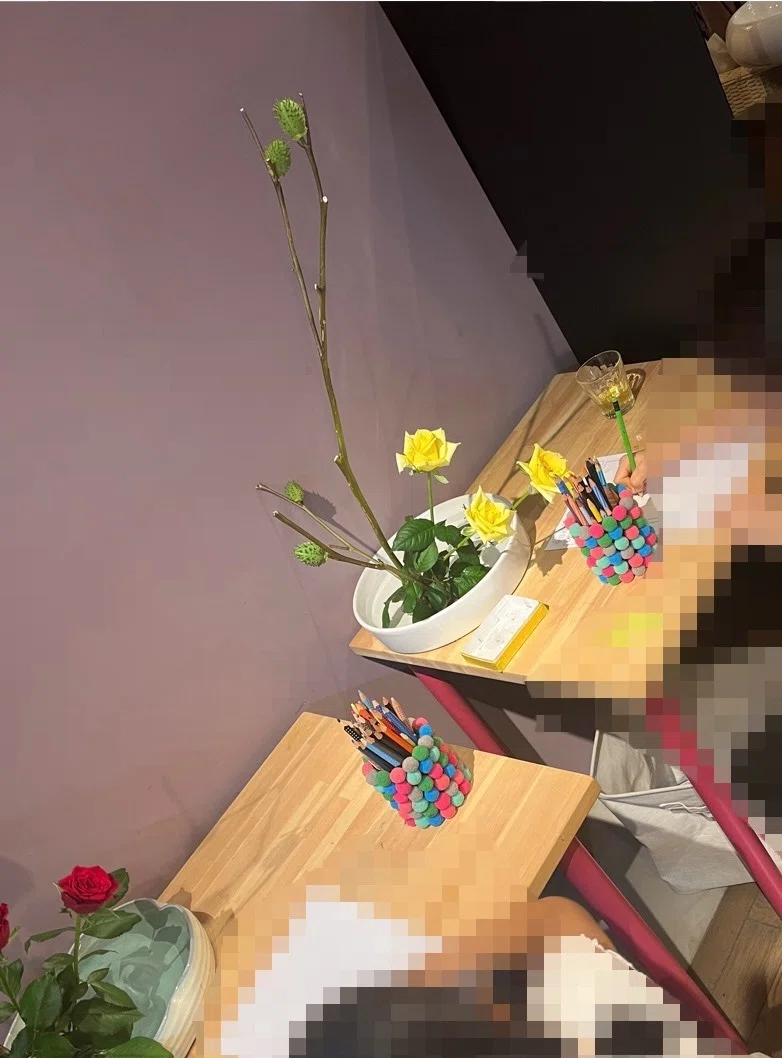
It is perfect for reflection, and drawing pictures makes you realize what you were paying attention to
Discoveries like 'Something so interesting came out from inside!' when taking petals apart, realizations like 'This stem is thick but soft,' and an awareness of water as a material unique to summer, such as 'The water feels good!'...
I felt that they were able to learn many things through play.
As the teacher, I was also surprised and learned from the flexibility of the children's unique perspectives, such as 'You're looking at that!!'
When wrapping the floral materials to take home, they would carefully wrap even the small chopped stems and leaves, saying, 'Because they're cute' or 'I'll play with them at home♪'.
I realized once again that there is so much to learn from plants and Ikebana.
It was a great program.
I want to hold it again next year.