The Committee on Foreign Investment in the United States, IN FOCUS, CRS, May 17, 2024.

The Committee on Foreign Investment in the United States
(CFIUS) is an interagency committee chaired by the
Secretary of the Treasury. It serves the President in
overseeing the national security risks of certain foreign
direct investment (FDI) in the U.S. economy. CFIUS
jurisdiction includes the review of mergers, acquisitions,
and takeovers that could result in foreign control of a U.S.
business; certain noncontrolling investments in businesses
involved in critical technologies, critical infrastructure, or
sensitive personal data (so-called “TID U.S. businesses”);
and certain real estate transactions. At the recommendation
of CFIUS, the President may suspend or prohibit
transactions that threaten to impair U.S. national security.
The United States is the world’s largest foreign investor and
recipient of foreign investment. U.S. policy supports a
rules-based and open investment environment domestically
and globally to promote U.S. economic growth and ensure
that the United States remains a premier FDI destination.
The Biden Administration has stated that it will retain an
open U.S. investment posture, while ensuring the CFIUS
review process “remains responsive to an evolving national
security landscape and the nature of the investments that
pose related risks.” Congressional and stakeholder debate
over CFIUS activities has intensified amid growing concern
that certain foreign investments by firms directed,
controlled, or funded by a foreign government, notably the
People’s Republic of China (PRC), raise additional national
security risks. These debates involve oversight of CFIUS
reforms mandated by Congress in 2018. The 118th Congress
is considering various legislation to address perceived
jurisdiction gaps and evolving priorities.
Source of Authority. CFIUS derives its authorities from
Section 721 of the Defense Production Act (DPA), as
amended (50 U.S.C. §4565), and implementing regulations
(31 C.F.R. Chapter VIII). CFIUS initially was created and
operated through a series of Executive Orders. In 1988,
Congress passed the “Exon-Florio” amendment to the DPA
(50 U.S.C. App. §2170), which codified the review process,
at the time largely driven by concerns over Japanese firms’
acquisitions of U.S. defense-related firms. In 2007, amid
concerns over the proposed foreign purchase of commercial
operations of U.S. ports, Congress passed the Foreign
Investment and National Security Act of 2007 (P.L. 110-
49), which formally gave CFIUS statutory authority. In
2018, Congress passed the Foreign Investment Risk Review
Modernization Act (FIRRMA, Title XVII, P.L. 115-232),
which expanded CFIUS’s jurisdiction and review process in
key ways. FIRRMA was intended to “strengthen and
modernize” CFIUS and enhance its ability to address
concerns involving nonpassive, noncontrolling investments
in TID business and real estate transactions in proximity to
military installations, or part of maritime ports or airports.
Membership of CFIUS. The committee consists of nine
members: the Secretary of the Treasury (chair), Secretaries
of State, Defense, Homeland Security, Commerce, and
Energy; Attorney General; U.S. Trade Representative; and
Director of the Office of Science and Technology Policy.
The Secretary of Labor and Director of National
Intelligence (DNI) serve as ex-officio members. Five White
House offices are observers or participate in CFIUS, as
appropriate (e.g., the Council of Economic Advisers and
National Security Council). The President can appoint other
officials to serve on a case-by-case basis.
CFIUS Review Process
The review process begins with notification by the parties
to the transaction, which is a voluntary step except in
certain cases. Even when notification is not mandatory,
firms have an incentive to do so to receive potential “safe
harbor” from CFIUS, which limits future action after a
transaction is cleared. Non-notified transactions remain
subject indefinitely to future CFIUS review and possible
divestment or other actions mandated by the President. As
directed by FIRRMA, CFIUS has increased attention and
resources to monitoring non-notified transactions of
concern. CFIUS may also unilaterally initiate a review.
The President can exercise authority to suspend or prohibit
a foreign investment, subject to a CFIUS review, if he/she
finds that (1) credible evidence exists that the foreign
person might take action that threatens to impair national
security; and (2) no other laws provide “adequate and
appropriate authority” to protect the national security risks.
Notification. A party’s notification of a transaction can
follow two-tracks: a declaration, an abbreviated, short-form
filing (30-day assessment); or a traditional written notice
(45-day review). Declarations and notices are generally
distinguished by submission length, timeline for CFIUS’s
consideration, and CFIUS’s options for disposition of the
submission. A declaration is mandatory in cases where (1) a
foreign government is acquiring a “substantial interest” in
TID U.S. businesses, and (2) a transaction involves a TID
U.S. business that produces, designs, manufactures, etc. a
critical technology subject to export licensing/controls.
National Security Review. Treasury and a co-lead agency
conduct a 45-day review to determine the effects of the
transaction on U.S. national security, informed by a DNI
threat analysis. CFIUS’s “risk-based assessment” considers
the threat, vulnerabilities, and consequences to national
security related to the transaction. In its assessment, CFIUS
is to consider an illustrative list of national security factors.
Factors include the domestic production needed for
projected national defense requirements; the control of
domestic industries and commercial activity by foreign
citizens; effects on potential sales of military goods,
equipment, or technology to a country that supports
terrorism or proliferates missile technology or chemical and
biological weapons; U.S. technological leadership in areas
affecting national security; and effects on U.S. critical
infrastructure, including major energy assets, and critical
technologies. In September 2022, amid an evolving national
security landscape, President Biden issued E.O. 14083 to
elaborate and expand on the factors in statute. These
include the transaction’s effect on resilience of U.S. critical
supply chains and technological leadership; aggregate
industry investment trends; cybersecurity risks; and risks to
U.S. person’s sensitive data. See CRS In Focus IF12415.
National Security Investigation. The transaction proceeds
to a 45-day investigation if CFIUS finds the transaction
threatens to impair U.S. national security and the risk has
not been mitigated; is foreign-government controlled; or
would result in foreign control of any U.S. critical
infrastructure. A 15-day extension is permitted in the event
of “extraordinary circumstances.” CFIUS can negotiate and
impose mitigation agreements or conditions on the parties
to address concerns identified; a lead agency is tasked with
monitoring compliance. In October 2022, Treasury issued
its first Enforcement and Penalty Guidelines, emphasizing
compliance with mitigation measures as a priority. In April
2024, Treasury issued a proposed rule to update mitigation
and enforcement provisions of CFIUS regulations.
Presidential Decision. If CFIUS determines the transaction
poses unresolved concerns, it may recommend to the
President that the deal be prohibited, unless the parties
choose to abandon the transaction. The President has 15
days to take action. Presidents have prohibited eight
transactions, the majority in the past decade (Table 1). In
2020, President Trump ordered PRC ByteDance Ltd. to
divest from Musical.ly, a social media firm; this 2017
acquisition formed the basis of U.S. operations of TikTok.
After a legal challenge by TikTok, the Justice Department
sought a national security agreement with the firm, despite
CFIUS’s determination in referring the case to the President
that mitigation was not feasible (see CRS In Focus
IF12640). In May 2024, President Biden ordered a PRC
cryptocurrency mining firm to divest its real estate
acquisition and operations located one mile from Francis E.
Warren Air Force Base, a strategic missile base.

Recent Activity
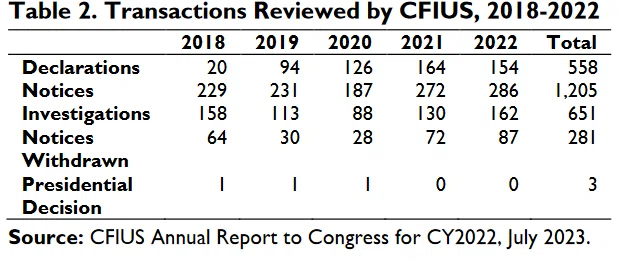
CFIUS must report annually to Congress on its activities
(Table 2). In most years since FIRRMA, there has been an
increase in transactions reviewed. In 2022, CFIUS reviewed
440 filings (154 declarations, 286 notices). CFIUS cleared
90 declarations, and requested parties submit a subsequent
written notice in 32% of cases. Five declarations involved
real estate transactions. Nearly 60% of total notices
proceeded to an investigation. In 87 cases, parties withdrew
the notice during investigation to address issues, and the
majority refiled with CFIUS. CFIUS adopted mitigation
measures for 41 notices (14% of total notices). In 12 cases,
parties abandoned the deal after CFIUS said it was unable
to identify mitigation that would resolve its concerns, or
after proposed measures were not accepted by the parties.
Issues for Congress
Congress remains engaged in oversight of implementation
of FIRRMA and CFIUS activities. Some Members say that,
despite FIRRMA, PRC and other state-directed investments
require a more proactive and strategic approach. Some are
concerned that PRC investments, particularly in emerging
tech and new operations, may evade or fall outside current
authorities. Some Members have introduced related
legislation in the 118th Congress. A Senate version of the
National Defense Authorization Act for FY2024 (S. 2226)
would have expanded CFIUS jurisdiction over agricultural
land and investments in U.S. companies in agriculture or
biotechnology; banned PRC and some others’ investments
in these areas; and added the Secretary of Agriculture as a
CFIUS member. These efforts stem in part from reports of
an uptick in PRC land purchases and Treasury’s 2022
decision that it did not find jurisdiction to review a PRC
firm’s land purchase in North Dakota near a U.S. Air Force
base. Some in Congress have expressed concerns about
Japanese firm Nippon Steel’s proposed acquisition of U.S
Steel Corporation, announced in December 2023, which is
reportedly under CFIUS review. Other issues include
• How well is CFIUS balancing an open U.S. investment
posture with the aim to protect national security? How
should CFIUS protect critical technologies in ways that
promote competitiveness and a market-driven economy?
• Six years post FIRRMA, how sufficient are CFIUS’s
current authorities to achieve policy objectives? How
has E.O. 14083 affected CFIUS reviews in practice?
• There appear to be incentives for parties to a transaction
to use declarations, which are shorter and have fast
turnaround relative to notices. To what extent is CFIUS
clearing transactions based on declarations and in what
instances should full filing notices be required?
• How is the Commerce Department’s process of
identifying “emerging and foundational technologies”
for export controls facilitating or hindering CFIUS
reviews of transactions related to such technologies?
• In what ways has CFIUS improved coordination with
allies and partners in information sharing and in
investment screening efforts as mandated by FIRRMA?
Cathleen D. Cimino-Isaacs, Specialist in International
Trade and Finance
Karen M. Sutter, Specialist in Asian Trade and Finance
https://sgp.fas.org/crs/natsec/IF10177.pdf