
[Recommendation for 'Savoring']: Longing for what crosses the line and savoring books


The things we secretly cherish.
Even though they certainly exist.
We cannot point to them.
They are not just things that can be seen.
We decipher them one by one.
We express them with care.
And then, we savor the collection of words created in this way.
・
・
・
■ Text
'[Expanded Edition] Knowledge Editing Engineering' (Asahi Bunko) by Seigow Matsuoka
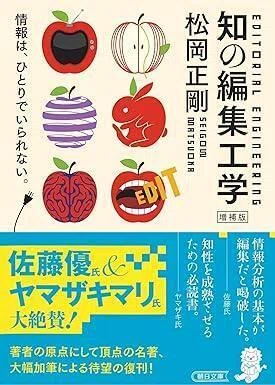
Revealing the historical background and thoughts at the time of the book's publication, as well as the production process for this expanded edition, the message that 'Knowledge Editing Engineering' sought to pose is explained again from the following five perspectives.
1. Connecting the 'world' and the 'self'
2. Making full use of various editing techniques
3. Continuing to hold an editorial worldview
4. Relatively re-weaving the values of the world
5. Utilizing narrative editing power
It might be worth reconsidering, especially now in the AI era, that at the root of these perspectives lie the basic stances of 'learning from life,' 'opening up history,' and 'playing with culture.'
■ Things that cross the line
・Step 1: There is an attraction to the unknown
The unknown has the power to move people.
The new has the energy to attract people.
Yes.
The anticipation when traveling to an unfamiliar city.
The curiosity toward rare cuisine.
And the courage to encounter something for the first time.
All of these, every single one of them.
It was because we were drawn to this gravitational pull, wasn't it?
Straight to what you love.
・Step 2: You cannot encounter a new world unless you step outside your own circle
When you start something new, you encounter a new world.
When you encounter a new world, there is always an unknown world waiting for you there.
Come to think of it, how many times have people been led down such paths and stepped into unknown worlds?
I still intend to live under the title of 'human'.
・Step 3: An era where common sense becomes old common sense before you know it
An era where something completely unknown becomes the new common sense in an instant.
Even when trying to be yourself, there are times when you get lost or come to a standstill.
But that is exactly why life is interesting.
While mingling with the values of various worlds, the
'likes' inside you
gaze at it, and live on.
・Step 4: From the beginning to the beginning
Something special that exists in between.
That something brings people who are apart closer together.
Seeing a world different from one's own.
Sharing joys and fears.
Knowing the power that moves everything.
You will surely gain something.
Within this line, which is like a journey.
From the place where you were, to the place where you want to go.
From the tension of the unknown, to the surprise of discovery.
From the trivial things that divide me, to the great things that encompass all of me.
In this line, there is a story that everyone lives.
As you head from the beginning to the beginning, you will surely understand.
No matter how far apart or how different we are, if we replay the story, I am not alone.
Yes, there is a world where I am not alone.
・Step 5: What is your 'unknown'?
Taking the black hole as an example, whether or not you can regard it as,
'an existence whose essence is that there is unknown information'
is likely an important perspective.
Just because that unknown information cannot be traced.
One should not criticize such things as if they do not exist.
<Reference Article>
'Parallel Universes'
Author: Fred Alan Wolf
Translation: Takayuki Toyama, Hiroshi Onishi
■ 20th Night, 200th Book
Starting from April 18, 2024, I will select 10 books each night as appropriate, and by emulating and following those books, I will introduce them as reference materials for practicing 'chibun' (writing to inform others of thoughts and matters) (^^)
I believe that for everyone, there are nights you have longed for, devoured, and made a part of your flesh and blood.
What kind of nights did you bring in, and from among them, what kind of nights did you choose?
And what are we trying to emulate and follow?
I believe that encountering books that can serve as the reason for such practice of practice allows us to experience very interesting nights.
Well then, wondering which one to read today.
Dressing up as if for the practice of martial arts or the tea ceremony.
Changing one's behavior.
Revisiting one's posture.
The 'practice of reading' where one immerses oneself in what one loves.
The literal meaning of 'keiko' (practice) is to reflect on the past.
It does not mean returning to the classics, but refers to learning from the 'past' itself and mastering that process.
Tadashi Nishihira's 'Zeami's Philosophy of Practice'
'Hita-katsu' (immersion activity) where you soak in time to face yourself (^^)
Now, for tonight's practice, the menu of books to savor is...
[Recommendation for 'Savoring'] Longing for what crosses the line and savoring books
Sanseido Encyclopedia of Japanese Mountains, Revised Edition, edited by Tamao Tokuhisa

HIDEO KODAMA: DESIGNER, by Hideo Kodama

Abhorsen (Old Kingdom Series, Vol. 1), by Garth Nix, translated by Masaru Harada

Abhorsen (Old Kingdom Series, Vol. 2), by Garth Nix, translated by Masaru Harada

Defeated Architecture (Iwanami Gendai Bunko), by Kengo Kuma

Animal Paintings of Edo: Archaeology of Early Modern Art and Culture, by Michiko Imahashi

Chronicle of Cherry Blossom Mania: The World of Edo Cherry Blossom Art, by Michiko Imahashi

The Phantom Museum: A Curious Compendium of the World's Most Extraordinary Art, by Edward Brooke-Hitching, supervised by Kumiko Tanaka, translated by Rumi Fujii, edited by National Geographic

New Edition: Image Analysis Handbook, edited by Mikio Takagi and Haruhisa Shimoda

Learning Image Recognition with Python (Machine Learning Practice Series), by Masato Tamura and Katsuyuki Nakamura

Learning Speech Recognition with Python (Machine Learning Practice Series), by Ryoichi Takashima

Learning Source Separation with Python (Machine Learning Practice Series), by Masahito Togami

The Medieval Book and a Modern Collector: Essays in Honour of Toshiyuki Takamiya, edited by Takami Matsuda, Richard A. Linenthal, and John Scahill

■ (Reference Article) Seigo Matsuoka's Thousand Nights, Thousand Books
・Chronicle of Talents
・Back Number INDEX: Complete Reading List
・Theme INDEX: Comprehensive Overview Menu
・A Library Compilation Suite Woven from Vast Strata of Knowledge